Interface ICs
An interface IC is a type of integrated circuit that is designed to facilitate communication between two devices or systems. These devices are commonly used in electronic systems to enable the transfer of data and control signals between different components or subsystems. Some common use cases for interface ICs include connecting microcontrollers to peripherals such as sensors or displays, linking multiple processors together in a network, and enabling communication between devices using different communication protocols. Flux.ai has the world's largest community-driven public library of interface ICs, with footprints, symbols, datasheets, and simulation models. This library is a valuable resource for engineers and designers who need access to accurate and up-to-date information on these important components. Whether you are working on a new design project or simply looking to learn more about interface ICs, Flux.ai is an excellent resource to help you find the information you need.
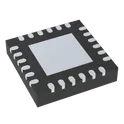
CP2102N-A02-GQFN24
USB-to-UART Bridge CP2102N-A02-GQFN24 is a highly integrated USB-to-UART bridge controller from Silicon Labs. It provides a simple and cost-effective way to add USB connectivity to embedded systems by converting USB 2.0 Full-Speed communication into a standard UART interface. The device integrates the USB transceiver, oscillator, voltage regulator, and UART controller, minimizing external components and eliminating the need for USB firmware development. It is commonly used in microcontroller programming interfaces, industrial equipment, POS terminals, data loggers, and USB-to-serial adapters. Key Features USB 2.0 Full-Speed compliant (12 Mbps) interface. USB-to-UART bridge with data rates up to 3 Mbaud. Integrated USB transceiver; no external USB resistors required. Integrated oscillator; no external crystal required. On-chip 3.3 V voltage regulator. USB Battery Charger Detection (BC 1.2) support. Remote wakeup capability from USB suspend state. Low operating current of approximately 9.5 mA. Hardware and software flow control support. Internal configurable ROM for Vendor ID, Product ID, serial number, and USB descriptors. Royalty-free Virtual COM Port (VCP) drivers available for major operating systems. Operating temperature range: −40°C to +85°C. Compact 24-pin QFN (4 mm × 4 mm) package. Typical Applications USB-to-Serial adapters Microcontroller programming and debugging interfaces Industrial automation equipment Point-of-sale (POS) terminals Medical instruments Data acquisition and logging systems Embedded systems requiring USB connectivity #commonpartslibrary #integratedcircuit
390 Uses0 StarsHC-ST-003-01-Z
USB Type-A 3.0 receptacle with 9 contacts, right-angle PCB-mount design for USB data and power connectivity. Rated 30 V and 1.5 A, with 2.00 mm contact pitch, 30 mΩ max contact resistance, and -25°C to +70°C operating temperature. Suitable for embedded systems, computer peripherals, industrial equipment, and other USB 3.0 host/device interfaces. #USB #USB3 #USBTypeA #Connector #Receptacle #RightAngle #PCBMount #HCTL
14 Uses0 StarsESP32-S3FH4R2
2.4GHz Wi-Fi+Bluetooth LE SoC ESP32-S3FH4R2 is a highly integrated low-power Wi-Fi and Bluetooth LE System-on-Chip (SoC) from Espressif Systems. It is based on a dual-core Xtensa® LX7 processor running at up to 240 MHz and is designed for IoT, smart home, industrial control, AIoT, audio processing, and embedded applications. The ESP32-S3FH4R2 variant includes 4 MB of in-package Quad SPI Flash and 2 MB of in-package Quad SPI PSRAM, reducing external component count and simplifying PCB design. Key Features Dual-core Xtensa® LX7 CPU Up to 240 MHz operating frequency 32-bit architecture with floating-point unit (FPU) SIMD instructions for AI and signal-processing workloads Integrated Memory 4 MB in-package Flash 2 MB in-package PSRAM 512 KB on-chip SRAM 384 KB ROM Additional RTC memory for low-power operation Wireless Connectivity IEEE 802.11 b/g/n 2.4 GHz Wi-Fi Bluetooth® 5 Low Energy (LE) Long-range and low-power wireless communication support Rich Peripheral Set Up to 45 programmable GPIOs USB OTG and USB Serial/JTAG SPI, I²C, I²S, UART, SDIO TWAI® (CAN 2.0 compatible) Camera interface LCD interface PWM, pulse counter, RMT, DMA controller Analog Features Two 12-bit SAR ADCs Temperature sensor 14 capacitive touch sensing inputs Security Features Secure Boot Flash Encryption AES, SHA, RSA, HMAC hardware accelerators True Random Number Generator (RNG) Digital Signature peripheral Low-Power Operation Multiple power-saving modes ULP-RISC-V coprocessor ULP-FSM coprocessor Deep-sleep support with RTC memory retention
31 Uses0 Stars2.54-2*8P针
Pin Header 2 2.54mm 6mm 16P -55℃~+105℃ 3mm 2.54mm 3A 2.54mm 2x8P Through Hole,P=2.54mm Headers, Male Pins RoHS The 2.54-2×8P pin header is a dual-row connector with 16 pins arranged in a 2×8 configuration and a standard 2.54 mm (0.1 inch) pitch. It is commonly used in PCB interconnections, development boards, modules, and general-purpose electronic circuits for signal routing and board-to-board or wire-to-board connections. Key Features Standard pitch: 2.54 mm (0.1 inch), widely compatible with breadboards and jumper wires Pin configuration: 2 rows × 8 pins (total 16 pins) Mounting type: Typically through-hole for strong mechanical stability Easy connectivity: Supports jumper wires, female sockets, and IDC connectors Versatile use: Common in development boards, microcontroller systems, and expansion interfaces Cost-effective: Simple and widely available connector solution Durable contact: Designed for repeated plugging and unplugging in prototyping environments #CommonPartsLibrary #Connector
336 Uses0 StarsSTUSB4500QTR
USB Controller USB 2.0 I2C Interface 24-QFN (4x4) Standalone USB PD sink controller with short-to-VBUS protections • Auto-run Type-C™ and USB PD sink controller • Dead battery mode support • Up to 3 sink PDO configurable profiles • Dual high power charging path support • Integrated VBUS switch gate drivers (PMOS) • Integrated VBUS voltage monitoring • Internal and/or external VBUS discharge paths • Short-to-VBUS protections on CC pins (22 V) • High voltage capability on VBUS pins (28 V) • Dual power supply (VSYS and/or VDD): – VSYS = [3.0 V; 5.5 V] – VDD = [4.1 V; 22 V] • Debug accessory mode support • Temperature range: -40 °C up to 105 °C • ESD: 3 kV HBM - 1.5 kV CDM • Certified: – USB Type-C™ rev 1.2 – USB PD rev 2.0 (TID #1000133) • Interoperable with USB PD rev 3.0 #CommonPartsLibrary #IntegratedCircuit
113 Uses0 Stars2.54-2*4P立贴针
CONN HEADER 8POS 2.54mm DUAL ROW SMD The 2.54-2×4P is a generic 8-pin dual-row connector/header with a 2.54 mm (0.1 inch) pitch, commonly used for board-to-board, wire-to-board, and programming/debug interfaces in electronic circuits. The designation 2×4P indicates two rows of four pins, providing a total of eight electrical connections in a compact arrangement. This type of connector is widely used in embedded systems, development boards, industrial control equipment, consumer electronics, and prototyping applications due to its standard pitch and broad compatibility with jumper wires, IDC cables, and mating sockets. Key Features 2.54 mm standard pitch (0.1 inch industry standard) 2×4 pin configuration (8 total contacts) Available in through-hole (THT) and sometimes surface-mount (SMT) versions Supports board-to-board and wire-to-board connections Compatible with standard jumper wires and ribbon cable connectors Compact dual-row design for higher pin density Typically constructed with gold-plated or tin-plated contacts for reliable electrical performance Suitable for signal, control, and low-power applications Commonly used for programming, debugging, communication interfaces, and expansion headers Available in straight (vertical) or right-angle orientations depending on manufacturer Typical Applications Microcontroller and development boards ISP/JTAG/SWD programming headers Sensor and peripheral connections Industrial control systems Prototyping and breadboard-compatible designs Communication interfaces and expansion ports #CommonPartsLibrary #Connector
110 Uses0 StarsSMAJ5.0A-Q
SMAJ5.0A-Q is an automotive-grade, unidirectional Transient Voltage Suppressor (TVS) diode from Bourns. It is designed to protect sensitive electronic circuits from Electrostatic Discharge (ESD), Electrical Fast Transients (EFT), lightning-induced surges, and other transient overvoltage events. The device is commonly used on 5 V power rails and communication interfaces in automotive, industrial, and telecom applications. Key Features Unidirectional TVS diode for DC line protection. 5 V reverse standoff voltage (VRWM) suitable for 5 V systems. 6.4 V minimum breakdown voltage (VBR). 9.2 V maximum clamping voltage (VC) at peak pulse current. 400 W peak pulse power dissipation (10/1000 μs waveform). 43.5 A peak pulse current (IPP) capability. AEC-Q101 qualified for automotive applications. Fast response time (<1 ps typical) for effective transient suppression. Wide operating temperature range: -55°C to +150°C. Surface-mount DO-214AC (SMA) package for compact PCB designs. RoHS compliant and suitable for automated assembly processes. Typical Applications Automotive ECUs and power rails 5 V power supplies Telecom equipment Industrial control systems I/O ports and communication interfaces Consumer electronics requiring surge protection #CommonPartsLibrary #Diode
611 Uses0 StarsKH-6X6X5H-STM
SWITCH TACTILE SPST SMD The KH-6X6X5H-STM is a compact surface-mount tactile push-button switch manufactured by Kinghelm. It is a 6 mm × 6 mm momentary SPST (Single Pole Single Throw) switch designed for user-input functions in consumer electronics, industrial controls, embedded systems, IoT devices, and portable equipment. The switch provides tactile feedback when pressed and automatically returns to its normal state when released. Key Features Tactile momentary switch with click feedback SPST normally-open contact configuration 6 mm × 6 mm footprint 5 mm actuator height Surface-mount (SMT) package 4-pin gull-wing terminals 12 V DC rated voltage 50 mA contact current rating 80,000-cycle mechanical life Round black actuator button Vertical actuation design Compact size suitable for dense PCB layouts RoHS compliant Typical Applications Power and reset buttons Consumer electronics Remote controls IoT and smart devices Industrial control panels Portable instruments Embedded development boards Home appliances and control interfaces For PCB library creation, the component is commonly classified as: Component Type: Tactile Switch Switch Configuration: SPST-NO Mounting Type: Surface Mount (SMT) Package: SMD-4P, 6×6 mm Designator Prefix: SW #CommonPartsLibrary #Switch
1.3k Uses0 Stars