Pad Type Differences Explained

what is the difference between smd, hold, std and conn in pad type
112 days

1:05

Clarifying pad types for PCB.

Understanding tool priorities for pad types.

Defining PCB pad types.

Accessing knowledge base.

Reading docs about In Flux PCB footprint and pad settings, what do pad types smd, hole, std, and conn mean? Clarify how each behaves (copper layers, drill, plating, soldermask/paste, DRC/assembly intent) and when to use each (SMD pads, plated through-hole pins, non-plated mounting holes, connector footprints, testpoints). Provide concise definitions..

Reading docs about Explain all Pad Type options in Flux PCB: SMD, STD, CONN, HOLE. What does each do and when to use them?.

Clarifying pad types with @help.

Here’s what the Flux documentation says about Pad Type options:
"Pad Type
Modifies the type of pad to one of the following:
  • SMD – a surface mount pad with no drill hole.
  • HOLE – a drill hole with no copper.
  • STD – a through-hole pad. (STD stands for "Standard".)
  • CONN – a connector pad with no drill hole, often used at the edges of a board."
When to use HOLE
Choosing CONN vs SMD
STD pad design details
Library footprint consistency
Mixed pad types on part
112 days

To get started, talk to Flux or create a New Document.

Documents

    Documents are markdown text files which describe project goals, capture details, or even simulation outputs.

    Assets

    step

    Seeed Studio-XIAO-MG24_.step

    Seeed Studio-XIAO-MG24_3D Model
    MG24.svg

    MG24.svg

    MG24Default
    Screenshot 2024-11-08 165813.png

    Screenshot 2024-11-08 165813.png

    Screenshot 2024-11-08 165813Thumbnail
    kicad_mod

    XIAO_MG24_SMD (1).kicad_mod

    XIAO_MG24_SMD (1)Footprint

    Seeed Studio XIAO MG24 DIP14

    Seeed Studio XIAO MG24 DIP14 thumbnail
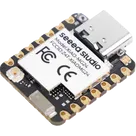
    XIAO MG24 is an ultra-low-power wireless development board based on Silicon Labs' EFR32MG24 SoC, featuring a high-performance 78MHz ARM Cortex®-M33 core. It‘s Matter® native over Thread® and Bluetooth® Low Energy 5.3, all supported by the Arduino® Core. With 4MB Flash onboard, 19 GPIOs, LED, and charging circuit, it boasts extremely low operating current and ultra-low-power modes, making it an ideal choice for IoT applications, especially battery-powered projects utilizing Matter® protocols. This model is used for through holes dip-14 connectors instead of SMD.

    Pricing & Availability

    Distributor

    Qty 1

    Controls