Mono Audio Amp
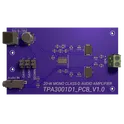
20-W MONO CLASS-D AUDIO POWER AMPLIFIER with terminal block connector for a speaker #audioDevices... show more0 Uses
222 Comments
15 Stars

oscilador 555
copilot Entiendo que deseas diseñar un oscilador utilizando el chip 555. Aquí están algunos pasos que puedes seguir para hacer esto. Conecta el pin 1 (GND) del IC 555 a la terminal negativa de tu fuente de alimentación (0V). Conecta el pin 8 (VCC) del IC 555 a la terminal positiva de tu fuente de alimentación (11V). Conecta la resistencia de 10kΩ (R1) entre el pin 8 (VCC) y el pin 7 (DISCHARGE) del 555. Conecta tu potenciómetro de 100kΩ (R2) entre el pin 7 (DISCHARGE) y el pin 6 (THRESHOLD) del 555. Junta los pines 2 (TRIGGER) y 6 (THRESHOLD) juntos y conecta los pines unidos al lado negativo de tu condensador de 10nF (C). Conecta el lado positivo del condensador de 10nF (C) a VCC (el pin 8). Conecta el pin 4 (RESET) al VCC si no quieres usar la función de reset. De lo contrario, puedes conectar una señal de reset aquí. Conecta el pin 3 (OUTPUT) del 555 al terminal positivo de tu resistencia de 470Ω. Conecta el otro terminal de la resistencia a tierra. El condensador de 10uF debe estar conectado en paralelo a la alimentación (entre VCC y GND) para suavizar cualquier ruido en la fuente de alimentación de 11V. Te sugiero que experimentes con el valor del potenciómetro (R2) hasta que consigas el Duty Cycle deseado. Por lo general, es posible cambiar la frecuencia del pulso y ajustar el Duty Cycle utilizando este control. Si, después de realizar estas conexiones y ajustes, aún no puedes obtener el Duty Cycle deseado, podría ser indicativo de que los valores de resistencia y condensador que tienes no son adecuados para tu rango de frecuencia y Duty Cycle objetivo. Para que obtengamos un Duty Cycle del 75%, necesitamos usar el chip 555 en modo astable y debemos calcular los valores de R1 y R2 (resistencia total de carga y descarga respectivamente) que nos ayude a conseguir esto. El tiempo de alta (T_high) y el tiempo de baja del ciclo (T_low) de la oscilación salen determinados por R1, R2, y C (el condensador). Se pueden usar las siguientes fórmulas para calcularlos: T_high = 0.693 * (R1 + R2) * C T_low = 0.693 * R2 * C Duty cycle = ( T_high ) / ( T_high + T_low ) Para un Duty Cycle de 0.75: Estableceremos R1 como la resistencia de 10 kilohmios que se proporcionó. Con el potenciómetro de 100 kilohmios como R2, podemos variarlo para ajustar el Duty Cycle según necesitemos hasta que se llegue a la relación deseada. Considerando que el condensador C es el condensador de 10 nF que se proporcionó, anteriores declaraciones son bajo supuesto que el tiempo de operación (T = T_high + T_low) caiga en un rango aceptable. Para el esquemático: Conecta VCC de tu 555 al terminal positivo de tu fuente de voltaje de 11V y GND a tierra. Conecta los pines 2 (TRIGGER) y 6 (THRESHOLD) juntos y al lado negativo de tu condensador de 10nF. Conecta el lado positivo del condensador a VCC. Conecta el pin 3 (OUTPUT) al terminal positivo de tu resistencia de 470 ohmios. Conecta el otro terminal de la resistencia a tierra. Conecta tu resistencia de 10 kilohmios entre VCC y los pines 2 y 6 del 555. Finalmente, conecta tu potenciómetro entre los pines 2 y 6 y el pin 7 (DISCHARGE) del 555. El condensador de 10uF debería estar conectado en paralelo a la alimentación para suavizar cualquier ruido en la alimentación de 11V. Estas son mis suposiciones y pasos sugeridos pero recuerda variar el potenciómetro hasta conseguir el Duty Cycle deseado en caso de no conseguirlo de forma inmediata. Si por alguna razón no puedes conseguir el Duty Cycle de 75%, es posible que las resistencias y condensadores proporcionados no sean los adecuados para el rango de frecuencia y Duty Cycle deseados. En tal caso, puede que tengas que utilizar otros valores de componentes.... show more0 Uses
19 Comments
11 Stars
Smart Button with E-Ink display
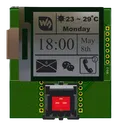
Smart Button Terminal Animator: ESP32 & Raspberry Pi Zero 2 W Edition... show more0 Uses
58 Comments
4 Stars
sEMG_DAQ
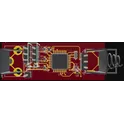
sEMG-DAQ is a wearable 6 channel data acquisition unit for capturing surface electromyographic (sEMG) signals from human arm muscles using SJ2-3593D jack connectors while conditioning, digitizing, processing and transmitting them as sEMG data to an external AI accelerated board through an SM12B-SRSS IDC connector where AI models are run for various applications including robotic control, muscle signals medical assessment and gesture recognition. The board leverages an INA125P instrumentation amplifier together with filter stages utilizing LM324QT op-amps for conditioning and an STM32G4A1VET6 microcontroller for the digitization, processing and data transmission of the signals. Since AI models can only be as good as the data, the design of such a DAQ is necessary to ensure clean, reliable and real-time data for AI applications requiring sEMG data. The board also has USB-FS and JTAG to cater for debugging. The power (5V) is fed through a screw terminal and is regulated by two LDK320AM LDO regulators to offer 5V, 3.3V and 1.8V to meet the requirements of various components on the board.... show more0 Uses
39 Comments
4 Stars
L7805 Fixed output regulator
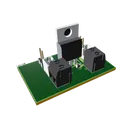
Linear Voltage Regulator with 1 Positive Fixed Output 5.0V. Input voltage 35V max With JST connectors(Vin and +5V) and with block terminal connectors(Vin and +5V) #project-template #voltageregulator #project... show more0 Uses
59 Comments
3 Stars
Copilot v4 DogFooding - Audio Amplifier
I'm building an audio amplifier. These are the project requirements: - Type of Amplifier: Class D (for energy efficiency). - Input Source: Line-level input from a standard audio source, e.g., mobile phone or PC. - Output Power: 10W per channel (for a stereo setup). - Number of Channels: 2 (stereo output). - Distortion: Total Harmonic Distortion (THD) of less than 0.1% at full power. - Frequency Response: 20Hz to 20kHz. - Power Supply: Operate from a single 12V DC source. - Protection: Over-current and thermal protection for the amplifier IC. - Connectivity: Standard 3.5mm audio jack for input and screw terminals for speaker outputs. - Volume Control: A physical potentiometer for volume control. - Indicator: An LED indicator that shows power ON status. - Size Constraints: PCB size should not exceed 100mm x 100mm. Consider every requirement individually when answering any question... show more0 Uses
0 Comments
2 Stars
Aaduino
The AAduino is an wireless Arduino clone the size of an AA battery with Keystone battery terminals rotated 180° to act as positive and negative terminals. It is meant to go inside a 3xAA battery holder creating a very small wireless node. Powered by an ATMega328p, it is fitted with an RFM69CW companion, two DS18B20 temperature sensors and an indicator LED... show more0 Uses
0 Comments
2 Stars
Smart Vending System Control Board
Designing a control board for a smart vending machine. Board will house an ESP32, AC and DC power supply, terminal port for stepper motor, MG990 servo motor, SIM7200 GSM module, 2004 LCD screen.... show more0 Uses
13 Comments
1 Star
Thermocouple Amplifier AD8495
The AD8495 K-type thermocouple amplifier from Analog Devices is so easy to use, we documented the whole thing on the back of the tiny PCB. Power the board with 3-18VDC and measure the output voltage on the OUT pin. You can easily convert the voltage to temperature with the following equation: Temperature = (Vout - 1.25) / 0.005 V. So for example, if the voltage is 1.5VDC, the temperature is (1.5 - 1.25) / 0.005 = 50°C with terminal block connections... show more0 Uses
12 Comments
1 Star
ACS712 current sensor layout example
Compact ACS712 current sensor module, capable of measuring up to 20A of AC or DC current. The layout includes a 2-pin connector for the input current, a terminal for the output voltage, and two capacitors for noise reduction. #template #project #sensor #current_sensor #ACS712... show more0 Uses
9 Comments
1 Star
semgdaq
The semgdaq board is a wearable 6 channel data acquisition unit for capturing surface electromyographic (sEMG) signals from human arm muscles using SJ2-3593D jack connectors while conditioning, digitizing, processing and feature extracting them then transmitting the feature data as vectors to an external AI accelerated board through an SM12B-SRSS IDC connector using 12C and UART communication protocals where AI models are run for various applications including robotic control, muscle signals medical assessment and gesture recognition. The feature vectors are comprised of onset detection, slope sign changes, autoregression coefficients and Short Time Fourier Transform magnitude spectrum data for each segment or window of the signals in real time. This vectors can be used as the basis for further feature extraction on more computationally resourceful hardware where machine learning algorthms can be employed for descision making in the applications mentioned earlier. The board leverages INA125P instrumentation amplifiers together with filter stages utilizing LM324QT op-amps for conditioning and an STM32G4A1VET6 microcontroller for the digitization, processing, feature extraction and data transmission. Since AI models can only be as good as the data, the design of such a DAQ is necessary to ensure clean, reliable and real-time data for AI applications requiring sEMG feature data. The board also has USB-FS and JTAG to cater for debugging and external flash memory to extend its data storage and processing capability. The power (5V) is fed through a screw terminal and is regulated by two LDK320AM LDO regulators to offer 5V, 3.3V and 1.8V to meet the requirements of various components on the board.... show more0 Uses
6 Comments
1 Star
L7805 Fixed output regulator wring airwires for devs
Linear Voltage Regulator with 1 Positive Fixed Output 5.0V. Input voltage 35V max With JST connectors(Vin and Vout) and with block terminal connectors(Vin and Vout) #project-template #voltageregulator #project... show more0 Uses
3 Comments
1 Star
oscilador 555 vfiY
copilot Entiendo que deseas diseñar un oscilador utilizando el chip 555. Aquí están algunos pasos que puedes seguir para hacer esto. Conecta el pin 1 (GND) del IC 555 a la terminal negativa de tu fuente de alimentación (0V). Conecta el pin 8 (VCC) del IC 555 a la terminal positiva de tu fuente de alimentación (11V). Conecta la resistencia de 10kΩ (R1) entre el pin 8 (VCC) y el pin 7 (DISCHARGE) del 555. Conecta tu potenciómetro de 100kΩ (R2) entre el pin 7 (DISCHARGE) y el pin 6 (THRESHOLD) del 555. Junta los pines 2 (TRIGGER) y 6 (THRESHOLD) juntos y conecta los pines unidos al lado negativo de tu condensador de 10nF (C). Conecta el lado positivo del condensador de 10nF (C) a VCC (el pin 8). Conecta el pin 4 (RESET) al VCC si no quieres usar la función de reset. De lo contrario, puedes conectar una señal de reset aquí. Conecta el pin 3 (OUTPUT) del 555 al terminal positivo de tu resistencia de 470Ω. Conecta el otro terminal de la resistencia a tierra. El condensador de 10uF debe estar conectado en paralelo a la alimentación (entre VCC y GND) para suavizar cualquier ruido en la fuente de alimentación de 11V. Te sugiero que experimentes con el valor del potenciómetro (R2) hasta que consigas el Duty Cycle deseado. Por lo general, es posible cambiar la frecuencia del pulso y ajustar el Duty Cycle utilizando este control. Si, después de realizar estas conexiones y ajustes, aún no puedes obtener el Duty Cycle deseado, podría ser indicativo de que los valores de resistencia y condensador que tienes no son adecuados para tu rango de frecuencia y Duty Cycle objetivo. Para que obtengamos un Duty Cycle del 75%, necesitamos usar el chip 555 en modo astable y debemos calcular los valores de R1 y R2 (resistencia total de carga y descarga respectivamente) que nos ayude a conseguir esto. El tiempo de alta (T_high) y el tiempo de baja del ciclo (T_low) de la oscilación salen determinados por R1, R2, y C (el condensador). Se pueden usar las siguientes fórmulas para calcularlos: T_high = 0.693 * (R1 + R2) * C T_low = 0.693 * R2 * C Duty cycle = ( T_high ) / ( T_high + T_low ) Para un Duty Cycle de 0.75: Estableceremos R1 como la resistencia de 10 kilohmios que se proporcionó. Con el potenciómetro de 100 kilohmios como R2, podemos variarlo para ajustar el Duty Cycle según necesitemos hasta que se llegue a la relación deseada. Considerando que el condensador C es el condensador de 10 nF que se proporcionó, anteriores declaraciones son bajo supuesto que el tiempo de operación (T = T_high + T_low) caiga en un rango aceptable. Para el esquemático: Conecta VCC de tu 555 al terminal positivo de tu fuente de voltaje de 11V y GND a tierra. Conecta los pines 2 (TRIGGER) y 6 (THRESHOLD) juntos y al lado negativo de tu condensador de 10nF. Conecta el lado positivo del condensador a VCC. Conecta el pin 3 (OUTPUT) al terminal positivo de tu resistencia de 470 ohmios. Conecta el otro terminal de la resistencia a tierra. Conecta tu resistencia de 10 kilohmios entre VCC y los pines 2 y 6 del 555. Finalmente, conecta tu potenciómetro entre los pines 2 y 6 y el pin 7 (DISCHARGE) del 555. El condensador de 10uF debería estar conectado en paralelo a la alimentación para suavizar cualquier ruido en la alimentación de 11V. Estas son mis suposiciones y pasos sugeridos pero recuerda variar el potenciómetro hasta conseguir el Duty Cycle deseado en caso de no conseguirlo de forma inmediata. Si por alguna razón no puedes conseguir el Duty Cycle de 75%, es posible que las resistencias y condensadores proporcionados no sean los adecuados para el rango de frecuencia y Duty Cycle deseados. En tal caso, puede que tengas que utilizar otros valores de componentes.... show more0 Uses
1 Comment
1 Star
RT6150B-33-Reference-Design
Typical Application Circuit for RT6150B-33GQW, 1 Positive Fixed Output 3.3V 800mA. Input voltage 6V max. With JST connectors(Vin and +3V3) and with block terminal connectors(Vin and +3V3) #project-template #voltageregulator #switchingregulator #BuckBoost #project... show more0 Uses
1 Comment
1 Star
LW18-S
I2C to dual PWM controller. The LED-Warrior18, manufactured by Code Mercenaries, is an I2C to dual channel PWM LED driver specifically designed to provide seamless brightness control for LED applications. This component, available in SOIC8 package (LW18-S) and as a ready-to-use module (LW18-01MOD), offers dual 16-bit PWM outputs with a dimming range from 0.001% to 100% and operates at a PWM frequency of 730 Hz. It supports programmable period lengths for higher-frequency or lower-resolution operation and includes an 8-bit data to logarithmic mapping feature for smoother dimming operations with just 256 steps. The LED-Warrior18 is engineered for minimal external circuitry with a 5V power supply requirement, offering ease of use in various lighting applications. It also features a sync mode for synchronized control of multiple units and customizable power-on status settings, making it highly versatile for standalone operations or integrated systems. Additionally, custom variants of both the chip and module are available, catering to specific application needs. The module version, LW18-01MOD, simplifies integration by including terminal blocks and supporting up to 4A load sink current for each output. The LED-Warrior18 stands out for its straightforward interface and operational flexibility, providing a comprehensive solution for advanced LED dimming and control projects.... show more0 Uses
0 Comments
1 Star
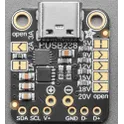
Adafruit HUSB238 USB Type C Power
Vertical USB & I2C Interface Module – Organized Power/Data Terminal Block... show more0 Uses
0 Comments
1 Star
Bluetooth RC Car Controller
Bluetooth RC car controller using ESP32-WROOM-32E, TB6612FNG dual H-bridge, XL4015 5V buck module, DC barrel battery input, dual 2-pin motor screw terminals, 1000uF VM bulk capacitor, 100nF decoupling, 10k EN pull-up, 30 mil power traces, 10 mil signal traces, and ESP32 antenna edge keep-out.... show more0 Uses
0 Comments
1 Star
LoRa load cell manager
Compact LoRa-based load cell manager board. Hosts Heltec WiFi LoRa 32, HX711 ADC for strain gauges, dual VL53L1X ToF sensors, 3.3V/2.8V rails, user buttons/LEDs, and screw terminals for robust interfacing.... show more0 Uses
0 Comments
1 Star
element v.s. node - terminal
Welcome to your new project. Imagine what you can build here.... show more0 Uses
1 Comment
0 Stars
exclude from pcb terminal issue
Welcome to your new project. Imagine what you can build here.... show more0 Uses
1 Comment
0 Stars
XLR Male to Terminal
Welcome to your new project. Imagine what you can build here.... show more0 Uses
0 Comments
0 Stars
XLR FeMale to Terminal
Welcome to your new project. Imagine what you can build here.... show more0 Uses
0 Comments
0 Stars
Two terminal, one ground
Welcome to your new project. Imagine what you can build here.... show more0 Uses
0 Comments
0 Stars
idc20 to terminal
Welcome to your new project. Imagine what you can build here.... show more0 Uses
0 Comments
0 Stars




Page 1 of 6
Next