Realistic Brown Battle Mech
Nice — you can do a clean pulse + latch using a single quad Schmitt-NAND chip: 74HC132 (or 74LVC132 for 3.3 V systems). The HC132 contains four 2-input NAND gates with Schmitt inputs so you can both clean a noisy SYN480R DATA line and build an SR latch (NAND SR is active-LOW) inside one package. Only a few passives and a driver transistor are needed. Below is a ready-to-build recipe (parts, wiring, explanation, tuning tips, and an ASCII schematic) — no extra logic ICs required. Parts (per latch) 1 × 74HC132 (quad 2-input NAND with Schmitt inputs). If your system is 3.3 V use 74LVC132 / 74HC132 rated for 3.3 V. Rin = 47 kΩ (input series) Cfilter = 10 nF (input RC to ground) — tweak for debounce/clean time Rpulldown = 100 kΩ (pull-down at input node, optional) Rpullup = 100 kΩ (pull-up for active-LOW R input so reset is idle HIGH) Rbase = 10 kΩ, Q = 2N2222 (NPN) or small N-MOSFET (2N7002) to drive your load Diode for relay flyback (1N4001) if you drive a coil Optional small cap 0.1 µF decoupling at VCC of IC Concept / how it works (short) Use Gate1 (G1) of 74HC132 as a Schmitt inverter by tying its two inputs together and feeding a small RC filter from SYN480R.DATA. This removes HF noise and provides a clean logic transition. Because it's a NAND with tied inputs its function becomes an inverter with Schmitt behavior. Use G2 & G3 as the cross-coupled NAND pair forming an SR latch (active-LOW inputs S̄ and R̄). A low on S̄ sets Q = HIGH. A low on R̄ resets Q = LOW. Wire the cleaned/inverted output of G1 to S̄. A valid received pulse (DATA high) produces a clean LOW on S̄ (because G1 inverts), setting the latch reliably even if the pulse is brief. R̄ is your reset input (pushbutton, HT12D VT, MCU line, etc.) — idle pulled HIGH. Q drives an NPN/MOSFET to switch your load (relay, LED, etc.). Recommended wiring (pin mapping, assume one chip; use datasheet pin numbers) I’ll refer to the 4 gates as G1, G2, G3, G4. Use G4 optionally for additional conditioning or to build a toggler later. SYN480R.DATA --- Rin (47k) ---+--- Node A ---||--- Cfilter (10nF) --- GND | Rpulldown (100k) --- GND (optional, keeps node low) Node A -> both inputs of G1 (tie inputs A and B of Gate1 together) G1 output -> S̄ (S_bar) (input1 of Gate2) Gate2 (G2): inputs = S̄ and Q̄ -> output = Q Gate3 (G3): inputs = R̄ and Q -> output = Q̄ R̄ --- Rpullup (100k) --- VCC (reset is idle HIGH; pull low to reset) (optional) R̄ can be wired to a reset pushbutton to GND or to an MCU pin Q -> Rbase (10k) -> base of 2N2222 (emitter GND; collector to one side of relay coil) Other side of relay coil -> +V (appropriate coil voltage) Diode across coil If you prefer MOSFET low side switching: Q -> gate resistor 100Ω -> gate of 2N7002 2N7002 source -> GND ; drain -> relay coil low side... show more0 Uses
0 Comments
1 Star
Inherent Crimson Transporter
SmartDeskPet v1.0 Shield Stage 1 status: - Goal: 5V input -> dual AMS1117-3.3 rails (+3V3_MCU and +3V3_WIFI) with common GND. - Note: Keep power nets explicitly named (avoid unnamed nets) to keep ERC happy. Stage 1 completion checklist: - Mark J1 Pin_1 (+5V) as a Power Output pin to satisfy ERC power-driver checks. - Verify all GND symbols/returns are on the same GND net. - Keep +5V_SERVO isolated from the main +5V net (only share GND). Stage 2 preparation notes (MPN/LCSC + layout constraints): - MPN/LCSC targets to define before Stage 2 exit: - AMS1117-3.3 (SOT-223): set exact MPN and (optionally) LCSC PN for both U1 and U2. - 100nF capacitor (0603): set MPN/LCSC for all 0603 100nF decouplers. - 4.7k resistor (0603): set MPN/LCSC for I2C pull-ups R1 and R2. - 1000uF bulk capacitor (radial): set MPN/LCSC for C7 (CP_Radial_D10.0mm_P5.00mm). - DC005 power jack/regulator input: select exact DC005 footprint + MPN/LCSC (if used). - 2.54mm headers/sockets: set MPN/LCSC for H1, H2, J1, J3, J4, J5, P3, P4, P5, and J2. - ESP-01S antenna keepout: - Reserve a copper keepout under and in front of the ESP-01S onboard antenna. - No copper pours/traces/components in the antenna region (top and bottom) per module guidelines. - H1/H2 header spacing: - Maintain 1000 mil spacing between H1 and H2 header centerlines (shield mechanical requirement). - Silkscreen placeholders: - Add silkscreen labels for: 5V IN, GND, +3V3_MCU, +3V3_WIFI, SERVO1, SERVO2, I2C SDA/SCL, DHT11, ASRPRO UART2, ESP-01S UART3. - Add placeholder text for: MPN, LCSC, board revision, and date code. Stage 3 layout constraints (placement and routing guidance): - Connector placement strategy: - Place H1 and H2 first to lock the shield mechanical interface; enforce 1000 mil spacing. - Place J1 and any DC005 input at the board edge for easy access. - Designated power area planning: - Group U1, U2, and C7 near the 5V entry point; keep high-current 5V and regulator loops short. - Use wide copper for +5V and any servo supply; stitch GND around power section. - Antenna keepout boundaries: - Place J2 (ESP-01S socket) at a board edge with the antenna facing outward. - Enforce a top-and-bottom copper keepout in the antenna region; keep noisy power traces away.... show more0 Uses
0 Comments
0 Stars
QRE1113 Reference Design
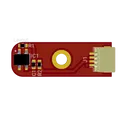
This project is a QRE1113 opto-reflective sensor circuit, using a 47K pull-up resistor (R2) and a 100 Ohm resistor (R1). It includes a 1µF capacitor (C1) for stability and attaches to a JST connector (J1) for easy interfacing. Power is provided via VCC, with the output signal (OPTO_OUT) fed back. #referenceDesign #industrialsensing #onsemi #template #reference-design... show more0 Uses
0 Comments
0 Stars
Generic Resistor
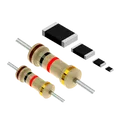
A generic fixed resistor ideal for rapid circuit topology development. Its footprint automatically adapts based on the selected package case code—supporting 0402, 0603, 0805, 1203, and many other standard SMD packages, as well as axial horizontal and vertical configurations. Save precious design time by seamlessly add more information to this part (value, footprint, etc.) as it becomes available. Standard resistor values: 1.0 ohm, 10 ohm, 100 ohm, 1.0k ohm, 10k ohm, 100k ohm, 1.0M ohm 1.1 ohm, 11 ohm, 110 ohm, 1.1k ohm, 11k ohm, 110k ohm, 1.1M ohm 1.2 ohm, 12 ohm, 120 ohm, 1.2k ohm, 12k ohm, 120k ohm, 1.2M ohm 1.3 ohm, 13 ohm, 130 ohm, 1.3k ohm, 13k ohm, 130k ohm, 1.3M ohm 1.5 ohm, 15 ohm, 150 ohm, 1.5k ohm, 15k ohm, 150k ohm, 1.5M ohm 1.6 ohm, 16 ohm, 160 ohm, 1.6k ohm, 16k ohm, 160k ohm, 1.6M ohm 1.8 ohm, 18 ohm, 180 ohm, 1.8K ohm, 18k ohm, 180k ohm, 1.8M ohm 2.0 ohm, 20 ohm, 200 ohm, 2.0k ohm, 20k ohm, 200k ohm, 2.0M ohm 2.2 ohm, 22 ohm, 220 ohm, 2.2k ohm, 22k ohm, 220k ohm, 2.2M ohm 2.4 ohm, 24 ohm, 240 ohm, 2.4k ohm, 24k ohm, 240k ohm, 2.4M ohm 2.7 ohm, 27 ohm, 270 ohm, 2.7k ohm, 27k ohm, 270k ohm, 2.7M ohm 3.0 ohm, 30 ohm, 300 ohm, 3.0K ohm, 30K ohm, 300K ohm, 3.0M ohm 3.3 ohm, 33 ohm, 330 ohm, 3.3k ohm, 33k ohm, 330k ohm, 3.3M ohm 3.6 ohm, 36 ohm, 360 ohm, 3.6k ohm, 36k ohm, 360k ohm, 3.6M ohm 3.9 ohm, 39 ohm, 390 ohm, 3.9k ohm, 39k ohm, 390k ohm, 3.9M ohm 4.3 ohm, 43 ohm, 430 ohm, 4.3k ohm, 43K ohm, 430K ohm, 4.3M ohm 4.7 ohm, 47 ohm, 470 ohm, 4.7k ohm, 47k ohm, 470k ohm, 4.7M ohm 5.1 ohm, 51 ohm, 510 ohm, 5.1k ohm, 51k ohm, 510k ohm, 5.1M ohm 5.6 ohm, 56 ohm, 560 ohm, 5.6k ohm, 56k ohm, 560k ohm, 5.6M ohm 6.2 ohm, 62 ohm, 620 ohm, 6.2k ohm, 62K ohm, 620K ohm, 6.2M ohm 6.8 ohm, 68 ohm, 680 ohm, 6.8k ohm, 68k ohm, 680k ohm, 6.8M ohm 7.5 ohm, 75 ohm, 750 ohm, 7.5k ohm, 75k ohm, 750k ohm, 7.5M ohm 8.2 ohm, 82 ohm, 820 ohm, 8.2k ohm, 82k ohm, 820k ohm, 8.2M ohm 9.1 ohm, 91 ohm, 910 ohm, 9.1k ohm, 91k ohm, 910k ohm, 9.1M ohm #generics #CommonPartsLibrary... show more0 Uses
0 Comments
0 Stars