Chat
Welcome to Flux
Treat Flux like your intern. Tell it what you'd like to build and it'll get to work. You can also ask it questions, brainstorm ideas, and teach it your preferences. Learn More
Explain project
Write a project description
Find schematic issues
Create a test plan
Simulate a circuit
Prepare for Manufacturing
Component Selection Workflow
New Subsystem Wizard
Write I2C initialization code
Generate firmware skeleton
please explain what U8 does.

1y
The component designated as U8 in your project is a LAN8710A, which is an Ethernet transceiver used for interfacing network-capable microcontrollers to an Ethernet network. Here's a breakdown of its function:
-
Ethernet Interface: The LAN8710A is a 10/100 Ethernet transceiver. It supports media-independent interface (MII) and reduced media-independent interface (RMII), which are industry-standard interfaces for Ethernet MAC/controllers to connect to Ethernet transceivers.
-
Data Conversion: It handles the conversion of Ethernet signals between the digital signals from the microcontroller or processor and the differential signals required for Ethernet communication on a physical medium like an Ethernet cable.
-
Physical Layer (PHY): The LAN8710A manages the Physical Layer of the Ethernet network, which includes the electrical and signaling elements. It's responsible for the data link layer and provides functionality such as speed and duplex negotiation.
-
Integration with ESP32: Assuming you want to connect the ESP32 module to an Ethernet network, the LAN8710A would be connected to appropriate GPIOs on the ESP32 that manage Ethernet communication.
In your schematic, U8 would be connected to the ESP32 to provide Ethernet functionality to your device. If you need to implement Ethernet connectivity, this component is crucial for handling the network communications.
1y
i want to to show GPIO number for each pin
1y
To show the GPIO number for each pin on the LAN8710A Ethernet transceiver (U8), let's align it with typical GPIO pins from a microcontroller (like the ESP32 in your project). Here's how you might connect the LAN8710A to the ESP32:
-
MDC (Management Data Clock) connects to GPIO pin:
- U8: MDC→ESP32: GPIO23
-
MDIO (Management Data Input/Output) connects to GPIO pin:
- U8: MDIO→ESP32: GPIO18
-
TXD0 to TXD3 (Transmit Data 0-3) connects to GPIO pins:
- U8: TXD0→ESP32: GPIO19
- U8: TXD1→ESP32: GPIO22
- U8: TXD2→ESP32: GPIO23
- U8: TXD3→ESP32: GPIO25
-
RXD0 to RXD3 (Receive Data 0-3) connects to GPIO pins:
- U8: RXD0→ESP32: GPIO34
- U8: RXD1→ESP32: GPIO35
- U8: RXD2→ESP32: GPIO32
- U8: RXD3→ESP32: GPIO33
-
TXEN (Transmit Enable) connects to GPIO pin:
- U8: TXEN→ESP32: GPIO21
-
CRS_DV (Carrier Sense / Data Valid) connects to GPIO pin:
- \text{U8: CRS_DV} \rightarrow \text{ESP32: GPIO36}
-
RXER (Receive Error) connects to GPIO pin:
- U8: RXER→ESP32: GPIO39
Please adjust these GPIO numbers to match the actual design constraints of your project, as different GPIOs may serve different functions or may already be in use. Let me know if you need more adjustments or any other interfaces!
1y
3
please explain what USB1 does.
1y
USB1 in this design is a USB Type-C connector used for both power and data communication for the ESP32-WROOM-32E based device. Here's a breakdown of its functions:
-
Power Supply:
- Pins 15 (VBUS) and 16 (VBUS) are connected to provide power. This VBUS line can be used to power the device.
-
Data Communication:
- Pins 2 (DP1) and 12 (DP2) are used for the USB data positive line (D+).
- Pins 3 (DN1) and 13 (DN2) are used for the USB data negative line (D-).
-
CC (Configuration Channel) Pins:
- Pins 1 (CC1) and 11 (CC2) are configuration channels for USB Type-C. They are used to configure the connection by detecting the cable orientation and power role.
-
Ground and Shielding:
- Pins 7 and 8 are connected to GND, providing a common ground.
- Pins 5, 6, 9, and 10 are connected to SHIELD for reducing electromagnetic interference (EMI) and providing shielding.
-
SBU (Sideband Use) Pins:
- Pins 4 (SBU1) and 14 (SBU2) are sideband use lines, which are typically used in alternate modes like video transmission.
This connector allows for the device to be powered through the USB port and also provides a means for data transfer between the ESP32 and an external host, such as a computer. If you have specific questions regarding connections or functionality, feel free to ask!
1y
5
Reviews
 A generic fixed inductor suitable for rapid circuit topology development. The footprint automatically adapts based on the selected package, supporting standard SMD sizes (e.g., 0402, 0603, 0805) as well as well-known inductor packages such as SDR1806, PA4320, SRN6028, and SRR1260. Standard inductor values: 1.0 nH, 10 nH, 100 nH, 1.0 µH, 10 µH, 100 µH, 1.0 mH 1.2 nH, 12 nH, 120 nH, 1.2 µH, 12 µH, 120 µH, 1.2 mH 1.5 nH, 15 nH, 150 nH, 1.5 µH, 15 µH, 150 µH, 1.5 mH 1.8 nH, 18 nH, 180 nH, 1.8 µH, 18 µH, 180 µH, 1.8 mH 2.2 nH, 22 nH, 220 nH, 2.2 µH, 22 µH, 220 µH, 2.2 mH 2.7 nH, 27 nH, 270 nH, 2.7 µH, 27 µH, 270 µH, 2.7 mH 3.3 nH, 33 nH, 330 nH, 3.3 µH, 33 µH, 330 µH, 3.3 mH 3.9 nH, 39 nH, 390 nH, 3.9 µH, 39 µH, 390 µH, 3.9 mH 4.7 nH, 47 nH, 470 nH, 4.7 µH, 47 µH, 470 µH, 4.7 mH 5.6 nH, 56 nH, 560 nH, 5.6 µH, 56 µH, 560 µH, 5.6 mH 6.8 nH, 68 nH, 680 nH, 6.8 µH, 68 µH, 680 µH, 6.8 mH 8.2 nH, 82 nH, 820 nH, 8.2 µH, 82 µH, 820 µH, 8.2 mH #generics #CommonPartsLibraryjharwinbarrozo16.5k
- A generic fixed capacitor ideal for rapid circuit topology development. You can choose between polarized and non-polarized types, its symbol and the footprint will automatically adapt based on your selection. Supported options include standard SMD sizes for ceramic capacitors (e.g., 0402, 0603, 0805), SMD sizes for aluminum electrolytic capacitors, and through-hole footprints for polarized capacitors. Save precious design time by seamlessly add more information to this part (value, footprint, etc.) as it becomes available. Standard capacitor values: 1.0pF, 10pF, 100pF, 1000pF, 0.01uF, 0.1uF, 1.0uF, 10uF, 100uF, 1000uF, 10000uF 1.1pF, 11pF, 110pF, 1100pF 1.2pF, 12pF, 120pF, 1200pF 1.3pF, 13pF, 130pF, 1300pF 1.5pF, 15pF, 150pF, 1500pF, 0.015uF, 0.15uF, 1.5uF, 15uF, 150uF, 1500uF 1.6pF, 16pF, 160pF, 1600pF 1.8pF, 18pF, 180pF, 1800pF 2.0pF, 20pF, 200pF, 2000pF 2.2pF, 22pF, 220pF, 2200pF, 0.022uF, 0.22uF, 2.2uF, 22uF, 220uF, 2200uF 2.4pF, 24pF, 240pF, 2400pF 2.7pF, 27pF, 270pF, 2700pF 3.0pF, 30pF, 300pF, 3000pF 3.3pF, 33pF, 330pF, 3300pF, 0.033uF, 0.33uF, 3.3uF, 33uF, 330uF, 3300uF 3.6pF, 36pF, 360pF, 3600pF 3.9pF, 39pF, 390pF, 3900pF 4.3pF, 43pF, 430pF, 4300pF 4.7pF, 47pF, 470pF, 4700pF, 0.047uF, 0.47uF, 4.7uF, 47uF, 470uF, 4700uF 5.1pF, 51pF, 510pF, 5100pF 5.6pF, 56pF, 560pF, 5600pF 6.2pF, 62pF, 620pF, 6200pF 6.8pF, 68pF, 680pF, 6800pF, 0.068uF, 0.68uF, 6.8uF, 68uF, 680uF, 6800uF 7.5pF, 75pF, 750pF, 7500pF 8.2pF, 82pF, 820pF, 8200pF 9.1pF, 91pF, 910pF, 9100pF #generics #CommonPartsLibraryjharwinbarrozo1.5M
- A generic fixed resistor ideal for rapid circuit topology development. Its footprint automatically adapts based on the selected package case code—supporting 0402, 0603, 0805, 1203, and many other standard SMD packages, as well as axial horizontal and vertical configurations. Save precious design time by seamlessly add more information to this part (value, footprint, etc.) as it becomes available. Standard resistor values: 1.0 ohm, 10 ohm, 100 ohm, 1.0k ohm, 10k ohm, 100k ohm, 1.0M ohm 1.1 ohm, 11 ohm, 110 ohm, 1.1k ohm, 11k ohm, 110k ohm, 1.1M ohm 1.2 ohm, 12 ohm, 120 ohm, 1.2k ohm, 12k ohm, 120k ohm, 1.2M ohm 1.3 ohm, 13 ohm, 130 ohm, 1.3k ohm, 13k ohm, 130k ohm, 1.3M ohm 1.5 ohm, 15 ohm, 150 ohm, 1.5k ohm, 15k ohm, 150k ohm, 1.5M ohm 1.6 ohm, 16 ohm, 160 ohm, 1.6k ohm, 16k ohm, 160k ohm, 1.6M ohm 1.8 ohm, 18 ohm, 180 ohm, 1.8K ohm, 18k ohm, 180k ohm, 1.8M ohm 2.0 ohm, 20 ohm, 200 ohm, 2.0k ohm, 20k ohm, 200k ohm, 2.0M ohm 2.2 ohm, 22 ohm, 220 ohm, 2.2k ohm, 22k ohm, 220k ohm, 2.2M ohm 2.4 ohm, 24 ohm, 240 ohm, 2.4k ohm, 24k ohm, 240k ohm, 2.4M ohm 2.7 ohm, 27 ohm, 270 ohm, 2.7k ohm, 27k ohm, 270k ohm, 2.7M ohm 3.0 ohm, 30 ohm, 300 ohm, 3.0K ohm, 30K ohm, 300K ohm, 3.0M ohm 3.3 ohm, 33 ohm, 330 ohm, 3.3k ohm, 33k ohm, 330k ohm, 3.3M ohm 3.6 ohm, 36 ohm, 360 ohm, 3.6k ohm, 36k ohm, 360k ohm, 3.6M ohm 3.9 ohm, 39 ohm, 390 ohm, 3.9k ohm, 39k ohm, 390k ohm, 3.9M ohm 4.3 ohm, 43 ohm, 430 ohm, 4.3k ohm, 43K ohm, 430K ohm, 4.3M ohm 4.7 ohm, 47 ohm, 470 ohm, 4.7k ohm, 47k ohm, 470k ohm, 4.7M ohm 5.1 ohm, 51 ohm, 510 ohm, 5.1k ohm, 51k ohm, 510k ohm, 5.1M ohm 5.6 ohm, 56 ohm, 560 ohm, 5.6k ohm, 56k ohm, 560k ohm, 5.6M ohm 6.2 ohm, 62 ohm, 620 ohm, 6.2k ohm, 62K ohm, 620K ohm, 6.2M ohm 6.8 ohm, 68 ohm, 680 ohm, 6.8k ohm, 68k ohm, 680k ohm, 6.8M ohm 7.5 ohm, 75 ohm, 750 ohm, 7.5k ohm, 75k ohm, 750k ohm, 7.5M ohm 8.2 ohm, 82 ohm, 820 ohm, 8.2k ohm, 82k ohm, 820k ohm, 8.2M ohm 9.1 ohm, 91 ohm, 910 ohm, 9.1k ohm, 91k ohm, 910k ohm, 9.1M ohm #generics #CommonPartsLibraryjharwinbarrozo1.5M
- An electrical connector acting as reusable interface to a conductor and creating a point where external circuits can be connected.Terminal
- Wirelessly connects nets on schematic. Used to organize schematics and separate functional blocks. To wirelessly connect net portals, give them same designator. #portaljharwinbarrozo43.0M
- General Purpose Thick Film Standard Power and High-Power Chip Resistor 47 kOhms ±5% 0.125W, 1/8W Chip Resistor 0805 (2012 Metric) Automotive AEC-Q200 Thick Film Features: - RMCF – standard power ratings - RMCP – high power ratings - Nickel barrier terminations standard - Power derating from 100% at 70ºC to zero at +155ºC - RoHS compliant, REACH compliant, and halogen free - AEC-Q200 compliantjharwinbarrozo1.2M
- 10 µF 16 V Aluminum - Polymer Capacitors Radial, Can - SMD 30mOhm 2000 Hrs @ 105°C #commonpartslibrary #capacitor #aluminumpolymer #radialcanjharwinbarrozo1.2M
- Battery Holder (Open) Coin, 20.0mm 1 Cell SMD (SMT) Tab bate or batt #forLedBlinkjharwinbarrozo700.5k


ESP32-WROOM-32E Reference Design 3iHk
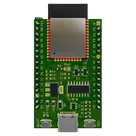
This project is a reference design for an ESP32-WROOM-32E based device. It features USB-C for power and data transfer, onboard voltage regulation, and multiple peripheral connections. It also includes a CH340C for USB to serial conversion #referenceDesign #project #ESP32 #ESP32WROOM #RF #WIFI #MCU #referenceDesign #simple-embedded #espressif #template #reference-design
Properties
Pricing & Availability
Distributor | Qty 1 |
|---|
Controls
Welcome 👋
Flux helps you build PCBs faster with an AI teammate!
Create your account to collaborate, stay updated, fork your own version, and get instant answers from our AI agent.
rasim
copilot
-
USB to Serial Conversion:
- It converts USB data signals into traditional RS-232/serial UART data signals.
- This allows a USB interface to communicate via serial protocols which are commonly used with microcontrollers.
-
Supported Data Rates:
- The CH340C can support various data rates, depending on the configuration, which makes it versatile for different applications.
-
Signal Level Conversion:
- It handles the necessary signal level conversions from USB levels to TTL/CMOS levels used by the microcontroller, making integration straightforward.
Applications: