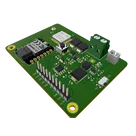
Board Refactor Plan

I’ve built a plan to refactor your board to LoRa‑E5 only with solar LiFePO4 VSYS, SWD, and SMD edge pads, preserving RF to U4J2.
  1. Cleanup & RF
  • Remove legacy/THT power/IO; keep U4/J2. Clear orphans. Define VSYS (set net types/voltages).
  1. Solar LiFePO4 → VSYS
  • Add Solar+/Solar− and Batt+/Batt− pads.
  • PFET ideal‑diode reverse protection + OVP on solar input.
  • LiFePO4 charger capped at 50 mA; power‑path to VSYS; charge/protect indicators.
  1. Rails from VSYS
  • Low‑Iq 3.3 V LDO with proper decoupling; verify dropout vs LiFePO4 min voltage (include peaks).
  • 5 V boost 30 mA cont / 40 mA peak, with in/out caps and 5V_OUT pad.
  1. Debug & I/O pads
  • Tag‑Connect TC2030 SWD: SWDIO/PA13, SWCLK/PA14, NRST (pull‑up), optional SWO/PB3, 3V3, GND.
  • Castellated SMD 2.54 mm pads:
    • I2C SDA/SCL with 4.7 kΩ pull‑ups to 3V3; note maximum 400 pF bus capacitance.
    • UART pads on PA2/PA3.
    • Two one‑wire pads on PB13/PB15 with 2‑pad jumpers selecting 3.3 V (default) or 5 V pull‑ups.
    • Adjacent 3V3/5V/GND pads.
  1. Layout & finalize
  • Compact square outline, U4 centered, blue soldermask; keep power away from RF; preserve 50‑ohm feed to J2.
  • Replace generics with real MPNs; run ERC/DRC and fix; update description/BOM.
Let me know if you want any tweaks; otherwise click Start on the plan bar to execute.
Pick charger IC
Select 3.3V LDO
Choose 5V boost
Flux net settings
I2C pull-up sizing
U11
C11
Capacitance
4u7 F
C1
Capacitance
10uF
C4
Capacitance
4u7 F
C2
Capacitance
10uF
C3
Capacitance
100nF
C8
Not Recommended for New Designs
Capacitance
68pF
C10
Capacitance
22uF
C9
Capacitance
100nF
C12
Capacitance
100nF
C7
Capacitance
22uF
C6
Capacitance
100nF
C5
Capacitance
10uF
IC4
R20
Resistance
4.7kΩ
R22
Resistance
10kΩ
R28
Resistance
10kΩ
R26
Resistance
4.7kΩ
R15
Resistance
4k7 Ω
R9
Resistance
20kΩ
R16
Resistance
4k7 Ω
R11
Resistance
22 Ω
R14
Resistance
120 Ω
R8
Resistance
2kΩ
R7
Resistance
15kΩ
R6
Resistance
150kΩ
R23
Resistance
20kΩ
R1
Resistance
3kΩ
R21
Resistance
4.7kΩ
R2
Resistance
1k5 Ω
R27
Resistance
4.7kΩ
R17
Resistance
4k7 Ω
R25
Resistance
100Ω
R10
Resistance
22 Ω
R4
Resistance
4k7 Ω
R13
Resistance
470 Ω
R19
Resistance
4.7kΩ
R3
Resistance
68kΩ
R24
Resistance
100kΩ
R5
Resistance
6k8 Ω
R18
Resistance
22 Ω
R12
Resistance
4.7kΩ
C25
Capacitance
10uF
C21
Capacitance
10uF
C20
Capacitance
100nF
C23
Capacitance
100nF
C22
Capacitance
10uF
C14
Capacitance
10uF
C18
Capacitance
100nF
C15
Capacitance
10uF
C17
Capacitance
100nF
C29
Capacitance
10nF
C28
Capacitance
100nF
C24
Capacitance
10uF
C27
Capacitance
100nF
C19
Capacitance
100nF
C16
Capacitance
10uF
C30
Capacitance
100nF
C26
Capacitance
100nF
C13
Capacitance
10uF
U3
L1
Inductance
10uH
U10
U9
L2
Inductance
2u2 H
D7
U4
D6
L3
Inductance
4.7uH
J2
J4
J5

No files yet

Documents

    Documents are markdown text files which describe project goals, capture details, or even simulation outputs.

    Assets

    flux logo.svg

    flux logoDefault
    image-removebg.png

    image-removebg.png

    image-removebgThumbnail
    The Green Dot 2040E5 Board thumbnail
    The "Green Dot 2040E5" Board is a Node that interfaces RS485 Sensor probes and can log information to the cloud using LoRa Connectivity. It uses the XIAO RP2040 and the LoRa-E5 (STM32WLE5JC) modules from Seeed Studio to do its magic. It also has amazing power management capabilities (Solar charging, Battery protection, etc) that make it very useful for IoT applications #internetOfThings #smartHomeDevices #SeeedStudio #XIAO #LoRa #RP2040 #IoT

    Properties

    Properties describe core aspects of the project.

    Pricing & Availability

    Distributor

    Qty 1

    Arrow

    $13.98–$18.87

    Digi-Key

    $11.61–$14.77

    LCSC

    $12.72

    Mouser

    $18.56

    TME

    $0.80

    Verical

    $2.88–$10.77

    Controls