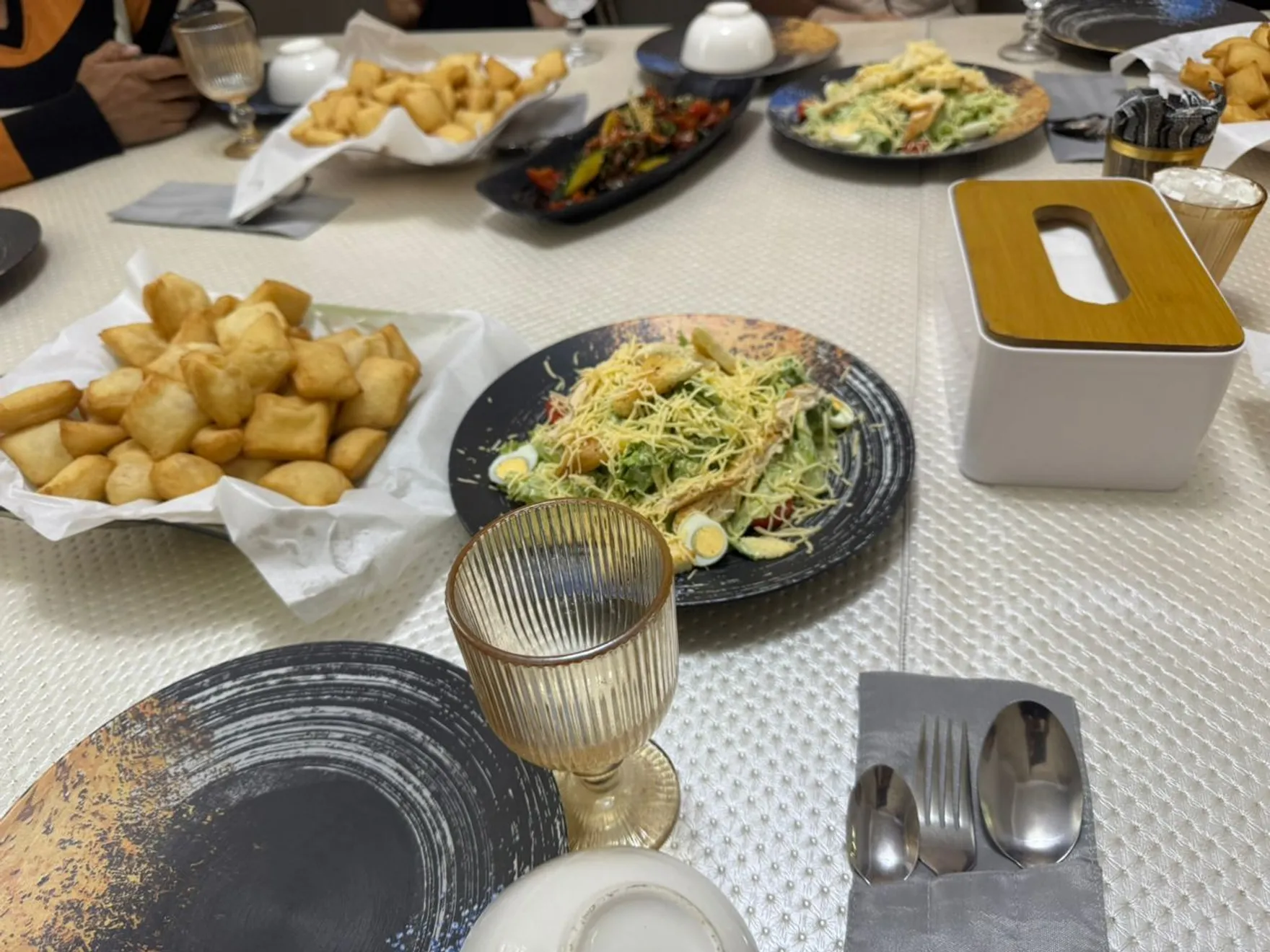
The photo shows a restaurant table with shared food: fried dough/bread pieces, fries, salad plates with shredded cheese and egg, a sizzling-style vegetable/meat dish, glasses, cutlery, napkins, and a tissue box. It’s a general dining scene—not an electronics/PCB photo—so there are no components, markings, or PCB issues to inspect.
The visible hand is on the upper-left side of the photo, holding a ribbed drinking glass. It appears to be a person seated at the table wearing a dark sleeve with an orange/yellow garment; only part of the hand and wrist are visible, so I can’t reliably infer anything beyond that.
Documents are markdown text files which describe project goals, capture details, or even simulation outputs.
Assets
No assets added.
Mechanical Plum T-800
a. Linearity
Design a network composed of resistors 1 and a current source located in a peripheral mesh.
This network should have at least two nodes and three meshes. Simulate this network in your
preferred simulation software. In the simulator, change 2 the value of current in your current
source. Record and analyze the changes you noticed in the network parameters. Pay close
attention to the branch currents.
Like step 1, design a network composed of resistors. However, this time, instead of a current
source, use a voltage source. Also, increase the complexity of the network by either adding
more nodes and meshes, placing the voltage source in a non-peripheral mesh, or both.
Simulate this network. In the simulator, change the value of voltage in your voltage source
(like step 1). Record and analyze the changes you noticed in the network parameters. Pay
close attention to the branch currents.
Make a generalization out of your results in steps 1 and 2.
Properties
Properties describe core aspects of the project.
Pricing & Availability
Distributor
Qty 1
Controls
Welcome 👋
Flux helps you build PCBs faster with an AI teammate!
Create your account to collaborate, stay updated, fork your own version, and get instant answers from our AI agent.