Schematic Design Issue Analysis
0:47
Based on the schematic content provided, here are the observations and issues identified:
-
Connectivity and Net Definition
- Missing Nets: The schematic currently has no net connections defined. Without explicit nets, there is no electrical connectivity between the terminals, making it impossible to ensure that power, signals, and grounds are properly distributed.
- Net Labeling: Even if wires are later added, the lack of defined net names or labels (e.g., VCC, GND, signal names) can lead to misinterpretation or incorrect wiring.
-
Power Distribution and Decoupling
- Decoupling Capacitors: There is no evidence of dedicated decoupling or bypass capacitors placed at the power input pins. For a high-performance microcontroller such as the RT1062 on the Teensy 4.1, each supply pin typically requires one decoupling capacitor to ensure stability and filter high-frequency noise.
- Ground Connectivity: Several terminals (e.g., those labeled “GND”, “USB_GND”, etc.) exist as separate symbols, but without explicit net connections or a common ground node (ideally using a Ground component), there is a high risk of floating or split ground networks.
-
Component and Pin Assignment Concerns
- Terminal Usage: Most components in the schematic are generic Terminal symbols. It is unclear if every signal – especially for power, USB, and programming – is assigned according to the Teensy 4.1 datasheet.
- Ambiguous or Unverified Pin Numbers: Several terminals include nonstandard or ambiguous pin labels (such as “ON/OFF”, “PROGRAM”, or “USB_GND”). These should be cross-checked against the device datasheet to confirm correct physical pin assignments and signal functions.
-
Signal Integrity and Resistor Configurations
- Pull-Up/Pull-Down Resistors: There is no indication of proper biasing for signals that require pull-ups (e.g., reset or I2C signals) or pull-downs for unused pins. This may cause undefined logic levels and potentially noisy signal edges.
- Current Limiting: Should there be LED indicators or other output elements, the schematic does not show any current limiting resistors that will be necessary to protect these devices.
Suggested Corrections and Optimizations:
-
Define Nets:
- Start by wiring the schematic so that every terminal is connected via correctly labeled nets (e.g., “3.3V”, “GND”, “USB_DP”, “USB_DN”, etc.).
- Use a common Ground component for all ground connections.
-
Power and Decoupling:
- For each power input pin on the main IC (or Teensy module), add a 0.1 µF (or as specified by the datasheet) decoupling capacitor between that power pin and ground.
- Verify that all power nets (e.g., VUSB, 5V, 3.3V) are clearly designated and properly connected.
-
Pin Assignment Verification:
- Revisit the pin assignments from the Teensy 4.1 datasheet. Ensure that each terminal symbol’s label and pin number match the documented configuration.
- Rename any ambiguous labels to clear, standardized net names.
-
Signal Integrity Enhancements:
- Add pull-up resistors where needed (for example, on I2C lines or reset lines) and include any necessary current limiting resistors for LEDs or sensitive signals.
- Verify that each signal path meets the design guidelines for impedance, especially if high-speed data lines such as USB are present.
Addressing these points will help ensure that the schematic adheres to best practices and minimizes risks during PCB layout and subsequent manufacturing.
372 days

I agree with the issues on undefined nets. Let's add a common ground node and clearly label the power nets. How do I add a proper ground symbol and assign net names consistently?
372 days
Ready.
To get started, talk to Flux or create a New Document.
Reviews
Documents
Documents are markdown text files which describe project goals, capture details, or even simulation outputs.
Assets
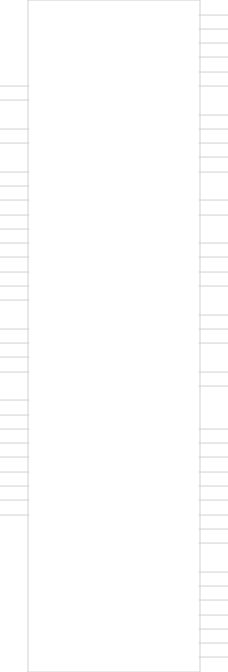
DEV-16771
defaultDefaultstep
DEV-16771.step
DEV-167713D Modelkicad_mod
MODULE_DEV-16771.kicad_mod
MODULE_DEV-16771FootprintRT1062 Teensy 4.1
RT1062 Teensy 4.1 series ARM® Cortex®-M7 MPU Embedded Evaluation Board
Properties
DEV-16771
Texas Instruments Inc.
U
Pricing & Availability
Distributor | Qty 1 |
|---|
Controls
Welcome 👋
Flux accelerates your PCB design with AI.
Create your account to start using this component and bring your ideas to life.