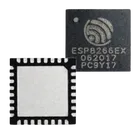
ESP8266EX Overview and Applications

Explain this part, including its purpose, key functions, and common applications. Describe how it operates within a circuit and any notable characteristics. Also explain the family or series this part belongs to, highlighting variations, key differences, and typical use cases compared to other models in the series.
Worked for 2 mins 53 sec
ESP8266EX is Espressif’s 2.4 GHz Wi‑Fi SoC: it combines an 802.11 b/g/n radio, RF front end, Tensilica L106 32-bit CPU, SRAM, GPIO/peripherals, and power-management modes for IoT devices. It commonly powers smart plugs/lights, sensors, home automation, wearables, Wi‑Fi beacons, and embedded Wi‑Fi adapters; notably, the datasheet marks it NRND and recommends ESP8684 for new designs. I couldn’t create the full project-file writeup because you only have comment access to this project.
Compare ESP8684
Power circuit
Find module
Boot pins