Project Description Creation

0:58

Based on the W25Q128JVSIQ datasheet, there’s no unique specification for a “USB boot CS” pin. In this datasheet, the chip select (CS) pin is described as active low. Under standard operating conditions, the CS pin is expected to be at a high level (close to the supply voltage, VCC) when it is not being driven low. Since the flash memory is designed to operate with a VCC in the range of 2.7V to 3.6V, the expected high voltage on the CS pin (when inactive) will be approximately within that range.
Thus, if you’re referring to the USB boot configuration for your application, the datasheet implies that the USB boot CS (or chip select) pin should be pulled high to the appropriate VCC level (around 2.7V to 3.6V) when not active.
For further details or any nuanced requirements, please refer directly to the datasheet sections describing the electrical interface characteristics of the CS pin.
405 days
what voltage is expected on the pin 5, 2, etc. pins of this chip? specifically do(io1), di(io0), io2 and io3?
405 days

0:39

The datasheet for the W25Q128JVSIQ specifies that the data I/O pins—including DI(IO0), DO(IO1), IO2, and IO3—operate at voltages defined by the device’s supply voltage (VCC, which is in the range of 2.7V to 3.6V).
In general, the electrical characteristics for these pins are given in the datasheet’s "Electrical Characteristics" section. Under typical conditions (with VCC = 3.3V), you will often see:
  • A minimum input high level (VIH) around 70% of VCC (approximately 2.31V), and
  • A maximum input low level (VIL) around 30% of VCC (approximately 0.99V).
Similarly, for output levels:
  • When driving a logic "high," the output (for example, DO(IO1)) will be very close to the supply voltage (typically just a few hundred millivolts below 3.3V), and
  • For a logic "low," the output will be near 0V.
For exact thresholds and performance margins (including any specific conditions for transient or dynamic operation), please refer directly to the "Electrical Characteristics" table in the datasheet.
Check datasheet for other interface requirements.
Add level shifters if interfacing with different VCC.
Ensure correct power decoupling for VCC.
405 days

To get started, talk to Flux or create a New Document.

Documents

    Documents are markdown text files which describe project goals, capture details, or even simulation outputs.

    Assets

    External_Flash_Module.png

    External_Flash_Module.png

    External_Flash_ModuleThumbnail

    External Flash Module

    External Flash Module thumbnail
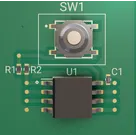
    External Flash Module #Module The External Flash Module is a compact, high-performance circuit designed around a 128Mbit NOR flash memory, ensuring fast and reliable data storage for modern embedded systems. Integrated with precision passive components and optimized connectivity, this module offers efficient power management and seamless integration for diverse applications in IoT, industrial automation, and consumer electronics. #ExternalFlashModule #NORFlash #EmbeddedSystems #IoT #DataStorage #ElectronicsDesign

    Properties

    Module

    Pricing & Availability

    Distributor

    Qty 1

    Arrow

    $1.12–$1.21

    Digi-Key

    $1.84–$2.03

    LCSC

    $0.52–$1.08

    Mouser

    $1.83

    Verical

    $1.46–$1.99

    Controls