Product Features Overview
Thought for 1 min 26 sec
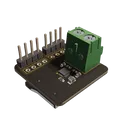
This product is a small digital-audio breakout board that lets a microcontroller send I2S audio directly to a speaker.
Main features
-
I2S digital audio input
- Works with common controllers like Arduino-class boards, ESP32, Raspberry Pi, and other devices that can output I2S.
-
Built-in audio power amplifier
- It converts digital audio into amplified speaker output, so you don’t need a separate DAC plus amp stage.
-
Direct speaker connection
- The design exposes a differential speaker output, making it easy to wire a small external speaker.
-
No master clock required
- It uses a simplified I2S interface, so you only need the usual audio lines rather than an extra MCLK source.
-
Selectable gain
- The board supports configurable gain settings, useful for matching different source levels and speaker loudness needs.
-
Channel selection / mono behavior
- It can be configured for left, right, or mixed mono playback from the incoming digital stream.
-
Shutdown / low-power control
- There is a control pin for disabling the amplifier or putting it into a low-power state.
-
Wide supply range
- It is intended to run from a low-voltage rail, making it convenient for embedded and USB-powered projects.
-
Compact breakout form factor
- The board is meant to be easy to drop into hobby and embedded projects without much extra circuitry.
This board is useful when you want:
- simple audio output from a microcontroller
- minimal wiring
- a small speaker driver board
- better audio output than a raw PWM buzzer approach
So the short version is: it’s an easy way to add amplified digital audio output to a small embedded project.
If you want, I can also give you:
- a beginner-friendly explanation of how to wire it up, or
- a pin-by-pin description of the interface.

How many speakers can this amplifier drive, and what is the power rating for each?
Thought for 15 sec
It appears to be designed to drive one speaker. The project description describes it as a compact breakout board for a single Class D audio amplifier channel, with configurable left, right, or combined mono output rather than separate multi-speaker outputs, and it specifies 3.2 W into a 4 Ω speaker at 5 V supply
So the practical answer is:
Table
| Output | Speaker count | Power rating |
|---|---|---|
| Amplifier output | 1 speaker | 3.2 W into 4 Ω at 5 V |
If you want, I can also explain whether it can be used with 8 Ω speakers and what power you should expect in that case.
8Ω speaker power
Check speaker connector
Mono vs stereo use