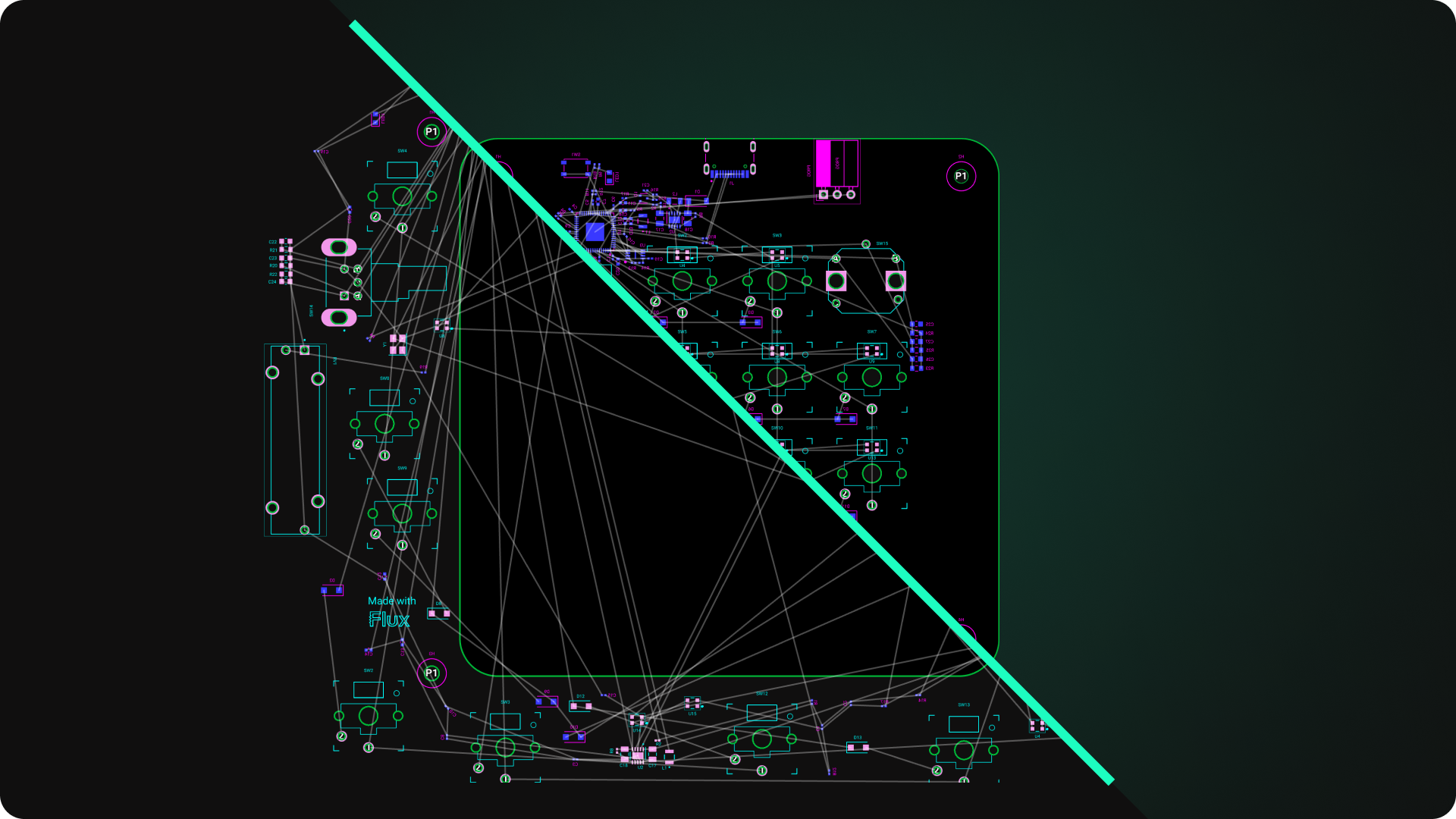
Pico Macro Keyboard PCB Design

Fresh-place the entire Pico Macro Keyboard PCB from scratch on a 100 mm × 100 mm rounded-rectangle 4-layer board.
Top side priority:
Keep the top side clean and user-facing.
Place the mechanical key switches in a regular macro-keypad grid with consistent row/column spacing and aligned orientation.
Keep the RGB LEDs visually associated with their corresponding switches and avoid crowding the key grid.
Place rotary encoders and any user-facing controls on the top side in ergonomic positions near the key grid.
Place mounting holes near the board corners and keep them clear of switches and encoders.
Bottom side priority:
Place the Raspberry Pi Pico / MCU module and the majority of supporting electronics on the bottom side.
Group the MCU, flash, crystal/oscillator, regulator/power parts, reset/boot circuitry, USB/support passives, and decoupling capacitors by function.
Keep decoupling capacitors close to their associated IC power pins, crystal/load caps close to the MCU oscillator pins, and power components clustered together.
Minimize estimated routing distance between the bottom-side MCU and the top-side switches, LEDs, and encoders.
Prefer moving support passives on the bottom side rather than contaminating the top-side visual layout.
Placement quality goals:
Resolve overlaps, keep all components inside the board outline, preserve routing channels between the key grid and MCU area, and maintain clean edge/corner clearance.
Use both layers intentionally: top for human-interface components, bottom for dense electronics.
After placement, run DRC/review and report any remaining overlap, off-board, or layer-assignment issues.
5 days
0:48
Considering layout plans.
Thinking deeply about your request.
I've made a plan, and started work on it.
Plan
- Freshly place the complete Pico Macro Keyboard design on a 100 mm x 100 mm rounded-rectangle, standard 4-layer PCB in a two-sided layout. The top side will host the user interface components including a grid of mechanical key switches, associated per-key RGB LEDs, and rotary encoder/user controls with clean, ergonomic layout and mounting holes at board corners. The bottom side will be dedicated to the Raspberry Pi Pico/MCU module and supporting circuitry (flash, crystal/oscillator, regulator/power, reset/boot, USB passives, and decoupling components), grouped by function with optimized routing to the top interface.
#Implementation plan
-
Configure board setup
- Set the PCB dimensions to a 100 mm x 100 mm rounded-rectangle using a standard 4-layer stackup.
- Adjust board outlines and routing channels to support a clean separation between top and bottom side components.
-
Fresh-place top-side user interface components
- Place a regular grid of mechanical key switches with consistent spacing and orientation.
- Position per-key RGB LEDs associated with each switch ensuring visual alignment and without overcrowding.
- Add rotary encoders and user controls near the switch grid for ergonomic access.
- Locate mounting holes at the board corners ensuring proper clearances and alignment.
-
Fresh-place bottom-side MCU and support electronics
- Position the Raspberry Pi Pico / MCU module centrally on the bottom side for ease of connectivity.
- Group supporting components (flash, oscillator with crystal/load capacitors, regulator, reset/boot circuitry, USB support components and decoupling capacitors) by function near their respective pins and power circuits.
- Ensure decoupling components are placed close to the IC power pins, and crystal/load capacitors are near oscillator pins.
-
Optimize layout and connectivity
- Verify that no component overlaps exist and that all parts remain within the board outline.
- Preserve routing channels on both layers with minimized routing distances between the MCU and top-side switches, LEDs, and encoders.
- Leverage both top and bottom layers to intentionally distribute components and route signals efficiently.
-
Validate design
- Run a Design Rule Check (DRC) to review for any remaining overlaps, off-board placements, or layer-assignment issues.
- Adjust placements and clearances as needed based on DRC results.
#Success criteria
- A complete fresh placement that meets the 100 mm x 100 mm rounded-rectangle board constraints.
- Organized top-side user interface with a grid of mechanical switches, properly associated RGB LEDs, ergonomic rotary encoders, and correctly placed mounting holes.
- Efficient bottom-side grouping of the Pico/MCU and supporting electronics with minimal routing distances.
- A successful DRC with no unresolved overlap, off-board, or layer-assignment issues.
USB edge access
Bottom passives
Switch alignment priority
Run placement review
5 days
To get started, talk to Flux or create a New Document.


![Pico Macro Keyboard AI Placement [Example] x1i2 thumbnail](https://img-cdn.flux.ai/eyJidWNrZXQiOiJncmF2aXRvbi1lbGVjdHJpYy1zeW1ib2xzIiwia2V5IjoiZG9jdW1lbnRfYXNzZXRzL1BpY28tTWFjcm8tS2V5Ym9hcmQtVGh1bWItNDhjOGRiYTgtYWQzOC00Y2EyLWEzZGEtY2I3MzVmNzAwNWU0LnBuZyIsImVkaXRzIjp7InJlc2l6ZSI6eyJ3aWR0aCI6MTM2LCJoZWlnaHQiOjEzNiwiZml0IjoiY29udGFpbiIsImJhY2tncm91bmQiOnsiciI6MCwiZyI6MCwiYiI6MCwiYWxwaGEiOjB9fX0sIm91dHB1dEZvcm1hdCI6IndlYnAifQ==)
Welcome 👋
Flux helps you build PCBs faster with an AI teammate!
Create your account to collaborate, stay updated, fork your own version, and get instant answers from our AI agent.