Project Overview and Design Breakdown

1:00

Accessing knowledge base.

Here is a structured explanation of your “Green Dot 2040E5: Robust LoRa/RS485 IoT Node” project based on the current schematic.

1. Overall Purpose
This design is a robust, field-deployable IoT node for (likely outdoor) AgriTech use that can:
  • Be powered from a Li-ion battery with solar input and USB for charging.
  • Communicate wirelessly via LoRaWAN using a U4.
  • Provide RS‑485 industrial bus connectivity using the IC2.
  • Use a compact Seeed XIAO RP2040 module U6 as the main controller/host.
High-level: it is a flexible node that can talk long-range (LoRa) and wired bus (RS485), powered from a small solar‑charged battery.

2. Core Functional Blocks and How They Interact 2.1 Power Input and Battery/Charging
Sources and storage:
  • Solar input via J3 (2‑Position Screw Terminal) on net VSOLAR:
    • Goes through D1 (SS34) into the VIN node.
  • USB power:
    • VUSB net from the XIAO U6 5 V pin, routed via D3 (SS34) into VIN.
  • Battery:
    • J1 (JST B2B PH) is the Li‑ion battery connector on VBAT.
    • U2 is the Li‑ion charger IC.
      • VIN (from solar/USB diodes) feeds [CN3063](U2: VIN).
      • U2 BAT and FB pins tie into VBAT and feedback network.
      • C1, C9 and R2 / LEDs D5, D2 implement input filtering, battery decoupling and charge-status LEDs via CHRG, DONE, CHARG nets.
Interaction:
  • Solar and USB power are OR’d with Schottky diodes (D1, D3) into VIN, avoiding back‑feeding between sources.
  • U2 manages Li‑ion charging from VIN to VBAT, and reports charging states to LEDs via CHRG, DONE.
Trade-off:
  • Diode OR-ing is simple and robust but wastes some headroom (diode drop).
  • Dedicated power‑path management ICs could improve efficiency but are more complex/costly.

2.2 Main 3.3 V Rail
  • 3.3 V regulator: U1.
    • Input: VBAT to [U1](U1: VIN, EN).
    • Output: +3V3 net via feedback network R3, R7, C2, C8, C3, C4 on VBAT.
    • L2 and LX net show a switching buck/boost topology around U1, making this effectively a switching converter, not a pure linear LDO.
Loads on +3V3:
  • U6 (3V3 pin, SCL/SDA pins, UART pins).
  • U4 on VCC.
  • IC2 on VCC.
  • C11, C12 and others provide decoupling on +3V3 and RS485 VCC.
Design choice:
  • Using a switching converter from VBAT to 3.3 V (rather than a linear LDO) trades higher efficiency and better battery life against more EMI and design complexity.

2.3 Boost Converter for 12.5 V Rail
  • IC1 boost converter block:
    • Input: VBAT to [IC1](IC1: IN, EN).
    • Output: 12_5V via L1, D4, @:handle=:C7, C10.
    • Feedback: FB net through R6 to 12_5V and SW1 for adjustable regulation.
  • SW1 is an SPDT switch tied to FB, SW_A, SW_C via R1, R4, R9.
    • This allows selectable feedback configuration, likely to:
      • Turn boost ON/OFF or
      • Switch between different output voltages or operating modes.
  • 12.5 V appears on:
    • 12_5V net, exported via a Net Portal and [J6](J6: Pin_10).
Use case:
  • Powering external actuators, sensors, or valves that need ~12 V (very typical in irrigation and AgriTech).
Trade-offs:
  • Boosting from VBAT (~3–4.2 V) to 12.5 V is inherently less efficient; only practical for low‑duty or low‑power loads.
  • Adds complexity (inductor L1, diode D4, etc.) but increases node versatility.

2.4 MCU / Controller: Seeed XIAO RP2040
  • U6 module:
    • Powered from +3V3 (3V3 pin).
    • Also has 5V / VUSB pin used as one of the power sources for the charger.
    • IO connections:
      • LoRa UART:
        • TX net: [U6](U6: P0_TX_D6) to [U4](U4: PB7) via R10.
        • RX net: [U6](U6: D7_CSn_P1_RX) to [U4](U4: PB6) via R11.
      • Reset / control:
        • Net 19: [U6](U6: D9_MISO_P4) to [U4](U4: RST) through R18 (pull network).
        • ENABLE net: [U6](U6: D10_MOSI_P3) to [IC2](IC2: DE, RE).
      • RS485 logic:
        • RO net: [U6](U6: P26_A0_D0) from [IC2](IC2: RO) via R17.
        • DI net: [U6](U6: P27_A1_D1) to [IC2](IC2: DI).
      • GPIO expansion:
        • PIO1 net: [U6](U6: P28_A2_D2) to [J6](J6: Pin_1).
        • PIO2 net: [U6](U6: P29_A3_D3) to [J6](J6: Pin_2).
Key technologies:
  • RP2040 dual‑core MCU on a ready‑made module simplifies high‑speed design and flash/QSPI routing.
  • The module includes USB, clock, and flash, so the baseboard is simpler.
Design choice:
  • Using a pre‑built XIAO module trades BOM and per‑unit cost for:
    • Faster development.
    • Reduced risk around high‑speed layout and flash interfacing.

2.5 LoRa Radio: LoRa-E5 (STM32WLE5JC)
  • U4:
    • Powered from +3V3, decoupled to GND.
    • RF output RFIO routed to J2 (IPEX1) for an external antenna.
    • Control & data:
      • UART with U6 via TX, RX nets.
      • Reset via Net 19 from RP2040.
      • Additional IO and a DIP switch:
        • SW2 and R13 on SW net connect to [U4](U4: PB13), giving a configurable mode/boot/feature pin (e.g. join mode, debug).
Trade-offs:
  • LoRa‑E5 module is more expensive than discrete RF + MCU + matching, but:
    • It massively reduces RF design risk.
    • Simplifies certification and antenna matching.

2.6 RS-485 Interface
  • IC2 RS‑485 transceiver:
    • Power: +3V3 (VCC), decoupled by C12.
    • Logic interface with RP2040:
      • RO (receiver out) to RP2040 via R17.
      • DI (driver in) from RP2040.
      • RE, DE tied to ENABLE net from RP2040 so firmware controls bus direction/enable.
    • Bus lines:
      • Differential pair A / B:
        • A net: [IC2](IC2: A) via R14 and R15 to [J6](J6: Pin_6).
        • B net: [IC2](IC2: B) via R16 and R14 to [J6](J6: Pin_7).
      • Likely R14, R15, R16 are fail‑safe bias and/or termination networks for the RS‑485 bus.
  • RS485 physical connector is the 10‑pin header J6, exposing:
    • A, B, 3.3 V, GND, additional I/O (PIO1, PIO2), and 12.5 V.
Design choice:
  • Using an RS‑485 transceiver instead of, say, RS‑232 or CAN leverages:
    • Long cable operation.
    • Robust noise immunity.
    • Multi‑drop bus capability (common in agriculture, industrial fields).

2.7 User / Status Interfaces
  • Charge status LEDs:
    • D5 and D2 driven by U2 via CHRG, DONE, CHARG nets with R2 and R8 as current‑set / sense.
  • DIP switch SW2 for LoRa/MCU mode selection via SW net to [U4](U4: PB13).
  • SW1 SPDT for power/boost configuration (FB network).
  • Mounting holes H1 and H2 for mechanical robustness.
  • 3D enclosure notes 3D Enclosure and Enclosure suggesting a custom housing.

3. Design Choices, Trade-offs, and Optimizations Power Architecture
  • Two DC‑DC stages: one for 3.3 V, one for 12.5 V.
    • Optimized for battery efficiency and supporting higher‑voltage actuators.
  • Diode OR-ing of solar and USB:
    • Simple, rugged, but dissipates some power in the diodes.
  • Single‑cell Li‑ion with U2:
    • Common, high‑energy‑density chemistry.
    • CN3063 gives a proven, integrated charger implementation.
Modularity and Connectivity
  • XIAO RP2040 module:
    • Reduces design complexity; firmware‑friendly pinout.
  • LoRa-E5 module:
    • Pre‑certified RF and integrated STM32 simplifies radio and LoRaWAN stack.
  • RS‑485 transceiver:
    • Industrial‑grade long‑distance wired connectivity.
  • Expansion header J6:
    • Exposes power rails, RS‑485 bus, general IO, and boosted voltage for external modules/sensors.
Robustness and Field Use
  • Multiple decoupling capacitors around each power IC and at distribution points.
  • Differential RS‑485 with bias/termination resistors for bus stability.
  • External antenna via IPEX for better LoRa range.
  • Mechanical mounting holes and enclosure markers for real‑world deployment.

4. Functional Summary
Putting it all together:
  1. Solar panel and/or USB power feed the VIN rail via diodes.
  2. U2 charges the Li‑ion battery connected on VBAT and reports charge status on LEDs.
  3. From VBAT:
    • U1 + L2 etc. generate +3V3 for all logic (RP2040, LoRa-E5, RS‑485).
    • IC1 + L1 etc. generate 12_5V for higher‑voltage loads and the expansion header.
  4. The RP2040 module runs user firmware, managing:
    • LoRaWAN messaging via UART to U4.
    • RS‑485 bus traffic and direction via IC2.
    • Any attached sensors/actuators via expansion header and boosted rail.
  5. The node can be mounted in a custom enclosure and run autonomously in the field, solar‑charged and maintaining communication via LoRa and RS‑485.

If you want, next I can:
  • Walk through just the power path step‑by‑step (VBAT/VIN/3V3/12.5V).
  • Or focus on communication architecture (LoRa + RS‑485 + firmware implications).
Focus on power path
Check power sizing
LoRa + firmware details
Review RS485 section
Optimize for battery life
149 days

To get started, talk to Flux or create a New Document.

Documents

    Documents are markdown text files which describe project goals, capture details, or even simulation outputs.

    Assets

    flux logo.svg

    flux logo.svg

    flux logoDefault
    image-removebg.png

    image-removebg.png

    image-removebgThumbnail

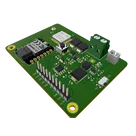
    The Green Dot 2040E5 Board

    The Green Dot 2040E5 Board  thumbnail
    Green Dot 2040E5: Robust LoRa/RS485 IoT Node

    Properties

    [Add details from decoupling_caps review]

    [Add details from resistor_power_rating review]

    [Add details from design_rule_check_missing_footprints review]

    [Add details from design_rule_check_airwires review]

    [Add details from capacitor_voltage_rating review]

    [Add details from pull_up_pull_down review]

    [Add details from parts_available review]

    AgriTech

    Pricing & Availability

    Distributor

    Qty 1

    Controls