Treat Flux like your intern. Tell it what you'd like to build and it'll get to work. You can also ask it questions, brainstorm ideas, and teach it your preferences. Learn More
@copilot, develop an FMEA (Failure Mode and Effects Analysis) report in a table format that analyzes the systems schematic, each unique component specification, and operational parameters. It should identify critical failure modes, assess their impact, and recommend mitigation actions based on severity, occurrence probability, and detectability. Include columns such as: process step, potential failure mode, potential failure effect, S, O, D, RPN, Action Recommended, and any other you see fit.
Creating an FMEA report involves evaluating each component and its interactions within your schematic to identify potential failure modes, their effects, and mitigation strategies. Let's develop a structured FMEA table for your project, concentrating on the most critical components and their interactions.
FMEA Report
Table
Process Step
Potential Failure Mode
Potential Failure Effect
Severity (S)
Occurrence (O)
Detectability (D)
RPN
Recommended Action
NFC Chip (IC1) Initialization
Chip not readable
NFC functionality fails
8
3
6
144
Ensure proper soldering and verify I2C line integrity
Power Supply
Insufficient voltage output
System won't power on properly
9
2
5
90
Validate boost converter output and adjust resistance
Capacitor (C16) Stability
Capacitance drift
Unstable power supply
7
3
4
84
Use capacitors with better tolerance or quality
Resistor (R5) Burnout
Resistance changes, circuit disruption
Inconsistent LED operation
6
2
3
36
Verify current ratings and replace if necessary
LED (LED9) Failure
Does not illuminate
Poor visibility or feedback
5
2
3
30
Choose LEDs with higher reliability
I2C Communication with NFC
Bus error or data corruption
Inability to update NFC tag
8
3
5
120
Implement error checking and retry mechanisms
Note:
Severity (S): How severe the effect of the failure is on overall functionality (1=Not Severe, 10=Highly Severe).
Occurrence (O): How frequently the failure is expected to occur (1=Rare, 10=Frequent).
Detectability (D): How easily a failure can be detected before it affects the customer (1=Always Detected, 10=Never Detected).
Risk Priority Number (RPN): Calculated as the product of Severity, Occurrence, and Detectability (RPN = S * O * D).
Recommended Actions:
For critical failures with high RPN: Aim to take corrective measures first for those with the highest RPN scores. Lower the probability, improve detectability, or reduce potential severity by implementing the suggested actions.
For NFC related issues: Ensure I2C connections are robust, including the use of pull-up resistors if necessary. Regular communication tests can help mitigate bus errors.
By addressing identified failure modes and recommended actions, the reliability and performance of your PCB business card with NFC functionality can be significantly enhanced. If you need more detailed analysis or further assistance, feel free to ask!
1y
Someone is typing...
2
R5
Resistance
47 Ω
C16
Capacitance
220nF
IC1
Note 1
Line 1
Refer to comment 2 to learn how to add your own QR code!
C15
Capacitance
7pF
LED9
Note 2
Line 1
Find my Modules in the Flux Library!
No files yet
Reviews
Documents
Documents are markdown text files which describe project goals, capture details, or even simulation outputs.
Assets
svg
FluxLogoTransparent.svg
FluxLogoTransparent
svg
Screenshot-2023-07-06-at-11.12.16-AM.svg
Screenshot-2023-07-06-at-11.12.16-AM
IMG_3077.jpg
IMG_3077
IMG_3077-removebg-preview.png
IMG_3077-removebg-previewThumbnail
svg
fluxaimodified.svg
fluxaimodifiedDefault
svg
adobe_express.svg
Project_Link_adobe_express
Change History from V1:
-13.56MHz tuning
-larger instruction font
-put some stuff on the back
#template
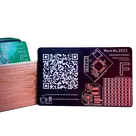
I wanted to create a business card that has some functionality and shows off a bit of my portfolio IRL:
bhannache
copilot
Table
- Severity (S): How severe the effect of the failure is on overall functionality (1=Not Severe, 10=Highly Severe).
- Occurrence (O): How frequently the failure is expected to occur (1=Rare, 10=Frequent).
- Detectability (D): How easily a failure can be detected before it affects the customer (1=Always Detected, 10=Never Detected).
- Risk Priority Number (RPN): Calculated as the product of Severity, Occurrence, and Detectability (RPN = S * O * D).
Recommended Actions: