Minimal Pico 2 Setup

0:09
Thought for 6 sec
Thought for a moment
9:15
Thought for 3 sec
Created 5 tasks.
1/5 Inspect existing Pico 2 shield schematic pins and current nets
Thought for 2 sec
Read schematic.
Thought for 7 sec
2/5 Select a minimal I2C humidity sensor and required support parts
Thought for 4 sec
Found 3 results for Find a readily available simple I2C humidity and temperature sensor IC suitable for 3.3V Raspberry Pi Pico 2 shield. Prefer Sensirion SHTC3/SHT31 or TI HDC series with minimal external components. Need part UID/library URL and key pins VDD GND SDA SCL, package, datasheet availability..
Thought for 3 sec
Read SHTC3-TR-2.5KS datasheet for recommended operating conditions supply .
Thought for 6 sec
3/5 Add sensor, pull-ups, and decoupling components
Thought for 5 sec
Thought for 9 sec
4/5 Wire power, ground, and I2C connections to the Pico 2 shield
Thought for 4 sec
Thought for 4 sec
5/5 Run ERC/design review and fix real schematic issues
Thought for 3 sec
Completed 6 design checks — found 46 issues.
Read schematic.
Thought for 27 sec
Thought for 20 sec
Thought for a moment
Thought for 3 sec
Thought for 1 sec
Completed 6 design checks — found 14 issues.
Thought for 12 sec
Thought for 9 sec
Thought for 6 sec
Completed 6 design checks — found 13 issues.
Thought for 6 sec
Completed design checks — found 13 issues.
Read schematic.
Thought for 11 sec
Found 2 results for Find common in-stock 0603 SMD 10 kΩ 1% resistor suitable as I2C pull-up. Need manufacturer part number and manufacturer for generic resistor BOM assignment..
Found 2 results for Find common in-stock 0603 SMD 100 nF 16 V X7R ceramic capacitor suitable for SHTC3 decoupling. Need manufacturer part number and manufacturer for generic capacitor BOM assignment..
Thought for 9 sec
Thought for 25 sec
Thought for 6 sec
Completed design checks — found 9 issues.
Thought for 5 sec
5/5 tasks completed.
Thought for a moment
Finished working
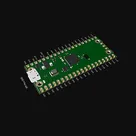
- Host/module: Raspberry Pi Pico 2 shield header symbol
U1. - Primary peripheral: Sensirion
SHTC3-TR-2.5KSdigital humidity and temperature sensorU2. - Interface: I2C on Pico GPIO4/GPIO5.
- Power: sensor is powered from the Pico 2
3V3pin; no extra regulator is required for this minimal shield because the Pico module provides the 3.3 V rail.
- Supply voltage range: 1.62 V to 3.6 V; 3.3 V operation is valid.
- I2C Fast Mode Plus supported up to 1 MHz.
- Required decoupling: 100 nF capacitor between VDD and VSS, placed close to the sensor.
- I2C lines are open-drain and require external pull-up resistors; datasheet example uses 10 kΩ.
- Center pad is internally connected to VSS and may be connected to GND.
Implemented connections
| Net | Connections |
|---|---|
| 3V3 | U1 3V3, U2 VDD, C1 P1, R1 P2, R2 P2 |
| GND | U1 GND pins, U1 AGND, U2 VSS, U2 EPAD, C1 P2 |
| I2C0_SDA | U1 GPIO4, U2 SDA, R1 P1 |
| I2C0_SCL | U1 GPIO5, U2 SCL, R2 P1 |
| VBUS | U1 VBUS power-domain label for the Pico module USB VBUS rail |
Added BOM items
| Designator | Part | Value / MPN | Purpose |
|---|---|---|---|
| U2 | Sensirion SHTC3-TR-2.5KS | SHTC3-TR-2.5KS | I2C humidity/temperature sensor |
| C1 | Generic capacitor | 100 nF, 16 V, 0603, Yageo CC0603KRX7R7BB104 | Sensor supply decoupling |
| R1 | Generic resistor | 10 kΩ, 1%, 0603, VO C2889366 | I2C SDA pull-up |
| R2 | Generic resistor | 10 kΩ, 1%, 0603, VO C2889366 | I2C SCL pull-up |
- Focused ERC for floating pins, missing power, no-connect, single-pin nets, undriven nets, and pin-to-pin issues passed with no open errors or warnings after wiring and no-connect marking.
- Full project review still reports PCB airwires because the new components have not been placed/routed on the PCB. This is expected before layout work and should be resolved during the layout phase after user confirmation.

Welcome 👋
Flux helps you build PCBs faster with an AI teammate!
Create your account to collaborate, stay updated, fork your own version, and get instant answers from our AI agent.