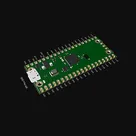
Minimal Pico 2 Humidity Sensor Design

Add the minimum required components needed for this Pi Pico 2 to function properly. Keep the design as simple and minimal as possible.
You may include a single humidity sensor as the primary peripheral, along with any essential supporting components such as power regulation, pull-up resistors, decoupling capacitors, or required connectors.
Thought for 4 sec
I’ll keep this minimal: inspect the Pico 2 shield symbol, choose one simple I2C humidity sensor with only required pull-ups/decoupling, wire it to Pico 2 power/GPIO, then run checks and fix any issues.
Worked for 3 mins 7 sec
The sensor circuit is wired. Review found only unused Pico 2 shield header pins, so I’m marking those intentionally unused while leaving the SHT31 circuit active on GPIO4/GPIO5.
Worked for 4 mins 1 sec
Done — I added the minimal SHT31-DIS humidity/temperature sensor circuit, with 10 kΩ I2C pull-ups, 100 nF local decoupling, Pico GPIO4/GPIO5 I2C wiring, unused pins marked intentionally unused, and manufacturable MPNs for the passives.
Schematic/ERC, manufacturing, and component checks are clean. Full project review still shows PCB airwires because the new parts have not been placed/routed yet; that’s expected before layout.
I also created Minimal Pico 2 Humidity Shield Notes with the wiring, BOM, power budget, and firmware bring-up notes. Ready to proceed to PCB placement when you are.
Proceed to placement
Keep sensor exposed
Minimize board size
Check layout first
Add mounting holes
Refine this doc
Ask about this doc
Minimal Pico 2 Humidity Shield Notes
Scope
Add the minimum required components for a Raspberry Pi Pico 2 shield with one primary humidity peripheral while keeping the schematic simple.
Selected Peripheral
- U2: Sensirion SHT31-DIS-B2.5KS humidity/temperature sensor.
- Reason: simple I2C interface, works from the Pico 2 3.3 V rail, and needs only pull-ups plus one local decoupling capacitor.
Datasheet-Grounded Wiring
From the SHT3x-DIS datasheet:
- VDD operating range: 2.15 V to 5.5 V, typical 3.3 V.
- VDD/VSS must be decoupled with 100 nF placed close to the sensor.
- SDA and SCL are open-drain I/O and require external pull-up resistors; datasheet example uses Rp = 10 kΩ.
- ADDR must not float; tied low for I2C address 0x44.
- ALERT must be left floating if unused.
- nRESET may be left floating if unused.
- R pin and exposed pad are connected to VSS/GND.
Implemented Connections
Table
| Net | Connections | Notes |
|---|---|---|
| 3V3 | U1 3V3, U2 VDD, R1 P2, R2 P2, C1 P1 | Pico 2 module 3.3 V rail powers sensor and pull-ups |
| GND | U1 GND/AGND pins, U2 VSS/R/EP/ADDR, C1 P2 | ADDR low selects 0x44 |
| I2C0_SDA | U1 GPIO4, U2 SDA, R1 P1 | Pico I2C0 SDA with 10 kΩ pull-up |
| I2C0_SCL | U1 GPIO5, U2 SCL, R2 P1 | Pico I2C0 SCL with 10 kΩ pull-up |
| VBUS | U1 VBUS | Modeled as Pico module USB supply rail |
Added BOM Items
Table
| Designator | Part | Value / MPN | Purpose |
|---|---|---|---|
| U2 | SHT31-DIS-B2.5KS | Sensirion SHT31-DIS-B2.5KS | Humidity and temperature sensor |
| R1 | Generic Resistor | 10 kΩ, Yageo RC0603FR-0710KL | SDA pull-up |
| R2 | Generic Resistor | 10 kΩ, Yageo RC0603FR-0710KL | SCL pull-up |
| C1 | Generic Capacitor | 100 nF, Yageo CC0603KRX7R7BB104 | Sensor VDD decoupling |
Power Budget
This shield adds only the SHT31 sensor and two pull-ups to the Pico 2 3.3 V rail. No extra regulator is required because the Pico 2 module already provides 3.3 V.
Approximate added steady-state load:
- SHT31-DIS: low-current I2C humidity sensor load from 3.3 V.
- I2C pull-ups: transient current only when SDA/SCL are pulled low; with 10 kΩ at 3.3 V, each line sinks about 0.33 mA when low.
- Worst case if both I2C lines are low: about 0.66 mA through pull-ups, plus sensor current.
Firmware Bring-Up
Use Pico I2C0 on GPIO4/GPIO5:
- SDA: GPIO4
- SCL: GPIO5
- Sensor address: 0x44
- Bus pull-ups: present on-board, 10 kΩ to 3V3
Recommended startup sequence:
- Initialize I2C0 on GPIO4/GPIO5 at 100 kHz or 400 kHz.
- Wait for sensor power-up.
- Communicate with address 0x44.
- Read humidity/temperature using the Sensirion SHT3x command set or a compatible SHT31 library.
Review Status
- Schematic ERC for the implemented circuit is clean.
- Full project review still reports PCB airwires because the new components have not been placed/routed yet; this is expected before entering the layout phase.
Scope
Selected Peripheral
Datasheet-Grounded Wiring
Implemented Connections
Added BOM Items
Power Budget
Firmware Bring-Up
Review Status