Replacement LDO Recommendations

3:17

Gathering component information.

Finding capacitor requirements.

Accessing knowledge base.

Searching for a component.

Searching.

Finished searching for a component.

Looking for "output capacitor requirement ESR range stability NCP1117 3.3V" in ncp1117-d.pdf

Looking for "minimum output capacitor value for stability" in ncp1117-d.pdf

Looking for "input capacitor requirement value and type" in ncp1117-d.pdf

Looking for "recommended output capacitor type electrolytic tantalum ceramic notes" in ncp1117-d.pdf

Looking for "allowable ESR range of output capacitor numeric values" in ncp1117-d.pdf

Looking for "placement recommendations for input and output capacitors" in ncp1117-d.pdf

Looking for "typical application schematic capacitance values" in ncp1117-d.pdf

Looking for "suggested capacitor values for 3.3 V fixed version" in ncp1117-d.pdf

Checking component details.

Reviewing existing capacitors.

Proposing capacitor recommendations.

Finalizing capacitor specifications.

Here’s what the Onsemi NCP1117 (SOT-223) requires around U1, quoted from its datasheet (NCP1117-D):
  • Input capacitor (Cin)
    • Value/type: 10 µF ceramic or tantalum is adequate for most applications.
    • When needed: Use Cin if the regulator is more than “a few inches” from the source or the source impedance is complex.
    • Placement: Mount with the shortest possible track directly across VIN–GND pins.
  • Output capacitor (Cout) – mandatory for stability
    • Minimum capacitance: 4.7 µF.
    • ESR window: 0.033 Ω (typ) to 2.2 Ω over operating temperature.
    • Allowed types: ceramic, tantalum, or aluminum electrolytic, as long as the effective capacitance and ESR stay within the limits across temperature.
    • Typical application: 10 µF at the output is shown in the reference circuit.
    • Placement: Keep Cout close to VOUT–GND.
Practical recommendations (aligning to the datasheet and good practice)
  • Cin: 10 µF X7R ceramic, 10 V or higher. Place right at VIN–GND of U1.
  • Cout: 10–22 µF tantalum or aluminum electrolytic that guarantees ESR within 0.033–2.2 Ω across temperature. Place at VOUT–GND of U1.
  • Optional: a small 0.1 µF ceramic in parallel with Cout for high‑frequency decoupling (ensure the total network still respects the ESR window).
  • Voltage rating/derating: choose capacitor voltage so operating voltage is at or below 60% of its rating (knowledge rule). For 5 V input and 3.3 V output rails, 10–16 V rated parts are typically appropriate.
If you’d like, I can swap U1 to NCP1117ST33T3G and set Cin = 10 µF ceramic, Cout = 22 µF tantalum (ESR in-spec), placed per the datasheet.
Ask for specific capacitor part numbers
Clarify ceramic-only output
Thermal consideration question
Placement/layout guidance
Rail decoupling strategy
128 days

To get started, talk to Flux or create a New Document.

Documents

    Documents are markdown text files which describe project goals, capture details, or even simulation outputs.

    Assets

    ESP32 x86 PC image.png

    ESP32 x86 PC image.png

    ESP32 x86 PC imageThumbnail

    ESP32 x86 PC 8k5d

    ESP32 x86 PC 8k5d thumbnail
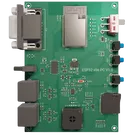
    A self-contained “retro PC” platform built around the ESP32, exposing classic PC-style IO: VGA video, PS/2 keyboard/mouse, audio-out to an onboard speaker, microSD storage, plus USB-C for power and USB-UART for programming/debug.

    Pricing & Availability

    Distributor

    Qty 1

    Arrow

    $0.29–$0.48

    Digi-Key

    $0.05–$0.78

    LCSC

    $0.57

    Mouser

    $8.05

    TME

    $0.24

    Verical

    $0.33–$18.32

    Controls