Do a deep dive into this project and come up with...
Thinking for 2 days 14 hrs...
Thought for a moment — Searching for components
Search "In the current project, identify the power archite...".
Search "In the current project, identify the power archite...".
Search project.
Thought for a moment — Searching for data components
Search project.
Search project.
Thought for a moment — Exploring asset options
Search project.
Search project.
Thought for 2 sec — Evaluating project data
Search project.
Search project.
Search project.
Checking 5 design areas.
Reading schematic details for U1, U2, U3 and 86 more.
Reading schematic details for U1, U2, U3 and 86 more.
Reading schematic details for U2, Q1, R1 and 86 more.
Reading schematic details for R6, R7, R8 and 86 more.
Thought for 14 sec — Calculating current values
Search "What are the main power rails in this project, and...".
Thought for a moment — Searching for power components
Search "What are the main power rails in this project, and...".
Thought for a moment — Investigating net connections
Search "What are the main power rails in this project, and...".
Search "What are the main power rails in this project, and...".
Thought for a moment — Exploring component search options
Search "What are the main power rails in this project, and...".
Thought for a moment — Searching for components
Search "What are the main power rails in this project, and...".
Thought for a moment — Investigating net components
Search "What are the main power rails in this project, and...".
Thought for a moment — Searching for resistor information
Search "What are the main power rails in this project, and...".
Thought for a moment — Analyzing RC network components
Search "What are the main power rails in this project, and...".
Search "What are the main power rails in this project, and...".
Thought for 18 sec — Analyzing RC networks
Searched "What are the main power rails in this project, and..." — 1297 results.
Search "Reconstruct the exact A/B/C phase sensing channel ...".
Thought for a moment — Exploring component options
Search "Reconstruct the exact A/B/C phase sensing channel ...".
Thought for a moment — Improving search queries
Search "Reconstruct the exact A/B/C phase sensing channel ...".
Thought for a moment — Searching for component information
Search "Reconstruct the exact A/B/C phase sensing channel ...".
Thought for a moment — Searching for component associations
Search "Reconstruct the exact A/B/C phase sensing channel ...".
Thought for a moment — Searching for design documents
Search "Reconstruct the exact A/B/C phase sensing channel ...".
Thought for a moment — Looking for components info
Search "Reconstruct the exact A/B/C phase sensing channel ...".
Search "Reconstruct the exact A/B/C phase sensing channel ...".
Thought for a moment — Searching for PCB footprints
Search "Reconstruct the exact A/B/C phase sensing channel ...".
Thought for 3 sec — Analyzing resistor values
Search "Reconstruct the exact A/B/C phase sensing channel ...".
Thought for a moment — Searching for specifics
Search "Reconstruct the exact A/B/C phase sensing channel ...".
Thought for a moment — Organizing components
Search "Reconstruct the exact A/B/C phase sensing channel ...".
Search "Reconstruct the exact A/B/C phase sensing channel ...".
Searched "Reconstruct the exact A/B/C phase sensing channel ..." — 948 results.
Running calculation.
Running calculation.
Running calculation.
Running calculation.
Running calculation...
README
Electronic Speed Controller (ESC)
A high-performance brushless motor controller for drone and robotics applications, featuring advanced PWM control, protection circuits, and thermal-management considerations.
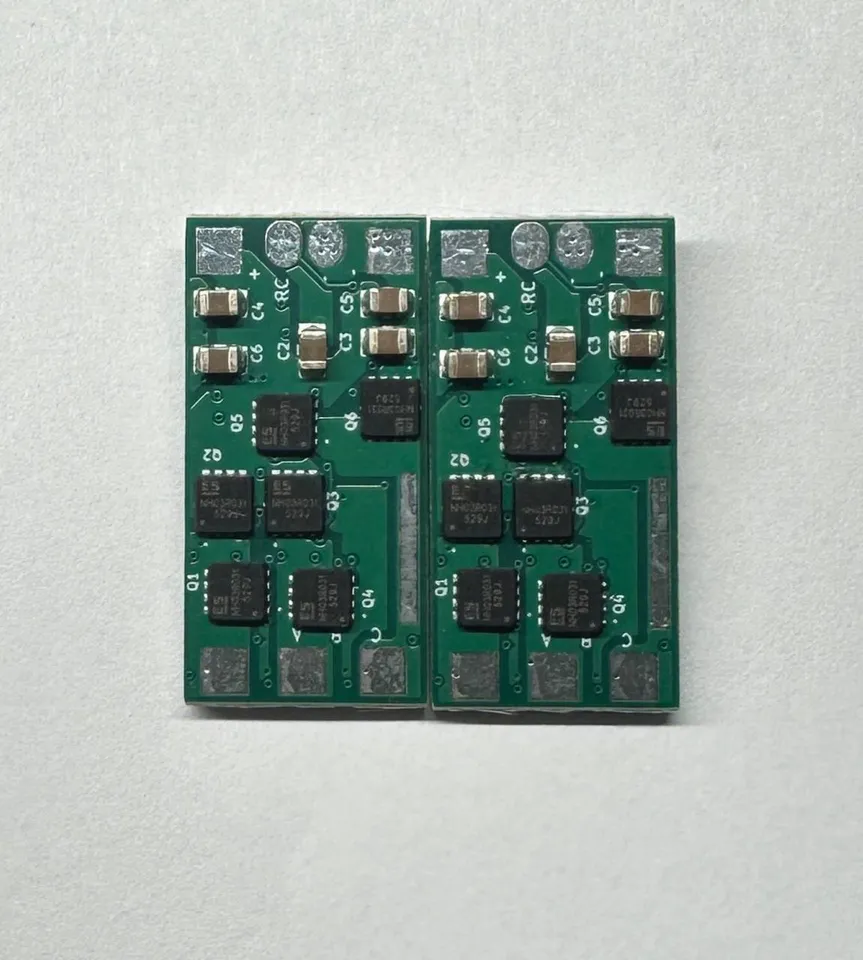
Image
Specifications
Table
| Specification | Value |
|---|---|
| Project type | 40 A BLDC electronic speed controller for quadcopters |
| Firmware target | BLHeli_S-compatible |
| Motor type | 3-phase brushless DC motor |
| Power stage | 3 half-bridge MOSFET phases |
| MOSFETs | TPN2R703NL, rated 45 A continuous / 90 A peak |
| Gate driver | MP1907 half-bridge gate driver |
| Microcontroller | EFM8BB21F16G-C-QFN20R |
| Logic rail | 3.3 V via MCP1755T-3302E/OT |
| Gate-drive / auxiliary rail | 12 V via L78L12ABUTR |
| Board size | 26 mm × 13 mm |
| PCB stackup | 4-layer PCB |
| Component count | 158 components |
| Net count | 38 nets |
| Primary application | Quadcopter propulsion and compact BLDC motor control |
| Validation status | Flight-tested on a real quadcopter with brushless motors |
What This Is
This is a complete Electronic Speed Controller (ESC) design featuring:
- High-current MOSFET bridge for efficient brushless motor control
- Advanced PWM control with configurable switching frequencies up to 32 kHz
- Current sensing with precision shunt resistors for overcurrent protection
- Temperature monitoring with thermal shutdown protection
- Back-EMF detection for sensorless motor control and timing optimization
- Regenerative braking capability for energy recovery during deceleration
- Configurable input voltage supporting 2S–6S LiPo battery configurations
- Compact form factor optimized for drone motor mounting
- Status LED indicators for operational feedback and diagnostics
- Bootloader-compatible microcontroller for firmware updates via PWM signal
- EMI filtering to minimize radio-frequency interference
- Robust protection circuits, including undervoltage, overvoltage, and thermal protection
The controller uses a dedicated motor-control microcontroller optimized for real-time PWM generation and sensor processing. This ensures precise motor timing and smooth operation across the entire RPM range.
Why I Built This
Commercial ESCs often lack transparency in their design and firmware, making customization and optimization difficult. Many also compromise on protection features to reduce cost, which can lead to reliability issues in demanding applications.
This open ESC design provides complete visibility into both hardware and firmware implementation, enabling users to understand, modify, and optimize performance for specific applications. The robust protection circuitry is intended to support reliable operation under extreme conditions.
The design philosophy prioritizes:
- Efficiency
- Thermal management
- Configurability
- Compatibility with common flight-controller ecosystems
Whether you are building high-performance racing drones, precision camera gimbals, or experimental robotics platforms, this ESC template provides a foundation for reliable motor control without vendor lock-in.
Compatible control protocols include:
- Standard PWM
- OneShot
- DShot
- Other digital protocols used in modern flight controllers
Full firmware-source access allows custom protocol implementation.
Create New Takes or Improvements
The ESC works as-is. Here are areas where the design could be extended:
- Telemetry integration — Add bidirectional communication for real-time RPM, temperature, and current feedback to flight controllers.
- CAN bus variant — Implement CAN bus communication for distributed motor control in larger vehicles and industrial applications.
- Higher current rating — Scale up MOSFET sizing and thermal management for heavy-lift drone and electric vehicle applications.
- Integrated sensor support — Add Hall-sensor inputs for precise motor timing in applications requiring guaranteed startup torque.
- Field-oriented control — Implement advanced control algorithms for maximum efficiency and torque production.
- Multi-motor version — Control multiple small motors from a single board for specialized applications such as thrust vectoring.
Take it beyond basic speed control. That is the point.
Fork it and make it yours — push the efficiency envelope.
Who This Is For
This project is for people who want to understand motor control at the circuit level, including:
- Drone builders seeking performance optimization
- Engineers developing electric vehicles
- Researchers working on precision motion control
- Anyone who has looked at a commercial ESC and thought, “I need better thermal management and custom control algorithms.”
It is not meant to replace basic hobby ESCs for standard builds. It is meant to be a development foundation: efficient, reliable, and documented enough to invite improvements and specialization.
If you remix it, I would love to see versions with:
- Integrated telemetry
- Higher power ratings
- Advanced control algorithms
- Specialized thermal management for extreme environments
The fun part is that the core motor-control capability is already there — the remix space is everything around it.
Performance Analysis and Validation
Recommended validation work includes:
- Efficiency curves across RPM and load ranges
- Thermal characterization under sustained high-power operation
- EMI compliance testing and filtering-effectiveness measurements
- Protection-circuit response-time analysis
Why This Architecture
This ESC architecture was selected to optimize the critical balance between switching efficiency, thermal performance, and control precision required for modern brushless motor applications while maintaining compatibility with existing drone and robotics control ecosystems.
Configuration and Tuning
Key tuning areas include:
- PWM-frequency optimization for different motor types
- Current-limit and protection-threshold setup
- Timing-advance configuration for performance tuning
- Thermal-management and derating parameters
README
Electronic Speed Controller (ESC)
Specifications
What This Is
Why I Built This
Create New Takes or Improvements
Who This Is For
Performance Analysis and Validation
Why This Architecture
Configuration and Tuning