ESP8266 Schematics
The ESP8266 is a low-cost microcontroller with built-in Wi-Fi capability. It is a versatile platform that can be used in a wide range of applications, including home automation, internet of things (IoT), and wearable electronics. The ESP8266 has a powerful processor and on-board memory, making it capable of running complex programs and connecting to the internet to transmit and receive data. One of the key use cases for the ESP8266 is in home automation, where it can be used to control and monitor various devices and appliances through a network connection. It can also be used in IoT applications, where it can collect and transmit data from sensors and other devices to the cloud for analysis and storage. Flux.ai has the world's largest community-driven public library of ESP8266 MCUs, with footprints, symbols, datasheets, and simulation models. This library is an invaluable resource for engineers and developers working with the ESP8266, providing access to a wealth of information and resources to help them design and build innovative applications.
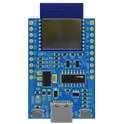
ESP-WROOM-02U Reference Design
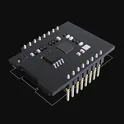
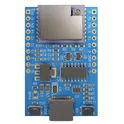
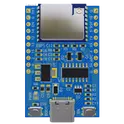
This project is a reference design for an ESP-WROOM-02U based device. It features USB-C for power and data transfer, onboard voltage regulation, and multiple peripheral connections. It also includes a CH340C for USB to serial conversion #referenceDesign #project #ESP8266 #WROOM #RF #WIFI #MCU #referenceDesign #simple-embedded #espressif #template #reference-design #polygon
0 Uses0 StarsBright Tan Flubber
Etapa 1: Recolección y Almacenamiento de Energía Entrada: tus cactus en serie (ej. 15 cactus × 0.5 V = 7.5 V). Componente clave: Supercapacitor o batería recargable de baja capacidad (Li-ion o LiFePO4, 3.7V-7.4V). Diodo Schottky entre los cactus y el capacitor para evitar descarga inversa. 🛠 Ejemplo de componentes: Supercapacitor de 5–10 F, 5.5 V o batería de 3.7 V (tipo 18650). Diodo Schottky 1N5819. Módulo cargador TP4056 (si usas batería). Etapa 2: Aumento de Voltaje (Boost Converter) Conversión de 3.7 V / 7.5 V DC a 110 V AC. Necesitas: Boost Converter (DC-DC Step-up) de hasta 300 V DC. Inversor DC-AC (pequeño, tipo mini inverter para LEDs) que convierta ese voltaje a 110 V AC. NOTA: Algunos focos LED pueden funcionar con 110 V DC directamente, si quieres evitar el inversor. Etapa 3: Detección de Noche Sensor LDR (resistor dependiente de luz) conectado a un comparador (ej. LM393) o a un microcontrolador (como un ATtiny o ESP8266 si quieres funciones extra). Al bajar la luz solar: El comparador activa un MOSFET o un relé que conecta la energía almacenada al foco.
0 Uses0 StarsESP-12F fZ1a
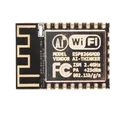
The ESP-12F is a compact and cost-effective Wi-Fi module based on the ESP8266 chip. It offers 802.11 b/g/n Wi-Fi connectivity, GPIOs, multiple interfaces (UART, SPI, I2C, ADC, PWM), and an integrated PCB antenna. It's ideal for IoT projects due to its low power consumption and small size.
59 Uses0 Stars
Nodemcu-12E ESP8266 sugq
NodeMCU V3 ESP8266 ESP-12E is WiFi development board that helps you to prototype your IoT product with few Lua script lines, or through Arduino IDE. The board is based on ESP8266 ESP-12E variant, unlike other ESP-12E, you won’t need to buy a separate breakout board, usb to serial adapter, or even solder it to a PCB to get started, you will only need a usb cable (Micro USB).
0 Uses0 StarsNodemcu-12E ESP8266
NodeMCU V3 ESP8266 ESP-12E is WiFi development board that helps you to prototype your IoT product with few Lua script lines, or through Arduino IDE. The board is based on ESP8266 ESP-12E variant, unlike other ESP-12E, you won’t need to buy a separate breakout board, usb to serial adapter, or even solder it to a PCB to get started, you will only need a usb cable (Micro USB).
0 Uses0 StarsESP-WROOM-02U Reference Design
This project is a reference design for an ESP-WROOM-02U based device. It features USB-C for power and data transfer, onboard voltage regulation, and multiple peripheral connections. It also includes a CH340C for USB to serial conversion #referenceDesign #project #ESP8266 #WROOM #RF #WIFI #MCU #referenceDesign #simple-embedded #espressif #template #reference-design
0 Uses0 StarsESP-WROOM-02D Reference Design
This project is a reference design for an ESP-WROOM-02D based device. It features USB-C for power and data transfer, onboard voltage regulation, and multiple peripheral connections. It also includes a CH340C for USB to serial conversion #referenceDesign #project #ESP8266 #WROOM #RF #WIFI #MCU #referenceDesign #simple-embedded #espressif #template #reference-design
0 Uses0 StarsESP-WROOM-02U Reference Design 3kPJ
This project is a reference design for an ESP-WROOM-02U based device. It features USB-C for power and data transfer, onboard voltage regulation, and multiple peripheral connections. It also includes a CH340C for USB to serial conversion #referenceDesign #project #ESP8266 #WROOM #RF #WIFI #MCU #referenceDesign #simple-embedded #espressif #template #reference-design
0 Uses0 Stars