Switches
A switch is a device that allows electricity to flow through a circuit by completing or interrupting the connection. It is a common component in electrical and electronic systems and is used in a variety of applications, such as controlling the flow of electricity in a circuit, turning devices on and off, and routing electrical signals. One of the primary use cases for switches is to control the flow of electricity in a circuit. This can be done by manually flipping the switch or by using a control mechanism, such as a timer or a sensor. Another common use for switches is to turn devices on and off. This can be done using a switch that is built into the device or by using a separate switch that is connected to the device. In addition to these basic use cases, switches can also be used to route electrical signals. For example, a switch can be used to route a signal from one device to another or to direct a signal to a specific circuit or component. If you're looking for a wide variety of switches for your projects, flux.ai has the world's largest community-driven public library of them. The library includes footprints, symbols, datasheets, and simulation models for a wide range of switches, making it easy to find the right switch for your needs.
AMS1117-3.3RG
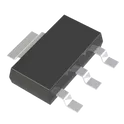
The AMS1117-3.3RG is a fixed-output, low-dropout (LDO) linear voltage regulator that provides a regulated 3.3 V output from a higher input voltage. It is capable of delivering up to 1 A output current and is commonly used in microcontroller, communication, and embedded-system power supplies where a stable 3.3 V rail is required. The device includes built-in protection features such as current limiting and thermal shutdown for improved reliability. Key Features Fixed 3.3 V output voltage Supports up to 1 A output current Low dropout voltage, typically around 1.2 V and up to 1.3 V at 1 A load Input voltage capability up to 12 V (some manufacturer variants specify higher absolute maximum ratings) Good line and load regulation Built-in current limiting protection Built-in thermal shutdown protection Available in SOT-223 surface-mount package Suitable for post-regulation of switching power supplies and general 3.3 V power conversion applications Typical Applications ESP32, STM32, and other microcontroller-based systems Embedded and IoT devices Communication modules LCD monitors and display circuits Battery-powered equipment Post-regulation for DC/DC converters Motherboards and expansion cards #CommonPartsLibrary #IntegratedCircuit #PowerManagement #LDO
172 Uses0 StarsMOV-14D471K
VARISTOR 470V 4.5kA P=7.5mm The MOV-14D471K is a 14 mm radial leaded metal-oxide varistor designed to protect electronic circuits from sudden voltage spikes such as lightning surges, switching transients, and power-line disturbances. It works by clamping high voltage surges and safely absorbing surge energy, preventing damage to sensitive components downstream. It is commonly placed across L–N (line to neutral) in AC input stages of power supplies and appliances. ⚙️ Key Features Varistor voltage: ~470 V (at 1 mA reference current) Maximum AC operating voltage: 300 VAC Maximum DC voltage: 385 VDC Surge current capability: up to 4.5 kA (8/20 µs pulse) Energy absorption rating: ~125 J Clamping voltage: ~775 V (at rated surge current) Capacitance: ~430 pF Response time: very fast (< nanoseconds range, typical MOV behavior) Operating temperature: -40°C to +85°C (typical range)
278 Uses0 StarsSTUSB4500QTR
USB Controller USB 2.0 I2C Interface 24-QFN (4x4) Standalone USB PD sink controller with short-to-VBUS protections • Auto-run Type-C™ and USB PD sink controller • Dead battery mode support • Up to 3 sink PDO configurable profiles • Dual high power charging path support • Integrated VBUS switch gate drivers (PMOS) • Integrated VBUS voltage monitoring • Internal and/or external VBUS discharge paths • Short-to-VBUS protections on CC pins (22 V) • High voltage capability on VBUS pins (28 V) • Dual power supply (VSYS and/or VDD): – VSYS = [3.0 V; 5.5 V] – VDD = [4.1 V; 22 V] • Debug accessory mode support • Temperature range: -40 °C up to 105 °C • ESD: 3 kV HBM - 1.5 kV CDM • Certified: – USB Type-C™ rev 1.2 – USB PD rev 2.0 (TID #1000133) • Interoperable with USB PD rev 3.0 #CommonPartsLibrary #IntegratedCircuit
117 Uses0 Stars