Microchip Technology
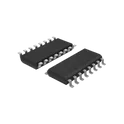
HX711
Precision 24-bit analog-to-digital converter (ADC) designed for weigh scales and industrial control applications to interface directly with a bridge sensor. Based on Avia Semiconductor’s patented technology, HX711 is a precision 24-bit analogto-digital converter (ADC) designed for weigh scales and industrial control applications to interface directly with a bridge sensor. The input multiplexer selects either Channel A or B differential input to the low-noise programmable gain amplifier (PGA). Channel A can be programmed with a gain of 128 or 64, corresponding to a full-scale differential input voltage of ±20mV or ±40mV respectively, when a 5V supply is connected to AVDD analog power supply pin. Channel B has a fixed gain of 32. Onchip power supply regulator eliminates the need for an external supply regulator to provide analog power for the ADC and the sensor. Clock input is flexible. It can be from an external clock source, a crystal, or the on-chip oscillator that does not require any external component. On-chip poweron-reset circuitry simplifies digital interface initialization. There is no programming needed for the internal registers. All controls to the HX711 are through the pins. • Two selectable differential input channels • On-chip active low noise PGA with selectable gain of 32, 64 and 128 • On-chip power supply regulator for load-cell and ADC analog power supply • On-chip oscillator requiring no external component with optional external crystal • On-chip power-on-reset • Simple digital control and serial interface: pin-driven controls, no programming needed • Selectable 10SPS or 80SPS output data rate • Simultaneous 50 and 60Hz supply rejection • Current consumption including on-chip analog power supply regulator: normal operation < 1.5mA, power down < 1uA • Operation supply voltage range: 2.6 ~ 5.5V • Operation temperature range: -40 ~ +85℃ • 16 pin SOP-16 package #commonpartslibrary #integratedcircuit #analog #digital #converter #sensor
801 Uses
1 Star
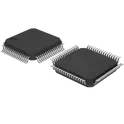
STM32F405RGT6
ARM® Cortex®-M4 series Microcontroller IC 32-Bit Single-Core 168MHz 1MB (1M x 8) FLASH 64-LQFP (10x10) Arm® Cortex®-M4 32b MCU+FPU, 210DMIPS, up to 1MB flash/192+4KB RAM, USB OTG HS/FS, Ethernet, 17 TIMs, 3 ADCs, 15 comm. interfaces, and camera Includes ST state-of-the-art patented technology • Core: Arm® 32-bit Cortex®-M4 CPU with FPU, Adaptive real-time accelerator (ART Accelerator) allowing 0-wait state execution from flash memory, frequency up to 168 MHz, memory protection unit, 210 DMIPS/ 1.25 DMIPS/MHz (Dhrystone 2.1), and DSP instructions • Memories – Up to 1 Mbyte of flash memory – Up to 192+4 Kbytes of SRAM including 64- Kbyte of CCM (core coupled memory) data RAM – 512 bytes of OTP memory – Flexible static memory controller supporting CompactFlash™, SRAM, PSRAM, NOR and NAND memories • LCD parallel interface, 8080/6800 modes • Clock, reset, and supply management – 1.8 V to 3.6 V application supply and I/Os – POR, PDR, PVD and BOR – 4-to-26 MHz crystal oscillator – Internal 16 MHz factory-trimmed RC (1% accuracy) – 32 kHz oscillator for RTC with calibration – Internal 32 kHz RC with calibration • Low-power operation – Sleep, Stop, and Standby modes –VBAT supply for RTC, 20×32-bit backup registers + optional 4 KB backup SRAM • 3×12-bit, 2.4 MSPS A/D converters: up to 24 channels and 7.2 MSPS in triple interleaved mode • 2×12-bit D/A converters • General-purpose DMA: 16-stream DMA controller with FIFOs and burst support • Up to 17 timers: up to twelve 16-bit and two 32- bit timers up to 168 MHz, each with up to 4 IC/OC/PWM or pulse counter and quadrature (incremental) encoder input • Debug mode – Serial wire debug (SWD) & JTAG interfaces – Cortex-M4 Embedded Trace Macrocell™ • Up to 140 I/O ports with interrupt capability – Up to 136 fast I/Os up to 84 MHz – Up to 138 5 V-tolerant I/Os • Up to 15 communication interfaces – Up to 3 × I2C interfaces (SMBus/PMBus) – Up to 4 USARTs/2 UARTs (10.5 Mbit/s, ISO 7816 interface, LIN, IrDA, modem control) – Up to 3 SPIs (42 Mbits/s), 2 with muxed full-duplex I2S to achieve audio class accuracy via internal audio PLL or external clock – 2 × CAN interfaces (2.0B Active) – SDIO interface • Advanced connectivity – USB 2.0 full-speed device/host/OTG controller with on-chip PHY – USB 2.0 high-speed/full-speed device/host/OTG controller with dedicated DMA, on-chip full-speed PHY and ULPI – 10/100 Ethernet MAC with dedicated DMA: supports IEEE 1588v2 hardware, MII/RMII #commonpartslibrary #integratedcircuit #microcontroller
53 Uses
1 Star

PS21964-4S
The Mitsubishi PS21964-4S is a dual-in-line package intelligent power module that integrates a transfer-mold type insulated design suitable for 600V/15A applications. This component combines low-loss 5th generation IGBT inverter bridge technology dedicated to three-phase DC-to-AC power conversion with open emitter configuration. It is designed with embedded drive circuits, high voltage high-speed level shifting, under-voltage protection for both upper and lower leg IGBTs, short circuit protection for lower-leg IGBTs, and system control functionalities into a compact package. The module supports fault signaling corresponding to short circuit faults in the lower-leg IGBT or under-voltage conditions, offering an integrated solution for AC100V~200V inverter drive applications in small power motor controls. With its UL approval (Yellow Card No. E80276) and featuring an input interface compatible with 3V and 5V lines (High Active), the PS21964-4S is engineered to cater to a broad range of industrial applications demanding reliable and efficient power conversion and control.
28 Uses
1 Star
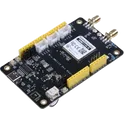
Wio-WM1110 Wireless Module
The Wio-WM1110 is a fusion positioning module for developing low-power, long-range IoT applications. It's embedded with Semtech LR1110 and Nordic nRF52840, features Semtech's LoRa technology for long-range wireless communication, GNSS, Wi-Fi, and Bluetooth for location tracking services.
45 Uses
1 Star
Wio-WM1110 Dev Kit
The Wio-WM1110 Dev Kit is an all-in-one solution for developing low-power, long-range IoT positioning applications. Based on Wio-WM1110 Wireless Module, features Semtech's LoRa® technology for long-range wireless communication, GNSS, and Wi-Fi for location tracking, and also supports Bluetooth Low Energy, Bluetooth mesh, NFC, Thread, and Zigbee.
0 Uses
1 Star
Seeed studio Wio-WM1110 Wireless
The Wio-WM1110 is a fusion positioning module for developing low-power, long-range IoT applications. It's embedded with Semtech LR1110 and Nordic nRF52840, features Semtech's LoRa technology for long-range wireless communication, GNSS, Wi-Fi, and Bluetooth for location tracking services.
4 Uses
1 Star
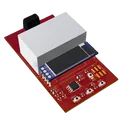
Energy Meter Module
This is an Energy Meter project leveraging an ATTiny85 microcontroller (U1) to sense current through an ACS712 module (U2). It displays the data in real-time on an OLED display (OLED1) and interacts with three buttons (NEXT, MENU, OK). This compact energy meter is suitable for edge computing and low-power Internet of Things (IoT) applications #project #keypad #arduino #attiny85 #ISP #reusable #module #edge-computing #edgeComputing #microchip #sublayout
29 Uses
1 Star
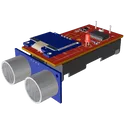
Ultrasonic Distance Meter Module
This circuit is an ultrasonic distance meter based on an ATTiny2313 microcontroller. It uses an HC-SR04 ultrasonic sensor to measure distance and displays the results on an OLED display. The power supply is constructed using a Boost converter (TPS613222A) and a 2-cell AA battery. Additionally, it also includes ISP for programming, RESET and START switches, and LED indicators. #project #Template #projectTemplate #ultrasonic #OLED #arduino #attiny2313 #TPS613222A #ISP #reusable #module #simple-embedded #microchip #sublayout
112 Uses
1 Star