Analog Devices
Analog Devices is a leading provider of high-quality analog and mixed-signal semiconductor solutions for a wide range of applications. From audio and video processing to power management and wireless communication, Analog Devices' extensive portfolio of products helps customers design and build innovative electronic systems with exceptional performance and reliability. If you're looking for comprehensive support in your design process, look no further than Flux.ai. With the world's largest community-driven public library of parts, Flux.ai provides footprints, symbols, datasheets, and simulation models for a wide range of Analog Devices products, making it easy to find the resources you need to get your designs off the ground. So why wait? Start your search for Analog Devices parts today and join the Flux.ai community of design professionals.
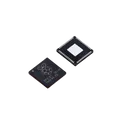
RP2040
RP2040 chip for Raspberry Pi Pico - ARM® Cortex®-M0+ MCU 32-Bit The RP2040 is a high-performance, low-cost microcontroller built around two ARM Cortex-M0+ cores. It is optimized for flexibility, ease of use, and deterministic real-time performance. Unlike many microcontrollers, it includes a unique programmable I/O subsystem (PIO), allowing custom hardware interfaces without extra components. Key Features Processing Dual-core ARM Cortex-M0+ processors Up to 133 MHz clock speed Efficient integer performance with low power consumption Memory 264 KB on-chip SRAM External QSPI flash support (typically 2 MB–16 MB depending on board) Programmable I/O (PIO) 2 PIO blocks, each with 4 state machines Enables custom protocols (e.g., SPI, I2C, UART, WS2812, VGA, etc.) Offloads timing-critical tasks from CPU 🔗 Connectivity Interfaces 2× UART 2× SPI 2× I2C USB 1.1 controller (device or host support) 16× PWM channels Analog Features 12-bit ADC (up to 5 channels, including internal temperature sensor) Power & Voltage Operating voltage: 1.8V – 3.3V Low-power modes available Package Options QFN-56 (7×7 mm) Development Ecosystem Supports C/C++ SDK MicroPython and CircuitPython support Strong community and documentation Typical Applications Embedded systems and IoT devices Robotics and automation DIY electronics and prototyping USB devices (HID, MIDI, etc.) Custom communication interfaces using PIO #CommonPartsLibrary #IntegratedCircuit #Microcontroller
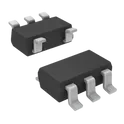
1.1k Uses12 StarsAP2112K-3.3TRG1
Linear Voltage Regulator IC Positive Fixed 1 Output 600mA SOT-25 3.3V LDO AP2112K-3.3 The AP2112K-3.3TRG1 is a low dropout (LDO) linear voltage regulator designed to provide a stable 3.3V output from a higher input voltage. It is optimized for low noise, high power supply rejection ratio (PSRR), and low quiescent current, making it suitable for battery-powered and noise-sensitive applications. The device features current limiting and thermal shutdown protection, ensuring reliable operation under fault conditions. It is commonly used in portable electronics, RF modules, microcontroller power supplies, and other low-power systems. Key Features Fixed output voltage: 3.3V Output current: up to 600 mA Low dropout voltage: ~250 mV at 300 mA load High PSRR: up to 70 dB at 1 kHz Low quiescent current: typically 55 µA Stable with low ESR ceramic capacitors Built-in overcurrent protection Thermal shutdown protection Fast transient response Absolute Maximum Ratings Input Voltage (VIN): up to 6.5 V Output Current: Internally limited Operating Junction Temperature: -40°C to +125°C Storage Temperature: -65°C to +150°C Electrical Characteristics (Typical values unless otherwise specified) Output Voltage Accuracy: ±2% Dropout Voltage: 250 mV @ 300 mA 400 mV @ 600 mA Line Regulation: 0.05%/V Load Regulation: 0.2% Quiescent Current: 55 µA Shutdown Current: <1 µA PSRR: 70 dB @ 1 kHz 45 dB @ 10 kHz Pin Configuration (SOT-23-5 / SC-70-5) VIN – Input voltage GND – Ground EN – Enable (active high) NC – No connection VOUT – Regulated output (3.3V) Package Information Package Type: SOT-23-5 (TRG1 suffix indicates tape & reel) Mounting: Surface mount Small footprint suitable for compact PCB layouts Typical Applications Battery-powered devices Wireless modules (Wi-Fi, Bluetooth, RF) Microcontroller and FPGA power supplies Portable consumer electronics Sensor and analog circuits requiring low noise Compliance & Reliability RoHS compliant Lead-free package Designed for high reliability and long operational life #CommonPartsLibrary #IntegratedCircuit #PowerManagement #LinearRegulator #VoltageRegulator
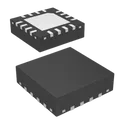
3.4k Uses2 StarsADXL335BCPZ
Accelerometer X, Y, Z Axis ±3g 1.6kHz (X,Y), 550Hz (Z) 16-LFCSP-LQ (4x4) The ADXL335BCPZ is a small, thin, low-power, complete 3-axis accelerometer with signal-conditioned voltage outputs. It measures acceleration with a minimum full-scale range of ±3 g. The device outputs analog voltages proportional to acceleration in each of the three orthogonal axes (X, Y, and Z). The accelerometer is designed for low power consumption and high resolution, making it suitable for mobile devices, tilt sensing, motion detection, and vibration monitoring. It operates over a wide temperature range and requires minimal external components, enabling easy integration into compact systems. Functional Overview The ADXL335 uses a capacitive sensing structure to detect acceleration. Changes in acceleration result in differential capacitance changes, which are converted into voltage outputs through an internal signal conditioning circuit. Each axis provides an independent analog output that can be directly interfaced with ADC inputs of microcontrollers or other processing units. Bandwidth for each axis can be adjusted using external capacitors, allowing flexibility depending on application requirements. Electrical Characteristics Supply Voltage Range: 1.8 V to 3.6 V Supply Current: Typical: 350 µA Measurement Range: ±3 g Sensitivity (Typical): 300 mV/g Zero-g Bias Level: Approximately mid-supply voltage Bandwidth: User-selectable via external capacitors Typical range: X, Y axes: up to 1600 Hz Z axis: up to 550 Hz Output Characteristics Output Type: Analog voltage (ratiometric to supply voltage) Number of Axes: Three (X, Y, Z) Output Noise: Low noise suitable for precision motion sensing Cross-Axis Sensitivity: Typically ±1% Mechanical Characteristics Package Type: 16-lead LFCSP (Lead Frame Chip Scale Package) Dimensions: Approximately 4 mm × 4 mm × 1.45 mm Mounting: Surface mount Environmental Specifications Operating Temperature Range: −40°C to +85°C Shock Survivability: Up to 10,000 g Interface Requirements External Components: Requires capacitors for bandwidth setting (one per axis) Output Interface: Direct analog output compatible with ADC inputs Applications Mobile devices and handheld electronics Tilt and orientation sensing Vibration monitoring systems Gaming and motion input devices Industrial instrumentation Wearable electronics Key Features Low power consumption Compact form factor High resolution analog outputs User-adjustable bandwidth Wide operating temperature range Simple integration with minimal external components #commonpartslibrary #sensor #transducer #motionsensor #accelerometer
58 Uses1 StarsMAX77972EWX+T
1-Cell Battery Fuel Gauge and 3A Charger IC – Integrated battery-management IC combining a buck charger, ModelGauge fuel gauge, USB Type-C/BC1.2 detection, and battery power management for single-cell Li-ion, Li-polymer, and LiFePO₄ batteries. The Analog Devices MAX77972EWX+T supports 13.7 V input operation, up to 3.15 A programmable charging current, and 3.4 V to 4.66 V programmable charge voltage. It provides I²C control, USB Type-C detection, OTG boost operation, and JEITA temperature-based charging control. The device is housed in a 36-WLP package and operates from −40°C to +85°C. #AnalogDevices #MAX77972 #BatteryManagement #BatteryCharger #FuelGauge #USBTypeC #I2C #LiIon #LiPo #LiFePO4 #PowerManagement #PMIC
0 Uses0 StarsADPD4100BCBZR7
Multimodal Sensor Front End – Analog front-end IC for optical and multimodal sensor measurements, supporting up to 8 input channels and 8 LED drivers, with dual-channel simultaneous processing and 12 programmable time slots. The Analog Devices ADPD4100BCBZR7 supports sampling rates from 0.004 Hz to 9 kHz, SPI communication, a 1.8 V analog core, and 1.8 V/3.3 V-compatible digital I/O. It provides 400 mA total peak LED drive current, on-chip digital filtering, and a 512-byte FIFO. The device is housed in a 35-ball WLCSP, 3.11 × 2.14 mm package and operates from −40°C to +85°C. #AnalogDevices #ADPD4100 #SensorAFE #OpticalSensor #MultimodalSensor #SPI #LEDDriver #Wearables #PPG #EmbeddedSystems
2 Uses0 StarsADM2865EBRNZ
Isolated RS-485/RS-422 Transceiver – Half-duplex transceiver with integrated signal and power isolation for isolated serial communication. The Analog Devices ADM2865EBRNZ provides a 25 Mbps data rate, 5.7 kV RMS isolation, 3.0 V to 5.5 V supply, and ±12 kV IEC contact / ±15 kV IEC air ESD protection on the RS-485 bus pins. It supports up to 192 bus nodes, with 250 kV/µs common-mode transient immunity, and operates from −40°C to +105°C in a 28-lead SOIC-W-FP package. #AnalogDevices #ADM2865EBRNZ #RS485 #RS422 #Transceiver #DigitalIsolation #IsolatedCommunication #25Mbps #IndustrialElectronics #PCBComponents
15 Uses0 StarsADG7421FBCPZ-RL7
Dual SPST Analog Switch with ±60 V Overvoltage Protection – The Analog Devices ADG7421FBCPZ-RL7 is a dual-channel analog switch designed for switching and protecting low-voltage analog signals. It provides 15 Ω maximum on-resistance, ±60 V overvoltage and power-off protection on the signal pins, and supports 1.8 V to 5.5 V single-supply or ±1.8 V to ±2.5 V dual-supply operation. It has a 580 MHz typical −3 dB bandwidth, 50 pA maximum off-state leakage, and −45 pC charge injection. The device is housed in a 10-lead LFCSP, 3 × 2 mm package and operates from −40°C to +125°C. #AnalogDevices #ADG7421F #AnalogSwitch #SPST #OvervoltageProtection #SignalSwitching #LFCSP #AnalogCircuit #DataAcquisition #Instrumentation
7 Uses0 StarsLT4363HDE-2#PBF
High-Voltage Surge Stopper IC – Overvoltage and surge protection controller that drives an external N-channel MOSFET to limit transient and sustained overvoltage conditions. The Analog Devices LT4363HDE-2#PBF supports 4 V to 80 V operating voltage, adjustable overvoltage clamping, and an external MOSFET switch. It is provided in a 12-DFN (4 × 3 mm) package with an exposed pad. #AnalogDevices #LT4363 #SurgeStopper #OvervoltageProtection #CircuitProtection #MOSFETController #PowerProtection #80V #DFN #PowerManagement
2 Uses0 StarsMAX9295DGTM/VY+T
Dual 4-Lane MIPI CSI-2 v1.3 Ports MIPI D-PHY v1.2 at 80Mbps - 2.5Gbps per Lane 4-Channel CSI-2 Virtual-Channel Support Support for RAW8/10/12/14/16/20, RGB565/666/ 888 and YUV8-/10-Bit Data Types CSI-2 Inputs in GMSL2 Mode Accept Cameras with Different Video Timing and Resolution CSI-2 ECC and Checksum Error Detection and Flagging CSI-2 Lane Reassignment and Polarity FlipMAX9295DGTM/VY+T is an Analog Devices automotive GMSL2 dual MIPI CSI-2 serializer with GMSL1 compatibility, supporting dual 4-lane CSI-2 inputs and 3/6 Gbps GMSL2 links in a 7 × 7 mm TQFN package. Keywords: MAX9295DGTM/VY+T, MAX9295D, GMSL2 serializer, MIPI CSI-2, automotive SerDes
0 Uses0 Stars



Page 1 of 58
Next