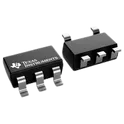
Voltage Regulators
A voltage regulator is an electronic device that maintains a constant output voltage level, regardless of changes in the input voltage or load conditions. These devices are commonly used to provide a stable power supply to electronic circuits, as well as to protect them from voltage spikes and surges. There are several types of voltage regulators, including linear, switching, and pulse width modulation (PWM) regulators, each with its own set of characteristics and applications. Linear regulators, for example, are simple and efficient, but have a relatively low switching speed and can only provide a limited output current. Switching regulators, on the other hand, have higher switching speeds and can provide a higher output current, but are more complex and require additional components. In addition to their use in power supplies and voltage protection, voltage regulators are also used in a wide range of other applications, including motor control, battery charging, and instrumentation. Flux.ai has the world's largest community-driven public library of voltage regulators, with footprints, symbols, datasheets, and simulation models for a wide range of devices. Whether you're a designer, engineer, or hobbyist, you can find the resources you need to get your project up and running quickly and efficiently.
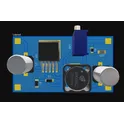
BEC-Arduino-LM2596-Sub_Layout
This is a DC/DC step-down voltage regulator that converts input voltage between 3.2V and 40V into a smaller voltage between 1.25V and 35V, capable of driving a 3A load with excellent line and load regulation. In some projects, you might need different voltages (3-35V) for your devices.
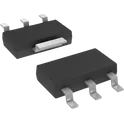
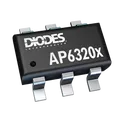
24 Uses2 StarsAP63203WU-7
Buck Switching Regulator IC Positive Fixed 3.3V 1 Output 2A SOT-23-6 Thin, TSOT-23-6 The AP63200/AP63201/AP63203/AP63205 is a 2A, synchronous buck converter with a wide input voltage range of 3.8V to 32V and fully integrates a 125mΩ high-side power MOSFET and a 68mΩ low-side power MOSFET to provide high-efficiency step-down DC/DC conversion. The AP63200/AP63201/AP63203/AP63205 device is easily used by minimizing the external component count due to its adoption of peak current mode control along with its integrated compensation network. The AP63200/AP63201/AP63203/AP63205 has optimized designs for Electromagnetic Interference (EMI) reduction. The converter features Frequency Spread Spectrum (FSS) with a switching frequency jitter of ±6%, which reduces EMI by not allowing emitted energy to stay in any one frequency for a significant period of time. It also has a proprietary gate driver scheme to resist switching node ringing without sacrificing MOSFET turn-on and turn-off times, which further erases highfrequency radiated EMI noise caused by MOSFET switching. The device is available in a low-profile, TSOT26 package. • VIN 3.8V to 32V • 2A Continuous Output Current • 0.8V ±1% Reference Voltage • 22µA Ultralow Quiescent Current • Switching Frequency o 500kHz: AP63200 and AP63201 o 1.1MHz: AP63203 and AP63205 • Pulse Width Modulation (PWM) Regardless of Output Load o AP63201 • Supports Pulse Frequency Modulation (PFM) o AP63200, AP63203, and AP63205 o Up to 80% Efficiency at 1mA Light Load o Up to 88% Efficiency at 5mA Light Load • Fixed Output Voltage o 3.3V: AP63203 o 5.0V: AP63205 • Proprietary Gate Driver Design for Best EMI Reduction • Frequency Spread Spectrum (FSS) to Reduce EMI • Precision Enable Threshold to Adjust UVLO • Protection Circuitry o Overvoltage Protection o Cycle-by-Cycle Peak Current Limit o Thermal Shutdown • 12V and 24V distributed power bus supplies • Flat screen TV sets and monitors • Power tools and laser printers • White goods and small home appliances • FPGA, DSP, and ASIC supplies • Home audios • Network systems • Set top boxes • Gaming consoles • Consumer electronics #commonpartslibrary #integratedcircuit #AP63203WU7 #BuckConverter #DCDCConverter #PowerManagement #VoltageRegulator #SynchronousBuck #EmbeddedSystems #IndustrialElectronics #PowerSupply #DiodesInc #3V3Power #ElectronicsDesign
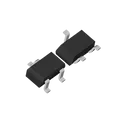
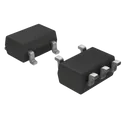
1.7k Uses1 StarsTLV62569DBVR
Buck Switching Regulator IC Positive Adjustable 0.6V Output 2A SC-74A, SOT-753 The Texas Instruments TLV62569DBVR is a high-efficiency synchronous step-down (buck) DC-DC converter designed for compact and low-power applications. It converts a higher DC input voltage down to a lower, regulated output voltage with high efficiency and small external component size. It is commonly used in portable electronics, embedded systems, routers, set-top boxes, and battery-powered devices where efficient power conversion and small footprint are important. 🔧 Key Features Input voltage range: 2.5 V to 5.5 V Output current capability: up to 2 A Adjustable output voltage: 0.6 V to VIN (via external resistors) High efficiency: up to ~95% Switching frequency: ~1.5 MHz (allows small inductors/capacitors) Synchronous rectification: improves efficiency by reducing losses Power Save Mode (PSM): boosts efficiency at light load Low quiescent current: ~35 µA typical 100% duty cycle support: low dropout operation 🛡️ Protection & Safety Features Overcurrent protection (OCP) Thermal shutdown protection Internal soft-start (reduces inrush current at startup) Power Good (PG) indicator for system monitoring 📦 Package SOT-23-5 (DBVR) Very small footprint for space-constrained PCB designs ⚙️ Typical Applications Point-of-load (POL) power supplies Wireless routers and networking devices Set-top boxes Battery-powered and portable systems Embedded controllers and IoT devices
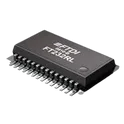
161 Uses1 StarsFT232RL
USB to Serial Interface, SSOP-28 FTDI USB Serial SSOP*5.3x10.2mm*P0.65mm* The FT232RL is a full-speed USB 2.0 to asynchronous serial data transfer IC. It integrates all the necessary USB protocol handling and UART interface logic, making it very easy to add USB connectivity to embedded devices without requiring complex firmware development. It is commonly used in development boards (like Arduino clones), USB-to-TTL converters, and debugging interfaces. Key Features USB Interface Fully compliant with USB 2.0 Full-Speed (12 Mbps) Integrated USB transceiver (no external components required) Supports USB suspend/resume modes Internal EEPROM for storing USB descriptors (no external EEPROM needed) Serial (UART) Interface Supports standard UART communication (TX, RX) Configurable baud rates from 300 bps up to 3 Mbps Supports hardware flow control (RTS/CTS, DTR/DSR) Bit-bang mode for simple GPIO control Integrated Components Built-in clock generator (no external crystal required) Internal EEPROM for configuration Integrated voltage regulator (3.3V output available for external use) Power Features Operates from 3.3V to 5V Can be powered directly from USB (bus-powered) Low power consumption with sleep mode Driver Support Virtual COM Port (VCP) drivers available for: Windows Linux macOS Also supports direct D2XX driver for advanced applications Package Typically available in SSOP-28 package Common Applications USB-to-serial converters (TTL/RS232) Microcontroller programming and debugging Embedded system communication Industrial and instrumentation interfaces
157 Uses1 Stars