Oscillators
An oscillator is an electronic circuit that generates a periodic, oscillating signal, often a sine wave or a square wave. Oscillators are used in a wide range of applications, including clocks, radios, and sound synthesis. Flux.ai has the world's largest community-driven public library of oscillators, with footprints, symbols, datasheets, and simulation models. This comprehensive resource allows engineers and designers to easily find the oscillator they need for their specific application and use it with confidence. Whether you are working on a simple clock circuit or a complex radio transmitter, Flux.ai's oscillator library has you covered. So, if you are in need of an oscillator for your next project, be sure to check out Flux.ai's extensive collection.
HT16K33A-28SSOP
SSOP-28 Display Drivers HT16K33A-28SSOP is a RAM-mapped, multi-function LED controller/driver IC with an I²C interface, supporting up to 128 display points in a 16×8 configuration and up to 13×3 matrix key scanning. It operates from 4.5–5.5 V, includes an internal RC oscillator and 16-step dimming control, and is suitable for LED displays, digital instruments, clocks, counters, and control panels in a 28-pin SSOP package. #HOLTEK #HT16K33A #LEDDriver #LEDController #I2C #Keyscan #DisplayDriver #SSOP28
1 Uses0 StarsSTDCRA3-8M
8 MHz SMD Crystal Unit – Fundamental-mode quartz crystal used as a frequency reference for microcontrollers, embedded systems, communication devices, and digital circuits. The NDK STDCRA3-8M has an 8 MHz nominal frequency, ±50 ppm frequency tolerance, ±150 ppm frequency stability over temperature, 8 pF load capacitance, and 500 Ω maximum equivalent resistance. It operates from −40°C to +150°C and uses a compact 2-SMD package (3.2 × 2.5 mm). #NDK #STDCRA38M #Crystal #QuartzCrystal #8MHz #FrequencyReference #SMD #Oscillator #EmbeddedSystems #Microcontroller
1 Uses0 StarsCP2102C-A01-GQFN24
USB-to-UART Bridge Controller that provides USB 2.0 full-speed connectivity to UART interfaces, integrating the USB transceiver, oscillator, UART, and 3.3 V regulator for simplified USB serial designs. It supports data rates up to 3 Mbaud, 3.0–5.25 V VREGIN operation, 3.0–3.6 V VDD, and −40 to +85 °C operation in a QFN24 package. Typical applications include embedded systems, USB serial interfaces, data loggers, and USB dongles. #USBtoUART #USBBridge #UART #SiliconLabs #CP2102C
4 Uses0 StarsESP32-C3-WROOM-02-N4
20.5dBm ESP32-C3 Chip 2.4GHz VFQFN-32-EP WiFi Modules ROHS RF Transceiver ICs ESP32-C3-WROOM-02-N4 BULETM-SMD_ESPRESSIF_ESP32-C3-WROOM-02-N4-4MB LCSC Part Number: C2934560 Espressif ESP32-C3-WROOM-02 wireless MCU module, based on ESP32-C3 32-bit RISC-V single-core processor up to 160MHz, supports 2.4GHz Wi-Fi 802.11b/g/n and Bluetooth LE 5.0 with Bluetooth mesh, 4MB or 8MB SPI flash options, 384KB ROM, 400KB SRAM and 8KB RTC SRAM, up to 15 GPIOs, SPI, UART, I2C, I2S, LED PWM, USB Serial/JTAG, ADC, timers and watchdogs, integrated 40MHz crystal oscillator, 3.0V to 3.6V supply voltage, on-board PCB antenna, RoHS/REACH compliant, 18.0 x 20.0 x 3.2mm module size. Search Keywords: ESP32-C3-WROOM-02, ESP32-C3-WROOM-02-N4, ESP32-C3-WROOM-02-H4, ESP32-C3-WROOM-02-N8, Espressif ESP32-C3-WROOM-02, ESP32-C3 WiFi Bluetooth module, ESP32-C3 RISC-V module, WiFi BLE 5 module, 802.11bgn module, Bluetooth mesh module, ESP32-C3 PCB antenna module, ESP32-C3 4MB flash module, ESP32-C3 8MB flash module Hashtags: #ESP32C3WROOM02 #ESP32C3WROOM02N4 #ESP32C3WROOM02H4 #ESP32C3WROOM02N8 #EspressifESP32C3 #ESP32C3 #WiFiBluetoothModule #WiFiModule #BluetoothLEModule #BLE5Module #RISCVMCU #IoTModule #PCBantenna #80211bgn
213 Uses0 StarsESP32-S3-WROOM-1-N8
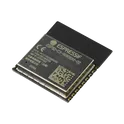
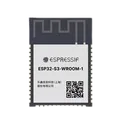
ESP32-S3-WROOM-1-N8 is a high-performance Wi-Fi and Bluetooth Low Energy (BLE) module from Espressif Systems. It is built around the ESP32-S3 SoC, featuring a dual-core Xtensa LX7 processor, integrated 2.4 GHz Wi-Fi and Bluetooth 5 LE connectivity, 8 MB SPI flash memory, and a PCB antenna. The module is optimized for AIoT, edge computing, human-machine interfaces, smart devices, and industrial IoT applications. Key Features Dual-core Xtensa® LX7 CPU running up to 240 MHz for high-performance embedded applications. 8 MB onboard SPI Flash (N8 variant) for firmware and data storage. 2.4 GHz Wi-Fi (802.11 b/g/n) with data rates up to 150 Mbps. Bluetooth 5 LE support including: Long Range mode 2 Mbps PHY Bluetooth Mesh Extended Advertising AI acceleration support through ESP32-S3 vector instructions for machine learning and signal-processing workloads. USB 1.1 OTG and USB Serial/JTAG integrated, simplifying debugging and USB device applications. Up to 45 GPIOs with extensive peripheral support: SPI I²C I²S UART PWM ADC Touch Sensors TWAI® (CAN-compatible) Camera Interface LCD Interface SDIO Host MCPWM Integrated 40 MHz crystal oscillator, RF matching circuitry, and PCB antenna for reduced external component count. Operating voltage range: 3.0 V to 3.6 V. Compact surface-mount module suitable for space-constrained designs. Typical Applications Smart home and home automation devices HMI displays and touchscreen products Voice recognition and audio processing Edge AI and machine learning applications Industrial IoT gateways and sensors Video streaming and camera systems USB-connected embedded devices Smart agriculture and healthcare equipment N8 specifically indicates 8 MB Flash and no PSRAM, making it a good choice for applications requiring substantial program storage but not large external RAM. #RF-transceiver #Module #ESP32
371 Uses0 StarsST25R3916B-AQET
RFID Reader/Transponder IC 13.56MHz FeliCa, ISO 14443, ISO 15693, MIFARE, NFC I2C, SPI 2.6V ~ 5.5V 32-UFQFN Exposed Pad NFC reader IC for contactless communication, supporting NFC-A/B, NFC-F, and NFC-V protocols with reader/writer, card-emulation, and peer-to-peer modes. It operates from 2.6–5.5 V, supports SPI up to 10 Mbit/s and I²C up to 3.4 Mbit/s, and uses a 27.12 MHz crystal oscillator. The device is housed in a 32-pin UFQFPN package measuring 5 × 5 mm. #NFC #NFCReader #RFID #STMicroelectronics #ST25R3916B
1 Uses0 StarsAD698AP
LVDT Signal Conditioner IC – Converts half-bridge, 4-wire LVDT, and RVDT sensor signals into a unipolar or bipolar DC voltage proportional to position. The Analog Devices AD698AP integrates an excitation oscillator, voltage reference, synchronous demodulation, and ratiometric signal conditioning. It supports 20 Hz to 20 kHz excitation, up to 24 V RMS differential excitation, 0.05% linearity, and ±11 V output. The AD698AP is supplied in a 28-PLCC surface-mount package. #AnalogDevices #AD698AP #LVDT #SignalConditioner #PositionSensor #RVDT #SensorInterface #AnalogIC #Instrumentation
0 Uses0 StarsADS1120IPWR
16-Bit Delta-Sigma Analog-to-Digital Converter (ADC) – Precision ADC with integrated programmable gain amplifier (PGA), voltage reference, two programmable current sources, oscillator, temperature sensor, and SPI interface. The Texas Instruments ADS1120IPWR supports two differential or four single-ended inputs, 16-bit resolution, and data rates up to 2 kSPS. It operates from a 2.3 V to 5.5 V supply, with programmable gain from 1 to 128 V/V. The device provides 50/60 Hz rejection at 20 SPS and is housed in a 16-pin TSSOP package, operating from −40°C to +125°C. #TexasInstruments #ADS1120 #ADS1120IPWR #ADC #DeltaSigmaADC #16BitADC #PGA #SPI #DataAcquisition #SensorInterface #EmbeddedSystems
21 Uses0 Stars