Interface ICs
An interface IC is a type of integrated circuit that is designed to facilitate communication between two devices or systems. These devices are commonly used in electronic systems to enable the transfer of data and control signals between different components or subsystems. Some common use cases for interface ICs include connecting microcontrollers to peripherals such as sensors or displays, linking multiple processors together in a network, and enabling communication between devices using different communication protocols. Flux.ai has the world's largest community-driven public library of interface ICs, with footprints, symbols, datasheets, and simulation models. This library is a valuable resource for engineers and designers who need access to accurate and up-to-date information on these important components. Whether you are working on a new design project or simply looking to learn more about interface ICs, Flux.ai is an excellent resource to help you find the information you need.
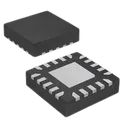
ATTINY1616-MFR
ATTINY1616-MFR QFN-20_L3.0-W3.0-P0.40-TL-EP1.7 LCSC Part Number: C1338523 JLCPCB Part Class: Extended Part Manufactured by MICROCHIP(美国微芯) Microchip ATtiny1614/1616/1617 tinyAVR 1-series 8-bit microcontroller, AVR CPU running up to 20MHz, up to 16KB self-programmable Flash memory, 256B EEPROM and 2KB SRAM, 1.8V to 5.5V operating voltage range, single-pin UPDI programming and debug interface, power-on reset and brown-out detector, internal 16/20MHz oscillator, timers, watchdog, USART, SPI, I2C/TWI, 10-bit ADC, DAC, analog comparators, event system, configurable custom logic and peripheral touch controller, available in 14-pin, 20-pin and 24-pin packages depending on variant. Search Keywords: ATtiny1614, ATtiny1616, ATtiny1617, Microchip ATtiny1614, Microchip ATtiny1616, Microchip ATtiny1617, tinyAVR 1-series, AVR 8-bit microcontroller, ATtiny 16KB Flash, ATtiny UPDI, ATtiny1616 microcontroller, ATtiny1617 MCU, ATtiny1614 MCU, 20MHz AVR microcontroller, ATtiny I2C SPI USART, ATtiny1616 datasheet, ATtiny1614 datasheet, ATtiny1617 datasheet Hashtags: #ATtiny1614 #ATtiny1616 #ATtiny1617 #MicrochipATtiny #MicrochipMCU #tinyAVR #tinyAVR1Series #AVRMicrocontroller #8bitMicrocontroller #ATtinyMCU #UPDI #16KBFlashMCU #20MHzMCU #I2CMCU #SPIMCU #USARTMCU #ADCmicrocontroller #TouchControllerMCU
50 Uses0 StarsHDMI2C1-14HD
Interface - Specialized HDMI2C1-14HD QFN-36_L6.5-W3.5-P0.50-BL-EP LCSC Part Number: C1852764 JLCPCB Part Class: Extended Part Manufactured by ST(意法半导体) STMicroelectronics HDMI2C1-14HDS integrated HDMI ESD protection and signal conditioning IC for HDMI source control links, provides TMDS high-bandwidth ESD protection, DDC I2C bidirectional level shifting and pull-up, CEC bus protection and level shifter, HEAC link protection, HPD pull-down and signal conditioning, 8kV contact ESD protection on connector side, supports low-voltage HDMI ASIC and CEC driver down to 1.8V, short-circuit protection on 5V output, overtemperature protection, HDMI compliant from -40°C to +85°C, QFN-24 500µm pitch package. Search Keywords: HDMI2C1-14HDS, ST HDMI2C1-14HDS, STMicroelectronics HDMI2C1-14HDS, HDMI2C1-14HDS HDMI protection, HDMI ESD protection IC, HDMI signal conditioning IC, HDMI DDC level shifter, HDMI CEC level shifter, HDMI TMDS ESD protection, HDMI HEAC protection, HDMI HPD signal conditioning, HDMI source control link protection, QFN-24 HDMI protection IC, IEC 61000-4-2 HDMI ESD Hashtags: #HDMI2C114HDS #STMicroelectronics #STHDMIProtection #HDMIProtectionIC #HDMIESDProtection #HDMISignalConditioning #TMDSProtection #DDCProtection #I2CLevelShifter #CECProtection #CECLevelShifter #HEACProtection #HPDProtection #HDMISourceProtection #IEC6100042 #ESDProtectionIC #QFN24
39 Uses0 StarsSHT31-DIS-F2.5kS
Humidity Sensors/Temperature and Humidity Sensors SHT31-DIS-F2.5kS DFN-8_L2.5-W2.5-P0.50-BL-EP LCSC Part Number: C453460 JLCPCB Part Class: Extended Part Manufactured by Sensirion(瑞士盛思锐) Sensirion SHT3x-DIS digital humidity and temperature sensor, fully calibrated and temperature-compensated digital output, 2.15V to 5.5V supply voltage range, I2C interface up to 1MHz with two user-selectable addresses, typical accuracy up to ±1.5%RH and ±0.1°C for SHT35, NIST traceability, fast start-up and measurement time, integrated RH and temperature sensing, tiny 8-pin DFN package with 2.5 x 2.5mm footprint and 0.9mm height. Search Keywords: SHT3x-DIS, Sensirion SHT3x-DIS, SHT30-DIS, SHT31-DIS, SHT35-DIS, SHT3x humidity sensor, Sensirion humidity temperature sensor, digital humidity sensor, digital temperature sensor, I2C humidity sensor, I2C temperature sensor, SHT35 high accuracy sensor, SHT3x DFN-8, 2.5x2.5mm humidity sensor, CMOSens humidity sensor, SHT3x-DIS datasheet Hashtags: #SHT3xDIS #SHT30DIS #SHT31DIS #SHT35DIS #SensirionSHT3x #SensirionSensor #HumiditySensor #TemperatureSensor #HumidityTemperatureSensor #DigitalHumiditySensor #I2CSensor #CMOSensSensor #DFN8Sensor #25x25mmSensor #HighAccuracyHumiditySensor #NISTTraceableSensor
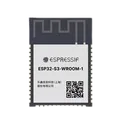
47 Uses0 StarsESP32-S3-WROOM-1-N8
ESP32-S3-WROOM-1-N8 is a high-performance Wi-Fi and Bluetooth Low Energy (BLE) module from Espressif Systems. It is built around the ESP32-S3 SoC, featuring a dual-core Xtensa LX7 processor, integrated 2.4 GHz Wi-Fi and Bluetooth 5 LE connectivity, 8 MB SPI flash memory, and a PCB antenna. The module is optimized for AIoT, edge computing, human-machine interfaces, smart devices, and industrial IoT applications. Key Features Dual-core Xtensa® LX7 CPU running up to 240 MHz for high-performance embedded applications. 8 MB onboard SPI Flash (N8 variant) for firmware and data storage. 2.4 GHz Wi-Fi (802.11 b/g/n) with data rates up to 150 Mbps. Bluetooth 5 LE support including: Long Range mode 2 Mbps PHY Bluetooth Mesh Extended Advertising AI acceleration support through ESP32-S3 vector instructions for machine learning and signal-processing workloads. USB 1.1 OTG and USB Serial/JTAG integrated, simplifying debugging and USB device applications. Up to 45 GPIOs with extensive peripheral support: SPI I²C I²S UART PWM ADC Touch Sensors TWAI® (CAN-compatible) Camera Interface LCD Interface SDIO Host MCPWM Integrated 40 MHz crystal oscillator, RF matching circuitry, and PCB antenna for reduced external component count. Operating voltage range: 3.0 V to 3.6 V. Compact surface-mount module suitable for space-constrained designs. Typical Applications Smart home and home automation devices HMI displays and touchscreen products Voice recognition and audio processing Edge AI and machine learning applications Industrial IoT gateways and sensors Video streaming and camera systems USB-connected embedded devices Smart agriculture and healthcare equipment N8 specifically indicates 8 MB Flash and no PSRAM, making it a good choice for applications requiring substantial program storage but not large external RAM. #RF-transceiver #Module #ESP32
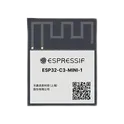
241 Uses0 StarsESP32-C3-MINI-1-H4
ESP32-C3-MINI-1-H4 is a compact, low-power wireless module from Espressif Systems built around the ESP32-C3 SoC. It integrates a 32-bit RISC-V processor, 2.4 GHz Wi-Fi, Bluetooth 5 LE, onboard 4 MB flash memory, crystal oscillator, RF matching circuitry, and a PCB antenna in a small surface-mount package. The module is designed for IoT devices, smart home products, industrial automation, wearable electronics, and wireless sensor applications. Key Features 32-bit RISC-V single-core processor with clock speeds up to 160 MHz. 2.4 GHz Wi-Fi 4 (802.11 b/g/n) connectivity. Bluetooth 5 Low Energy (BLE 5.0) support with long-range capability. 4 MB embedded SPI flash memory (H4 variant). 384 KB ROM and 408 KB SRAM for application execution. Integrated PCB antenna for simplified RF design. USB Serial/JTAG controller for programming and debugging without an external USB-to-UART bridge. Multiple peripheral interfaces: UART SPI I²C I²S PWM GPIO ADC USB JTAG Operating voltage range: 3.0 V to 3.6 V. Supports secure boot, flash encryption, and hardware cryptographic acceleration. Compact SMD module suitable for space-constrained designs. Typical Applications Smart home and home automation devices Wireless sensors and data loggers IoT gateways and edge devices Industrial monitoring and control systems Bluetooth beacons Wearable electronics Consumer connected products H4 Variant Note: The ESP32-C3-MINI-1-H4 version includes 4 MB flash memory and supports an extended operating temperature range up to 105°C, making it suitable for more demanding industrial environments. #RF-Transceiver #ESP32 #Module
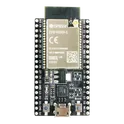
99 Uses0 StarsESP32-DevKitC
The ESP32-DevKitC is an official ESP32-based development board from Espressif Systems designed for rapid prototyping and IoT application development. It integrates an ESP32 module (such as ESP32-WROOM-32E or ESP32-WROVER variants), USB-to-UART programming interface, power regulation circuitry, reset and boot buttons, and access to most ESP32 GPIOs through dual-row headers. The board is breadboard-friendly and supports wireless connectivity, making it suitable for smart devices, industrial monitoring, home automation, wearable electronics, and embedded control systems. Key Features ESP32 Dual-Core Processor Xtensa® 32-bit LX6 dual-core MCU Up to 240 MHz clock frequency High-performance embedded processing capability. Wireless Connectivity Integrated 2.4 GHz Wi-Fi (802.11 b/g/n) Bluetooth Classic (BR/EDR) and Bluetooth Low Energy (BLE) support. Memory Typically includes 4 MB SPI Flash Some variants provide additional PSRAM for memory-intensive applications. Rich Peripheral Interfaces UART, SPI, I²C, I²S, SDIO ADC and DAC PWM outputs Capacitive touch sensing Pulse counter and timer peripherals. Extensive GPIO Access Most ESP32 pins are broken out to headers Supports digital I/O, interrupts, analog inputs, and communication interfaces. Development-Friendly Hardware USB-to-UART bridge for programming and debugging Dedicated EN (Reset) and BOOT buttons On-board 3.3 V regulator Breadboard-compatible layout. Flexible Power Options Powered through Micro-USB and onboard power circuitry Supports external power connections through header pins. #DevelopmentBoard
179 Uses0 StarsESP32-WROOM-32E
ESP32-WROOM-32E is a powerful, general-purpose Wi-Fi and Bluetooth MCU module from Espressif Systems. It is built around the ESP32 SoC and integrates a dual-core processor, wireless connectivity, flash memory, and numerous peripherals in a compact module suitable for IoT, industrial control, smart home, wearable, and wireless communication applications. KB ROM 520 KB SRAM 16 KB RTC SRAM for low-power operation - Integrated PCB antenna on the WROOM-32E version Optional 8 MB and 16 MB flash variants available on request Converter) TWAI® (CAN-compatible interface) T applications CE-RED SRRC Bluetooth BQB RoHS and REACH compliant devices Smart lighting systems Remote control and automation equipment 4 MB flash memory, extensive peripheral interfaces, and low-power operation in a compact package. Its strong wireless capabilities and rich I/O make it one of the most widely used modules for IoT and embedded system development. #Module #Esp32
456 Uses0 StarsRP2040
133MHz LQFN-56(7x7) Microcontrollers (MCU/MPU/SOC) ROHS RP2040 The RP2040 is a high-performance, low-cost 32-bit microcontroller developed by Raspberry Pi Ltd.. It features dual ARM Cortex-M0+ processor cores, flexible digital interfaces, and a unique Programmable I/O (PIO) subsystem that enables custom hardware protocols and timing-critical applications. The device is widely used in embedded systems, IoT devices, robotics, industrial control, consumer electronics, and educational projects. Key Features Dual ARM Cortex-M0+ CPU cores operating up to 133 MHz (up to 200 MHz under specific conditions) 264 KB on-chip SRAM organized in six independent memory banks External QSPI Flash interface with Execute-In-Place (XIP) support and up to 16 MB Flash memory capability 30 multifunction GPIO pins with extensive peripheral multiplexing 2 × UART interfaces 2 × SPI controllers 2 × I²C controllers 16 PWM channels for motor control and signal generation USB 1.1 Host and Device support with integrated PHY 12-bit ADC with four external analog inputs and internal temperature sensor, up to 500 ksps sampling rate 12-channel DMA controller for efficient data transfers Programmable I/O (PIO) subsystem with 8 state machines for implementing custom communication interfaces and precise timing applications Integrated PLLs and programmable LDO regulator for clock and power management Operating voltage range: 1.8 V to 3.3 V Available in a compact 7 mm × 7 mm QFN-56 package Typical Applications IoT and connected devices Industrial automation Robotics and motor control Human-machine interfaces (HMI) Consumer electronics USB peripherals Sensor data acquisition systems Educational and maker projects Custom communication protocol implementations using PIO #CommonPartsLibrary #IntegratedCircuit #Microcontroller
130 Uses0 StarsSTUSB4500QTR
USB Controller USB 2.0 I2C Interface 24-QFN (4x4) Standalone USB PD sink controller with short-to-VBUS protections • Auto-run Type-C™ and USB PD sink controller • Dead battery mode support • Up to 3 sink PDO configurable profiles • Dual high power charging path support • Integrated VBUS switch gate drivers (PMOS) • Integrated VBUS voltage monitoring • Internal and/or external VBUS discharge paths • Short-to-VBUS protections on CC pins (22 V) • High voltage capability on VBUS pins (28 V) • Dual power supply (VSYS and/or VDD): – VSYS = [3.0 V; 5.5 V] – VDD = [4.1 V; 22 V] • Debug accessory mode support • Temperature range: -40 °C up to 105 °C • ESD: 3 kV HBM - 1.5 kV CDM • Certified: – USB Type-C™ rev 1.2 – USB PD rev 2.0 (TID #1000133) • Interoperable with USB PD rev 3.0 #CommonPartsLibrary #IntegratedCircuit
81 Uses0 StarsMAX31865AAP+T
15Bit 3V~3.6V SPI SSOP-20-208mil Analog to Digital Converters (ADCs) ROHS The MAX31865 is an easy-to-use resistance-to-digital converter optimized for platinum resistance temperature detectors (RTDs). An external resistor sets the sensitivity for the RTD being used and a precision delta-sigma ADC converts the ratio of the RTD resistance to the reference resistance into digital form. The MAX31865’s inputs are protected against overvoltage faults as large as Q45V. Programmable detection of RTD and cable open and short conditions is included. ● Integration Lowers System Cost, Simplifies Design Efforts, and Reduces Design Cycle Time • Simple Conversion of Platinum RTD Resistance to Digital Value • Handles 100Ω to 1kΩ (at 0°C) Platinum RTDs (PT100 to PT1000) • Compatible with 2-, 3-, and 4-Wire Sensor Connections • SPI-Compatible Interface • 20-Pin TQFN and SSOP Packages ● High Accuracy Facilitates Meeting Error Budgets • 15-Bit ADC Resolution; Nominal Temperature Resolution 0.03125NC (Varies Due to RTD Nonlinearity) • Total Accuracy Over All Operating Conditions: 0.5NC (0.05% of Full Scale) max • Fully Differential VREF Inputs • 21ms (max) Conversion Time ● Integrated Fault Detection Increases System Reliability • ±45V Input Protection • Fault Detection (Open RTD Element, RTD Shorted to Out-of-Range Voltage, or Short Across RTD Element) #CommonPartsLibrary #IntegratedCircuit #PowerManagement
164 Uses0 Stars