Top Organization Components
Curated collection features components used in significant projects by various businesses and institutions, reflecting the current trends and high standards of the industry. From basic electronic elements to advanced modules, these components are selected for their superior quality, efficiency, and adaptability in diverse applications. It offers a glimpse into the components that are shaping the future of PCB design in professional settings. It serves as a vital resource for designers and organizations looking to stay ahead of the curve, providing insights into the component choices that lead to successful and innovative designs. By showcasing the preferred components of leading organizations, Flux.ai creates an avenue for knowledge exchange and benchmarking within the electronics design community. This subcategory is more than just a list of components; it's a reflection of industry-leading practices and a source of inspiration for those striving for excellence in PCB design.
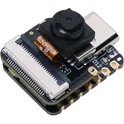
Seeed Studio XIAO ESP32S3 Sense a323
Seeed Studio XIAO ESP32S3 leverages dual-core ESP32S3 chip, supporting both Wi-Fi and BLE wireless connectivities, which allows battery charge. It integrates built-in camera sensor, digital microphone. It offers 8MB PSRAM, 8MB FLASH, and external SD card slot. All of these make it suitable for embedded ML, like intelligent voice and vision AI. #SeeedStudio #xiao
0 Uses1 StarsRipe Silver Flux Capacitor
@COPILOT Elimina piezas que tengan elementos metálicos en su estructura. El sistema cuenta con un sensor infrarrojo y uno inductivo, el primero detecta la presencia de una ficha en la zona y el segundo, identifica si una ficha contiene un elemento metálico. Si el sensor inductivo se activa se debe expulsar la ficha con el pistón, esta zona contabiliza el número de piezas rechazadas y las visualiza en un Display LCD
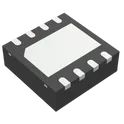
0 Uses1 StarsACPL-C87A
The Broadcom® ACPL-C87B/C87A/C870 voltage sensors are optical isolation amplifiers designed specifically for voltage sensing. Its 2V input range and high 1-GΩ input impedance, makes it well suited for isolated voltage sensing requirements in electronic power converters applications, including motor drives and renewable energy systems. In a typical voltage sensing implementation, a resistive voltage divider is used to scale the DC-link voltage to suit the input range of the voltage sensor. A differential output voltage that is proportional to the input voltage is created on the other side of the optical isolation barrier.
1 Uses1 Stars