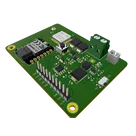
You want the STM32WLE5JC (LoRa‑E5) to be the only MCU, with SWD via Tag‑Connect, I2C/UART/one‑wire breakouts, solar+LiFePO4 power, and a 5 V output on a rectangular blue PCB.
Plan summary:
Remove unused parts: U6, J1, J3, J6, 12.5 V boost rail (IC1, L1, D4, related passives), RS‑485 (IC2, related), and mounting holes H1/H2.
Make U4 sole MCU; add Tag‑Connect TC2030 SWD pads (SWDIO, SWCLK, NRST, 3V3, GND; SWO optional); keep RF and J2.
Power: add Solar+/Solar− pads; replace U2 with a LiFePO4 charger for 5 V input and 14430 cell; add Batt+/Batt− pads; ensure 3.3 V rail for STM32; add a 5 V boost converter and 5V_OUT pads.
IO breakouts: add solder pads for I2C (SCL/SDA with pull‑ups), UART (TX/RX), and two GPIO for one‑wire (optional pull‑ups), plus nearby 3V3 and GND pads.
PCB/layout: remove headers/holes; place new pads; connect nets; set rectangular outline and blue mask note; run ERC/DRC and availability checks.
This plan is ready to execute. Click Start to begin.
Before I proceed, two quick details to finalize:
5 V rail: what maximum continuous and peak current should we design for?
One‑wire sensors: power at 3.3 V or 5 V? Do you want onboard 4.7 kΩ pull‑ups to that rail, or leave footprints unpopulated?
Breakout style: edge castellated pads or interior rectangular solder pads (no headers)? Any preferred pad pitch/size?
Your goal: single‑MCU STM32WLE5JC board with SWD, castellated IO, 5 V boost (30 mA cont/40 mA pk), and 5 V/60 mA solar + 14430 LiFePO4 power, on a rectangular blue PCB.
Plan:
Remove legacy circuits and holes; keep LoRa‑E5 RF path.
Redesign power: LiFePO4 charger (5 V solar), 3.3 V rail, 5 V boost, add Solar/Batt/5V pads.
Add 6‑pad SWD, verify reset/decoupling.
Add 2.54 mm castellated I2C (4.7 k pull‑ups, ≤ 400 pF), UART, two one‑wire with 3V3/5V/GND.
Rectangular outline, blue mask; route and review.
Click Start to execute, or let me know if you want tweaks.
The component U4 is using the part number 317990687, which refers to the Seeed Studio LoRa-E5 module. This module is based on the STM32WLE5JC, which is a chip that combines a microcontroller and a LoRa modem. Here's a brief overview of its main functions and purposes:
Microcontroller: The STM32WLE5JC part of the module includes a 32-bit ARM Cortex-M4 processor. This allows it to perform various processing tasks, handle data, and interface with other peripherals.
LoRa Connectivity: LoRa (Long Range) is a wireless communication technology designed for long-range, low-power communications. It's commonly used in IoT applications for sending small amounts of data over large distances.
I/O Capabilities: The module has multiple I/O pins, allowing it to interface with other components, sensors, or devices to collect data or send control signals.
Integrated RF Circuitry: The module includes RF components necessary for wireless communication, which simplifies the design process by reducing the need to design these circuits from scratch.
The U4 module in your design is primarily responsible for enabling communication with the cloud using LoRa, which is part of what makes your project suitable for IoT applications. Do you need further details on how to interface this module with other components in your design?
Wirelessly connects nets on schematic. Used to organize schematics and separate functional blocks. To wirelessly connect net portals, give them same designator. #portal
General Purpose Thick Film Standard Power
and High-Power Chip Resistor
47 kOhms ±5% 0.125W, 1/8W Chip Resistor 0805 (2012 Metric) Automotive AEC-Q200 Thick Film
Features:
- RMCF – standard power ratings
- RMCP – high power ratings
- Nickel barrier terminations standard
- Power derating from 100% at 70ºC to zero at +155ºC
- RoHS compliant, REACH compliant, and halogen free
- AEC-Q200 compliant
The "Green Dot 2040E5" Board is a Node that interfaces RS485 Sensor probes and can log information to the cloud using LoRa Connectivity. It uses the XIAO RP2040 and the LoRa-E5 (STM32WLE5JC) modules from Seeed Studio to do its magic. It also has amazing power management capabilities (Solar charging, Battery protection, etc) that make it very useful for IoT applications #internetOfThings#smartHomeDevices#SeeedStudio#XIAO#LoRa#RP2040#IoT
Properties
Properties describe core aspects of the project.
Pricing & Availability
Distributor
Qty 1
Arrow
$13.68–$36.95
Digi-Key
$13.01–$15.08
LCSC
$35.58–$36.70
Mouser
$16.26–$16.77
Verical
$5.02–$6.41
Controls
Welcome 👋
Flux helps you build PCBs faster with an AI teammate!
Create your account to collaborate, stay updated, fork your own version, and get instant answers from our AI agent.