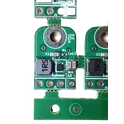
• ESP32 ROBOT CONTROLLER

    ESP32 ROBOT CONTROLLER

    Control board for autonomous or radio-controlled robots. It has inputs to connect distance sensors and encoders for autonomous mode. It can be radio controlled by the ESP32 bluetooth or by connecting a Flysky RC controller receiver to the IBUS port. It also has 3 push buttons and you can connect some kind of display by I2C to visualize and select configuration modes.

    jr98

    1 Comment

    77 Stars


  • PCB Business Card V2

    PCB Business Card V2

    Change History from V1: -13.56MHz tuning -larger instruction font -put some stuff on the back #template I wanted to create a business card that has some functionality and shows off a bit of my portfolio IRL: -NFC to my flux page -here's the [instructables](https://www.instructables.com/PCB-Business-Card-With-NFC-Make-Yours-With-NFC-QR-/) -Put a bunch of modules on it Find the BoM [here](https://www.digikey.com/short/2db2vnmp)

    markwuflux

    7 Comments

    37 Stars


  • The Green Dot 2040E5 Board

    The Green Dot 2040E5 Board

    The "Green Dot 2040E5" Board is a Node that interfaces RS485 Sensor probes and can log information to the cloud using LoRa Connectivity. It uses the XIAO RP2040 and the LoRa-E5 (STM32WLE5JC) modules from Seeed Studio to do its magic. It also has amazing power management capabilities (Solar charging, Battery protection, etc) that make it very useful for IoT applications #internetOfThings #smartHomeDevices #SeeedStudio #XIAO #LoRa #RP2040 #IoT

    seeedstudio

    &

    jharwinbarrozo
    collinsemasi
    janeyang
    +2

    339 Comments

    35 Stars


  • USB Security Token

    USB Security Token

    This design implements a USB security token powered by an STM32 microcontroller. The device is engineered for compactness and efficient PCB integration while ensuring robust security features. Key elements of the design include: - **Microcontroller Core:** A STM32F103T8U6 serves as the primary processing unit, handling USB communication and security protocols. - **USB Interface:** A USB-A plug provides connectivity to the host. Dedicated net portals ensure proper routing of the VBUS, D+, D–, and ground signals. - **Power Regulation:** A low-dropout regulator supplies a stable 3.3V operating voltage, ensuring low noise and proper current supply to the microcontroller and peripherals. - **Signal Conditioning and EMI Filtering:** An EMI filter is used to maintain signal integrity and reduce interference while preserving the security token’s functionality. - **Synchronous Elements:** A ceramic resonator is incorporated to provide a precise clock source for USB data transfer and microcontroller operations. - **Additional Components:** Surface-mount resistors, capacitors, and LED indicators are deployed to ensure proper conditioning, decoupling, and status feedback. Their compact 0402 packages facilitate a highly integrated design. - **Connectivity and Net Portals:** Custom net portals are used throughout the schematic to streamline connectivity and PCB layout, keeping the design modular and easy to modify. This USB security token is designed with industry-standard components and robust connectivity to ensure secure, reliable operation in portable security applications. #USBToken #STM32 #PCBDesign #SecurityTechnology #PortableSecurity #Microcontrollers #USBInterface #PowerRegulation #EMIProtection #CompactDesign

    jharwinbarrozo

    &

    yamilll

    253 Comments

    29 Stars


  • ArduinoMicro-MidiFreak

    ArduinoMicro-MidiFreak

    Arduino Micro - MIDI Controller It uses the Arduino Micro as USB midi controller. It has 1 capacitive touch octave (12 Keys), 2 rotary encoders, a button, and a proximity sensor that can be used as a mod wheel, sustain pedal or MPE. The oled screen displays the different configuration options. It can be set to any channel or C.C. so it can be used to modify other instruments behavior. The capacitive touch keys can also be used as 12 drum machine pads.

    ebarranco

    35 Comments

    21 Stars


  • USB-C to 4 USB-A Hub V1

    USB-C to 4 USB-A Hub V1

    Introducing my USB-C to 4 USB-A Hub V1, a compact and efficient solution for expanding your device's connectivity. Easily connect multiple USB-A peripherals to a single USB-C port. The USB-C and USB-A high speed differential pairs were done with the help of Flux Automated Impedance Control. #USBCHub #Connectivity #project

    vasy_skral

    31 Comments

    20 Stars


  • MIDI controller PCB

    MIDI controller PCB

    This device will be connected to computer through type-C and recognize as MIDI device. User can change two effects(A and B) from lists, effect speed(Tempo) and volume. #audioDevices

    vasy_skral

    &

    jharwinbarrozo

    84 Comments

    20 Stars


  • BMS

    BMS

    DIY BMS using ATTINY841-SSU this hardware has a higher balance current, fuse and TVS diode to help with voltage spikes. Most importantly, an external crystal to the micro controller (attiny841) which means the device is more reliable in low voltage situations

    adrian95

    &

    jharwinbarrozo
    sawigma

    157 Comments

    14 Stars


  • Photon-2-reference-design

    Photon-2-reference-design

    Use this template if you're planning to get your 1 to 2-layer board manufactured in JLCPCB. It has the via min/max and trace width constraints already baked as global rules. #project-template #template

    particle

    &

    nico
    vasy_skral

    14 Stars


  • PCB Business Card V2

    PCB Business Card V2

    Change History from V1: -13.56MHz tuning -larger instruction font -put some stuff on the back I wanted to create a business card that has some functionality and shows off a bit of my portfolio IRL: -NFC to my flux page -here's the awesome [instructables](https://www.instructables.com/PCB-Business-Card-With-NFC/) -Put a bunch of modules on it Find the BoM [here](https://www.digikey.com/short/2db2vnmp)

    nico

    3 Comments

    13 Stars


  • 16 channel relay module

    16 channel relay module

    16 channel relay that will allow you to control different types of electrical loads

    jharwinbarrozo

    211 Comments

    12 Stars


  • ESP32-S3 - PLC for Home and Small industry

    ESP32-S3 - PLC for Home and Small industry

    ESP32-S3-PLC For Home and Small Industry, include 8 12V SSR to control DC and AC Current, 8 isolated I/O and a ESP32 as a brain with a USB C to upload the code and the connectivity advantages of the ES32 like WIFI and Bluetooth.

    &

    9 Comments

    12 Stars


  • oscilador 555

    oscilador 555

    copilot Entiendo que deseas diseñar un oscilador utilizando el chip 555. Aquí están algunos pasos que puedes seguir para hacer esto. Conecta el pin 1 (GND) del IC 555 a la terminal negativa de tu fuente de alimentación (0V). Conecta el pin 8 (VCC) del IC 555 a la terminal positiva de tu fuente de alimentación (11V). Conecta la resistencia de 10kΩ (R1) entre el pin 8 (VCC) y el pin 7 (DISCHARGE) del 555. Conecta tu potenciómetro de 100kΩ (R2) entre el pin 7 (DISCHARGE) y el pin 6 (THRESHOLD) del 555. Junta los pines 2 (TRIGGER) y 6 (THRESHOLD) juntos y conecta los pines unidos al lado negativo de tu condensador de 10nF (C). Conecta el lado positivo del condensador de 10nF (C) a VCC (el pin 8). Conecta el pin 4 (RESET) al VCC si no quieres usar la función de reset. De lo contrario, puedes conectar una señal de reset aquí. Conecta el pin 3 (OUTPUT) del 555 al terminal positivo de tu resistencia de 470Ω. Conecta el otro terminal de la resistencia a tierra. El condensador de 10uF debe estar conectado en paralelo a la alimentación (entre VCC y GND) para suavizar cualquier ruido en la fuente de alimentación de 11V. Te sugiero que experimentes con el valor del potenciómetro (R2) hasta que consigas el Duty Cycle deseado. Por lo general, es posible cambiar la frecuencia del pulso y ajustar el Duty Cycle utilizando este control. Si, después de realizar estas conexiones y ajustes, aún no puedes obtener el Duty Cycle deseado, podría ser indicativo de que los valores de resistencia y condensador que tienes no son adecuados para tu rango de frecuencia y Duty Cycle objetivo. Para que obtengamos un Duty Cycle del 75%, necesitamos usar el chip 555 en modo astable y debemos calcular los valores de R1 y R2 (resistencia total de carga y descarga respectivamente) que nos ayude a conseguir esto. El tiempo de alta (T_high) y el tiempo de baja del ciclo (T_low) de la oscilación salen determinados por R1, R2, y C (el condensador). Se pueden usar las siguientes fórmulas para calcularlos: T_high = 0.693 * (R1 + R2) * C T_low = 0.693 * R2 * C Duty cycle = ( T_high ) / ( T_high + T_low ) Para un Duty Cycle de 0.75: Estableceremos R1 como la resistencia de 10 kilohmios que se proporcionó. Con el potenciómetro de 100 kilohmios como R2, podemos variarlo para ajustar el Duty Cycle según necesitemos hasta que se llegue a la relación deseada. Considerando que el condensador C es el condensador de 10 nF que se proporcionó, anteriores declaraciones son bajo supuesto que el tiempo de operación (T = T_high + T_low) caiga en un rango aceptable. Para el esquemático: Conecta VCC de tu 555 al terminal positivo de tu fuente de voltaje de 11V y GND a tierra. Conecta los pines 2 (TRIGGER) y 6 (THRESHOLD) juntos y al lado negativo de tu condensador de 10nF. Conecta el lado positivo del condensador a VCC. Conecta el pin 3 (OUTPUT) al terminal positivo de tu resistencia de 470 ohmios. Conecta el otro terminal de la resistencia a tierra. Conecta tu resistencia de 10 kilohmios entre VCC y los pines 2 y 6 del 555. Finalmente, conecta tu potenciómetro entre los pines 2 y 6 y el pin 7 (DISCHARGE) del 555. El condensador de 10uF debería estar conectado en paralelo a la alimentación para suavizar cualquier ruido en la alimentación de 11V. Estas son mis suposiciones y pasos sugeridos pero recuerda variar el potenciómetro hasta conseguir el Duty Cycle deseado en caso de no conseguirlo de forma inmediata. Si por alguna razón no puedes conseguir el Duty Cycle de 75%, es posible que las resistencias y condensadores proporcionados no sean los adecuados para el rango de frecuencia y Duty Cycle deseados. En tal caso, puede que tengas que utilizar otros valores de componentes.

    19 Comments

    11 Stars


  • Amplificador

    Amplificador

    Welcome to your new project. Imagine what you can build here.

    3 Comments

    11 Stars


  • sf-hackathon-2023-bee-hotel-R0.5

    sf-hackathon-2023-bee-hotel-R0.5

    Check out the winning project at the SF climate hardware hack! This project intends to bring smart IoT capabilities to homes for native bees so that more people can provide them housing and we can all participate in citizen science to gather more information about the bees! Requirements: -Daytime Operation Only -Track Bee Input/Output Directionality -Connects to House via WiFi Features: -MPPT Solar Power Conditioning -96% efficient IR LED Drive Next Version Feature Wants: Microphone!

    particle

    &

    nico

    1 Comment

    11 Stars


  • SmokeSensor_ShieldCompetition

    SmokeSensor_ShieldCompetition

    Arduino Uno shield used to monitor chimney smoke and provide feedback to stove. This shield powers the Arduino using TEGs and a battery. This shield provides power to an LED, fans, and a light sensor used to detect light intensity.

    11 Stars


  • Raspberry Pi Development Board

    Raspberry Pi Development Board

    Welcome to your new project. Imagine what you can build here.

    11 Stars


  • BLE Encoder

    BLE Encoder

    BLE remote control board. Based on SoC ESP32-C3-MINI-1 that allows you to program it as HID volume multichannel control, you can switch channels with the user button, or use it as arrow keys. #internetOfThings

    vasy_skral

    &

    jharwinbarrozo

    193 Comments

    10 Stars


  • Pet Tracker Device

    Pet Tracker Device

    This is a Pet Tracker Reference Design based on STM32L4. Tracker connects with network by SIM800L module connected to the STM. Also MCU connected to the GPS by uart and send data to server #STM32 #GPS #G4 #G3 #LTE #IoT #Tracker #smartHomeDevices #referenceDesign #edge-computing #edgeComputing #stm #template #referenceDesign

    &

    jharwinbarrozo

    63 Comments

    10 Stars


  • HADES

    HADES

    HADES Flight Control System. Complete flight control system designed from scratch. The flight control system is primarily designed for fixed-wing, autonomous drones to enable them to perform tasks autonomously, such as take-off, landing, waypoint navigation, payload delivery, etc.

    adrian95

    &

    jharwinbarrozo

    6 Comments

    10 Stars


  • ESP32 Drone

    ESP32 Drone

    ESP32 Tiny Drone by Jon VB I wanted to make a low cost drone with all the bells and whistles, so people working with a small budget can get into the drone game. #allThingsRobotics ~$50 https://hackaday.io/project/188578-esp32-drone #allThingsRobotics

    vasy_skral

    1 Comment

    10 Stars


  • AISLER 2 Layer 1.6mm ENIG DRC

    AISLER 2 Layer 1.6mm ENIG DRC

    Use this template if you're planning to get your 2-layer board manufactured with AISLER. #project-template #template #manufacturer-design-rules

    &

    jharwinbarrozo

    10 Stars


  • Aerospace Electronics | Copilot Preset

    Aerospace Electronics | Copilot Preset

    Use this Copilot's template to design satellite payloads, avionic systems, or space instruments, considering MIL-STD, radiation hardening, and extreme environmental constraints. Modify project requirement properties to adapt to specific needs. #template #project-template

    jharwinbarrozo

    319 Comments

    9 Stars


  • Mosfet board with driver

    Mosfet board with driver

    This is a IR2110 high side mosfet driver circuit with mosfet included. This is a circuit I use often and I believe it is time to give it its own board and project.

    adrian95

    &

    jharwinbarrozo

    129 Comments

    9 Stars


  • [2-layer] OSHPARK Constraints

    [2-layer] OSHPARK Constraints

    Use this template if you're planning to get your board manufactured in OSHPARK. It has the via min/max and trace width constraints already baked as global rules. #project-template #template #manufacturer-design-rules

    jharwinbarrozo

    37 Comments

    9 Stars


  • AISLER 4 Layer 1.6mm ENIG DRC

    AISLER 4 Layer 1.6mm ENIG DRC

    Use this template if you're planning to get your 4-layer board manufactured with AISLER. #project-template #template #manufacturer-design-rules

    &

    jharwinbarrozo

    9 Stars


  • Cycle Sentry: 24-GHz Radar For Bicyclist Detection

    Cycle Sentry: 24-GHz Radar For Bicyclist Detection

    A PCB for automotive testing, featuring a 24 GHz radar system with an MCU for processing I&Q values. It connects to a frequency analyzer and uses CW and FMCW modes to detect bicyclists in blind spots of parked cars.

    78 Comments

    8 Stars


  • AISLER 2 Layer 1.6mm HASL DRC

    AISLER 2 Layer 1.6mm HASL DRC

    Use this template if you're planning to get your 2-layer board manufactured with AISLER. #project-template #template #manufacturer-design-rules

    &

    jharwinbarrozo

    8 Stars


  • MEGABOARD FRONT

    MEGABOARD FRONT

    Welcome to your new project. Imagine what you can build here.

    &

    +2

    4 Comments

    7 Stars


  • Solar power for Raspberry Pi

    Solar power for Raspberry Pi

    To power the Raspberry Pi from solar panels or a lifepo4 battery, an efficient ultra-low power boost converter with battery management is used to generate power BQ25504RGTT

    7 Stars


  • [Example] Simulation of AC to DC Converter

    [Example] Simulation of AC to DC Converter

    A simulated circuit that demonstrates how diodes in a bridge configuration convert an AC voltage to DC voltage.

    jharwinbarrozo

    5 Comments

    6 Stars


  • Scale Snap 3D

    Scale Snap 3D

    3D Camera Module is a scalable SPI enabled 4 camera array pinout for 3D photogrammetry reconstruction which uses I2C to connect between each module to expand camera capacity while keeping capture sequences in sync. It uses ATMega32U4 with its built in USB 2.0 for data transfer and camera array adjustments and capture as well as a micro SD card slot for local image storage. An interrupt logic pinout should be used on the SPI master module as capture command. Each module is powered via USB-C (5V) or barrel jack (12V regulated to 5V).

    &

    collinsemasi

    96 Comments

    6 Stars


  • HC32L110B6YA-CSP16 breakout board

    HC32L110B6YA-CSP16 breakout board

    Discover the benefits of the HC32L110 microcontroller with our compact and versatile breakout board, designed to streamline development and testing for various applications. This user-friendly solution offers essential components like decoupling capacitors, a 32MHz crystal oscillator, and accessible power supply connections. The breakout board also features 0.1" pitch connectors, allowing for easy integration of I/O pins into any project. Unlock the full potential of the HC32L110B6YA-CSP16 microcontroller for rapid prototyping and smooth deployment with our ingeniously designed breakout board.

    vasy_skral

    &

    jharwinbarrozo

    53 Comments

    6 Stars


  • Analog Guitar Pedal V0

    Analog Guitar Pedal V0

    Schematic by Carson Cal Poly Senior Project This Flux Project only attempts to export a PCB. An external BoM can be found on Mouser with this access ID: 2b6f7daaed

    markwuflux

    42 Comments

    6 Stars


  • buffered-mult

    buffered-mult

    A simple 1-to-3 buffered mult - Eurorack-talk for an audio/CV distributor The board itself is a 3U 4hp rack-mountable module This circuit was designed by https://www.skullandcircuits.com/utilities-buffered-multiple/ and their T&Cs apply to commercial use (I built these for myself)

    &

    36 Comments

    6 Stars


  • silly roblox script vault part 1 idk

    silly roblox script vault part 1 idk

    Welcome to your new project. Imagine what you can build here.

    8 Comments

    6 Stars


  • 7 Seg 3-Bit Counter

    7 Seg 3-Bit Counter

    A 3-bit counter showcasing digital logic simulation. Input is a sequence of pulses which pass through a logic block to determine the segments.

    6 Stars


  • sf-hackathon-2023-bee-hotel-R0.5

    sf-hackathon-2023-bee-hotel-R0.5

    Check out the winning project at the SF climate hardware hack! This project intends to bring smart IoT capabilities to homes for native bees so that more people can provide them housing and we can all participate in citizen science to gather more information about the bees! Requirements: -Daytime Operation Only -Track Bee Input/Output Directionality -Connects to House via WiFi Features: -MPPT Solar Power Conditioning -96% efficient IR LED Drive Next Version Feature Wants: Microphone!

    markwuflux

    &

    jharwinbarrozo
    +2

    6 Stars


  • Environmental Data Logger Copilot V2 Example Project

    Environmental Data Logger Copilot V2 Example Project

    Overview: BME280 Sensor data -> uSD card Click on the bubble comments to see copilot design this project! Very impressed copilot routed all the SPI buses accurately for me. TODO: Just realized that there is no footprint for the SD Card holder, gotta add that Also, there needs to be a way to program the ATTINY841, Probably over UART?

    markwuflux

    6 Stars


  • ESP32 ROBOT CONTROLLER

    ESP32 ROBOT CONTROLLER

    Control board for autonomous or radio-controlled robots. It has inputs to connect distance sensors and encoders for autonomous mode. It can be radio controlled by the ESP32 bluetooth or by connecting a Flysky RC controller receiver to the IBUS port. It also has 3 push buttons and you can connect some kind of display by I2C to visualize and select configuration modes.

    &

    nico

    6 Stars


  • Pulse Width Modulation (PWM) Controller

    Pulse Width Modulation (PWM) Controller

    This project is a Pulse Width Modulation (PWM) Controller, built around an LM555 timer IC. It controls a load connected to a MOSFET, with adjustments via a potentiometer, and uses capacitors, resistors and diodes for various functions. #PWM #controller #project #Template #projectTemplate

    vasy_skral

    88 Comments

    5 Stars


  • Ouija Board

    Ouija Board

    First in the world hands-free Otherside communication device! You need only the board, spirit or ghost don't need to move the ouija anymore. Symbols will light up from the inside so you will be able to read your messages and spirit or ghost just need to turn on a red bottom entry LED. Two MEMS microphones allow your interlocutor to clearly hear your questions. WiFi connectivity gives you an opportunity to "dial" without a Medium anytime anywhere. And it has Bluetooth as well, because: "Everything is better with Bluetooth"! This board is powered by a single 10440(AAA) LiFePO4 battery that gives you up to 2 hours of seance. Designed by Vasyl Skral

    vasy_skral

    32 Comments

    5 Stars


  • 83 Keyboard

    83 Keyboard

    A 83 key keyboard, Norwegian QWERTY/DVORAK ISO style. It's of course possible to use other languages, as the MX cherry switches will accept keycaps with whatever language you need. It uses 83 1N4148 diodes and three LED's for caps lock,scroll lock, and QWERTY/DVORAK. It also needs pin headers that accepts the pins from a Teensy++2.0

    adrian95

    5 Comments

    5 Stars


  • [4-layer] OSHPARK Constraints

    [4-layer] OSHPARK Constraints

    Use this template if you're planning to get your board manufactured in OSHPARK. It has the via min/max and trace width constraints already baked as global rules. #project-template #template #manufacturer-design-rules OSHpark 4-layer stackup specs: Top overlay or silkscreen: 1 mil thick Top solder mask or solder resist: 1 mil thick Top copper: 1.7 mil thick on 1 oz copper Dielectric: 7.96 mil thick FR408HG 2113 Mid layer 1: 0.68 mil thick on 0.5 oz copper Dielectric core: 39 mil thick FR408HR Mid layer 2: 0.68 mil thick on 0.5 oz copper Dielectric: 7.96 mil thick FR408HG 2113 Bottom copper: 1.7 mil thick on 1 oz copper Bottom solder mask or solder resist: 1 mil thick
Bottom overlay or silkscreen: 1 mil thick

    jharwinbarrozo

    5 Comments

    5 Stars


  • Smart system for a greenhouse

    Smart system for a greenhouse

    This project is a 6-output irrigation control board with pump and other device support. It features 8 connectors, 2 GPIO pins each, and a GC9A01A display. The board is powered by an STM32L073V8T6 microcontroller and has 6 LEDs connected to GPIO pins. #irrigationcontrol #STM32 #GPIO #GC9A01A #LEDs.

    4 Comments

    5 Stars


  • Amplificador de audio solo con resistencias un transistor y capasitador

    Amplificador de audio solo con resistencias un transistor y capasitador

    Welcome to your new project. Imagine what you can build here.

    1 Comment

    5 Stars


  • Buck Boost 3.3V 500mA Physical Module

    Buck Boost 3.3V 500mA Physical Module

    A buck boost converter that can be powered from a Li-Ion battery and output 3.3V @ 500mA. Powered by the TPS63051YFFR and in the same package as a standard Adafruit buck converter. Expect to squeeze around 5-10% SoC from a typical Li-Ion battery. Input Voltage Range: 2.5V to 5.5V Assembled at pcbway.com

    markwuflux

    5 Stars


  • Grove Vision AI Module V2 schematics alpha v0.2

    Grove Vision AI Module V2 schematics alpha v0.2

    Here is the schematic of grove vision ai v2. with this you can edit and customize your vision sensor to incorporate with you own projects

    seeedstudio

    &

    5 Stars


  • Strangest LED Blinker TestSite

    Strangest LED Blinker TestSite

    Project Overview: This project is an enhanced LED blinking circuit that goes beyond a simple 555 timer-based design. It incorporates additional features such as random blinking patterns, speed control, and a start/stop function. The project utilizes a microcontroller, such as an Arduino or Raspberry Pi, to control the blinking patterns, speed, and start/stop functionality. LED Blinking: The board features a total of 8 LEDs that blink in various random patterns. When the board is powered on, even before user interaction, the LEDs start blinking randomly, creating an eye-catching display. Each LED has its own current-limiting resistor to ensure proper current flow and prevent damage. The microcontroller is programmed to generate random blinking patterns for the LEDs, ensuring that the LEDs do not blink in a predictable or sequential order. This random blinking adds an element of unpredictability and visual interest to the project. Speed Control: The board includes two speed control buttons that allow the user to adjust the blinking speed of the LEDs. Button 1 is designated as the "fast" button, increasing the blinking speed when pressed, while Button 2 is designated as the "slow" button, decreasing the blinking speed when pressed. The speed control provides a range of blinking speeds, from a slow, gradual blink to a rapid, strobe-like effect. The microcontroller monitors the state of the speed control buttons and adjusts the blinking speed accordingly. Start/Stop Functionality: A third button serves as a start/stop control. When pressed, it toggles the blinking of the LEDs on or off. This allows the user to freeze the blinking pattern at any desired moment or resume the blinking when desired. The microcontroller handles the start/stop functionality by turning the LEDs on or off based on the state of the start/stop button. Manual Speed Adjustment: In addition to the speed control buttons, the board includes a potentiometer or variable resistor. This component allows the user to manually adjust the blinking speed of the LEDs by turning the knob or sliding the control. The manual speed adjustment provides more precise and customizable control over the blinking speed compared to the preset speeds of the buttons. The microcontroller reads the analog value from the potentiometer and adjusts the blinking speed accordingly. Power and Connectivity: The board is powered through a USB-C or USB-micro B connector, allowing it to be easily connected to a power source such as a computer or wall adapter. A voltage regulator may be included to ensure a stable and appropriate voltage supply to the components. A power switch is incorporated to conveniently turn the board on or off.

    224 Comments

    4 Stars


  • ButterFlyback AC/DC Converter

    ButterFlyback AC/DC Converter

    110V-130V to 15V @ 3A AC/DC Flyback Converter.

    &

    markwuflux

    177 Comments

    4 Stars