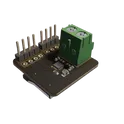
MAX98357 Audio DAC Breakout 077b
This compact breakout board makes it easy to add high-quality audio output to your microcontroller projects using the MAX98357A/B Class D audio amplifier. Perfect for Arduino, ESP32, Raspberry Pi, or any microcontroller with I2S output capabilities. Features High-Performance Audio: Delivers Class AB audio quality with Class D efficiency (92% efficient at 1W) Powerful Output: 3.2W into 4Ω speakers at 5V supply Clean Sound: Low distortion (0.013% THD+N at 1kHz) Wide Supply Range: Operates from 2.5V to 5.5V Simplified I2S Interface: No MCLK required, just BCLK, LRCLK, and DIN Selectable Gain: Solder jumpers for easy gain selection (3dB, 6dB, 9dB, 12dB, or 15dB) Channel Selection: Configure for left, right, or combined (mono) output Filterless Design: No need for external output filtering components Compact Form Factor: Minimal board space with optimized layout Applications Smart speakers and voice assistants Portable audio devices IoT audio projects Gaming devices and sound effects Educational audio projects Digital instrument amplification The FLUX MAX98357 breakout board requires only three I/O pins plus power, making it the perfect audio solution for projects where simplicity and sound quality matter.... show more0 Uses
0 Comments
2 Stars

USB Measurement Audio Interface
High-end 2-channel USB Audio Class 2.0 measurement interface for Smaart/REW use, with XMOS digital audio, isolated converter domain, smart encoder/LED UI, precision mic input, DAC line output, loopback ADC, phantom power, and protected USB-C power input.... show more0 Uses
0 Comments
1 Star
Zoophagous Beige Matter Compiler
- ESP32 DevKitC V4 (microcontroller) - 2x BME280 sensors (temperature, humidity, pressure) - 8ch relay board with 12VDC relays (NO/NC SPDT) - 12VDC power supply - USB connectivity - Various components (resistors, caps, opto couplers, op-amps, motor drivers, multiplexers) - 2x SPDT relay boards (for fan fail-safe) - 4x 2ch bidirectional level controllers (3.3V to 5V) - ESP32 GPIO 21 (SCL) to BME280's SCL - ESP32 GPIO 22 (SDA) to BME280's SDA - ESP32 GPIO 5 (digital output) to 8ch relay board input - ESP32 GPIO 25 (PWM output) -> Fan PWM (0-255 value) - ESP32 GPIO 26 (PWM output) -> Light PWM (0-255 value) - ESP32 GPIO 34 (analog input) -> Tachometer input (0-4095 value, 12-bit ADC) - Add a 5V voltage regulator (e.g., 78L05) to power the ESP32 and other 5V components - Add a 3.3V voltage regulator (e.g., 78L03) to power the BME280 sensors and other 3.3V components - Include decoupling capacitors (e.g., 10uF and 100nF) to filter the power supply lines - Ensure proper grounding and shielding to minimize noise and interference -- Power supply: - VCC=12VD Available, to be used for LM358P - 5V voltage regulator (78L05) - VCC=5V, GND=0V - 3.3V voltage regulator (78L03) - VCC=3.3V, GND=0V - 3.3V voltage regulator (78L03) - VCC=3.3V, GND=0V - Fan PWM boost: - Input (3.3V PWM): 0-3.3V, frequency=20kHz - Output (5V PWM): 0-5V, frequency=20kHz - LM358P op-amp (unity gain buffer) - VCC=5V, GND=0V - R1=1kΩ, R2=1kΩ, R3=1kΩ, R4=1kΩ - C1=10uF (50V), D1=1N4007 - 0-10V signal conditioning: - Input (3.3V PWM): 0-3.3V, frequency=13kHz - Output (0-10V): 0-10V, frequency=13kHz - LM358P op-amp (non-inverting amplifier) - VCC=5V, GND=0V - R5=2kΩ, R6=1kΩ, R7=2kΩ, R8=1kΩ, R9=1kΩ, R10=2kΩ - C2=10uF (50V), R11=10kΩ (1%) ------------------------------------ Fan PWM Boost (3.3V to 5V): 1. ESP32 GPIO 25 (PWM output) -> R1 (1kΩ) -> VCC (3.3V) 2. ESP32 GPIO 25 (PWM output) -> R2 (1kΩ) -> Vin (LM358P) 3. LM358P (Voltage Follower): - VCC (5... show more0 Uses
0 Comments
0 Stars
Skinny Sapphire Sonic Screwdriver
Here’s a detailed project description prompt that you can use to generate the circuit: --- ### Project Description for Circuit Generation **Project Title**: Vehicle-to-Vehicle (V2V) Communication System for Preventing Dangerous Overtaking Maneuvers **Objective**: The prime objective of this project is to develop and implement a Vehicle-to-Vehicle (V2V) communication system that enhances road safety by preventing dangerous overtaking maneuvers. This system will provide real-time alerts to drivers about the presence and intentions of nearby vehicles, reducing the risk of collisions and improving overall traffic flow on highways. **Components**: 1. **Microcontroller (e.g., Arduino)** 2. **GPS Module (NEO-6M)** 3. **LoRa Module (SX1272)** 4. **Audio/Visual Alert Systems (e.g., Buzzer, LEDs)** 5. **SD Card Module** 6. **LM7805 Voltage Regulator** 7. **9V Battery** **Connections**: 1. **Power Supply**: - **9V Battery**: - Positive to **LM7805 Voltage Regulator Input** - Negative to **Common Ground** - **LM7805 Voltage Regulator**: - Output to **5V Rail (VCC)** - Ground to **Common Ground** 2. **Microcontroller (e.g., Arduino)**: - **Power**: - VCC to **5V Rail (VCC)** - GND to **Common Ground** 3. **GPS Module (NEO-6M)**: - **Power**: - VCC to **5V Rail (VCC)** - GND to **Common Ground** - **Communication**: - TX to **RX (Digital Pin) of Microcontroller** - RX to **TX (Digital Pin) of Microcontroller** (if needed) 4. **LoRa Module (SX1272)**: - **Power**: - VCC to **3.3V or 5V (based on module specification)** - GND to **Common Ground** - **SPI Communication**: - MOSI to **MOSI (Digital Pin) of Microcontroller** - MISO to **MISO (Digital Pin) of Microcontroller** - SCK to **SCK (Digital Pin) of Microcontroller** - NSS to **CS (Digital Pin) of Microcontroller** 5. **Audio/Visual Alert System (Buzzer, LEDs)**: - **Buzzer**: - Positive to **Digital Output Pin** of Microcontroller through a resistor - Negative to **Common Ground** - **LEDs**: - Anode (Positive) to **Digital Output Pin** of Microcontroller through a resistor - Cathode (Negative) to **Common Ground** 6. **SD Card Module**: - **Power**: - VCC to **3.3V or 5V (based on module specification)** - GND to **Common Ground** - **SPI Communication**: - MOSI to **MOSI (Digital Pin) of Microcontroller** - MISO to **MISO (Digital Pin) of Microcontroller** - SCK to **SCK (Digital Pin) of Microcontroller** - CS to **Digital Pin of Microcontroller** **System Functionality**: - **System Initialization and Configuration**: Ensure the microcontroller and communication modules are correctly initialized and configured for optimal performance. - **GPS Signal Acquisition and Data Parsing**: Accurately acquire and parse GPS data to determine the vehicle's current location and speed. - **Vehicle Position and Speed Calculation**: Calculate precise vehicle position and speed in real-time to provide accurate data for communication. - **V2V Communication Establishment**: Establish a reliable communication link between vehicles using the LoRa module to transmit and receive data. - **Overtaking Intention Detection and Signal Transmission**: Detect overtaking intentions and transmit this information to nearby vehicles to alert them of potential hazards. - **Signal Reception and Processing by Nearby Vehicles**: Ensure nearby vehicles can receive and process overtaking signals to determine the position and speed of the overtaking vehicle. - **Driver Alert Generation**: Generate audio and visual alerts to inform drivers of the presence and intentions of nearby vehicles, especially during overtaking. - **Continuous Monitoring and Data Logging**: Continuously monitor the system's performance and log relevant data for analysis and future improvements.... show more0 Uses
0 Comments
0 Stars
Only Ivory Transporter
Digital Logic Circuit with Enhanced LED Output Requirements This project is designed to deliver advanced digital logic functionality incorporating precise circuit requirements tailored for LED output. It outlines a detailed digital logic function where specific logical conditions trigger LED activation, ensuring optimal brightness and reliability. The circuit is engineered with strict voltage regulation and current limiting mechanisms to safeguard the LED and maintain consistent performance. Emphasizing modularity and scalability, this design meets industry-standard digital protocols and electronic reliability benchmarks, streamlining development while delivering robust and efficient LED interfacing. #DigitalLogic #LEDOutput #CircuitDesign #ElectronicEngineering #ElectronicsDesign... show more0 Uses
0 Comments
0 Stars

NOR Gate p49g
A digital logic gate that gives an output of 0 when any of its inputs are 1, otherwise 1.... show more0 Uses
1 Comment
0 Stars

Audio Amplifier PCB
This project aims to build an Audio Amplifier using the TDA2822 IC. The TDA2822 is a commonly used dual-channel audio amplifier that can deliver high power output. The amplifier will be designed to drive two speakers with volume control and the audio input can be directly provided through an audio jack. This project is inspired by my class Analogue and Digital electronics.... show more0 Uses
6 Comments
0 Stars
FJ Cruiser Compass
Dashboard-mounted automotive digital compass with protected 12V power input, regulated logic supply, 3-axis magnetometer sensing, MCU control, seven-segment display output, calibration controls, and mounting provisions for Toyota FJ Cruiser installation.... show more0 Uses
0 Comments
0 Stars
Secret Crimson Hoverboard
Circuit Overview The circuit you're describing is a digital counter that uses an LDR (Light-Dependent Resistor) and a transistor to detect wheel rotations. The counter's output is then displayed on a seven-segment LED display. Here's a breakdown of the components and their roles: 1. Wheel Rotation Detection (LDR and Transistor) * LDR: The LDR acts as a sensor to detect changes in light intensity. You can mount it on the wheel' or near it, with a reflective or non-reflective surface attached to the wheel. As the wheel rotates, the LDR will be exposed to alternating light and dark conditions, causing its resistance to change. * Transistor: The transistor (e.g., a 2N2222 NPN BJT) is used as a switch or amplifier. The changing resistance of the LDR is used to control the base current of the transistor. When the LDR's resistance drops (more light), the transistor turns on, and when the resistance increases (less light), the transistor turns off. This converts the analog change in light into a digital ON/OFF signal (a pulse). 2. Counter (7490) * 7490 IC: This is a decade counter, meaning it can count from 0 to 9. The output of the transistor (the pulses) is fed into the clock input of the 7490. Each pulse represents one rotation of the wheel, and the 7490 increments its count accordingly. The 7490 has four outputs (Q0, Q1, Q2, Q3) that represent the BCD (Binary-Coded Decimal) equivalent of the count. 3. BCD to Seven-Segment Decoder (7446) * 7446 IC: The 7446 is a BCD-to-seven-segment decoder/driver. Its job is to take the 4-bit BCD output from the 7490 and convert it into a signal that can drive a seven-segment LED display. It has seven outputs (a, b, c, d, e, f, g), each corresponding to a segment of the LED display. 4. Seven-Segment LED Display * Seven-Segment Display: This display is used to show the count. The 7446's outputs are connected to the corresponding segments of the display. 5. Power Supply and Other Components * Power Supply: A regulated DC power supply (e.g., 5V) is needed to power all the ICs and components. * Resistors: Resistors are used for current limiting (e.g., for the LDR and the LED display) and biasing the transistor. * Capacitors: A capacitor might be used for debouncing the signal from the transistor to prevent multiple counts for a single rotation. Conceptual Connections Here is a step-by-step breakdown of how the components would be connected: * LDR and Transistor: * The LDR and a current-limiting resistor are connected in series across the power supply. * The junction between the LDR and the resistor is connected to the base of the NPN transistor. * The emitter of the transistor is connected to ground. * The collector of the transistor, with a pull-up resistor, becomes the output for the pulse signal. * Transistor to 7490: * The output from the transistor's collector is connected to the clock input of the 7490 IC. * The 7490's reset pins (MR and MS) should be connected to ground for normal counting operation. * 7490 to 7446: * The BCD outputs of the 7490 (Q0, Q1, Q2, Q3) are connected to the BCD inputs of the 7446 (A, B, C, D). * 7446 to Seven-Segment Display: * The outputs of the 7446 (a, b, c, d, e, f, g) are connected to the corresponding segments of the seven-segment display. * Crucially, you need to use current-limiting resistors (e.g., 330Ω) in series with each segment to protect the LEDs from high current. * The common terminal of the seven-segment display is connected to the power supply (for a common anode display) or ground (for a common cathode display). This setup creates a chain reaction: wheel rotation changes light, which changes LDR resistance, which turns the transistor on/off, generating a pulse. This pulse increments the 7490, and the 7490's output is decoded by the 7446, which then displays the count on the seven-segment LED.... show more0 Uses
0 Comments
0 Stars
Decisive White Flux Capacitor
This project involves designing a complete schematic for a robotic arm controller based on the ESP32-C3 microcontroller, specifically using the ESP32-C3-MINI-1-N4 module. The design features a dual power input system and comprehensive power management, motor control, I/O interfaces, and status indicators—all implemented on a 2-layer PCB. Key Specifications: Microcontroller: • ESP32-C3-MINI-1-N4 module operating at 3.3V. • Integrated USB programming connections with reset and boot mode buttons. Power System: • Dual power inputs with automatic source selection: USB-C port (5V input) and barrel jack (6-12V input). • Power management using LM74610 smart diode controllers for power source OR-ing. • AMS1117-3.3 voltage regulator to deliver a stable 3.3V supply to the microcontroller. • Filter capacitors (10μF electrolytic and 100nF ceramic) at the input and output of the regulators. • Protection features including USBLC6-2SC6 for USB ESD protection and TVS diodes for barrel jack overvoltage protection. Motor Control: • Incorporates an Omron G5LE relay with a PC817 optocoupler and BC547 transistor driver. • Provides dedicated header pins for servo motors with PWM outputs. • Flyback diode protection implemented for relay safety. I/O Connections: • Header pins exposing ESP32-C3 GPIOs: Digital I/O (IO0-IO10, IO18, IO19) and serial communication lines (TXD0, RXD0), plus an enable pin. • Each I/O pin includes appropriate 10kΩ pull-up/pull-down resistors to ensure reliable performance. Status Indicators: • A power status LED with a current-limiting resistor. • A user-controllable LED connected to one of the GPIO pins. PCB Layout Requirements: • 2-layer PCB design with separate ground planes for digital and power sections. • Placement of decoupling capacitors close to power pins to reduce noise. • Adequate trace width for power lines to ensure efficient current flow. • Inclusion of mounting holes at the board corners for secure installation. • All components are properly labeled with correct values for resistors, capacitors, and other passive elements, following standard design practices for noise reduction, stability, and reliability. #RoboticArmController #ESP32C3 #SchematicDesign #PCBDesign #ElectronicsDesign #PowerManagement #MotorControl #EmbeddedSystems #IoT... show more0 Uses
0 Comments
0 Stars
Raspberry Pi Pico Shield Template
Using the Raspberry Pi Pico microcontroller, I was able to design a hearing aid with volume control. The components and a description of why they were used: MCP3008 - CONVERTS ANALOG AUDIO SIGNALS INTO DIGITAL DATA CONVERTED BY THE MICROCONTROLLER MCP4725 - CONVERTS DIGITAL AUDIO SIGNALS TO ANALOG SO THE AUDIO CAN BE OUTPUTTED THROUGH A SPEAKER LM358 - USED TO AMPLIFY WEAK SIGNALS IN THE HEARING AID, REMOVES UNWANTED FREQUENCIES SPU0410LR5HQB - THIS COMPONENT IS A MICROPHONE, SPECIFICALLY CHOSEN BECAUSE IT IS OMNIDIRECTIONAL AND CAN CAPTURE AMBIENT SOUNDS, IT IS A SMALL COMPONENT PERFECTLY USED FOR NOISE REDUCTION, ASSISTING IN CAPTURING CLEAR AUDIO PAM8302AASCR - EFFICIENTLY AMPLIFIES AUDIO, AUDIO SIGNAL FROM DAC (VOUT) IS FED INTO THE INPUT OF THE AUDIO AMPLIFIER, WHICH OUTPUTS IDEAL FREQUENCY AUDIO CEM-1203(42) - SPEAKER WHICH OUTPUTS THE AUDIO AMPLIFIER MODIFIED FEATURE: POTENTIOMETER - WITH THE CCW CONNECTED TO GND, CW CONNECTED TO VDD, WIPER CONNECTED TO PIN 27 OF THE MICROCONTROLLER, THIS FEATURE IS A VOLUME ADJUSTER, WE ARE ABLE TO FULLY TURN OFF AND ON THE VOLUME BY ADJUSTING THE HEARING AID FOR THE IDEAL AUDIO OUTPUT... show more0 Uses
0 Comments
0 Stars