• Res_0603-Template 38SQ

    Res_0603-Template 38SQ

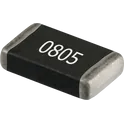
    Chip Resistor 0603 (1608 Metric) Moisture Resistant Thick Film

    1 Star


  • BLM02AX121SN1_CLONE

    BLM02AX121SN1_CLONE

    The BLM02AX121SN1# is a chip ferrite bead manufactured by Murata, designed to function as a resistor at noise frequencies, thereby minimizing resonance and maintaining signal integrity. This surface-mount device (SMD) features a compact size of 0.4mm x 0.2mm, making it ideal for noise suppression in small electronic equipment, such as PA modules for cellular phones. The component operates effectively across a wide frequency range (30MHz to several hundred MHz) without requiring a ground connection, making it suitable for circuits without stable ground lines. The BLM02AX121SN1# offers a rated current of 250mA at 125°C, a maximum DC resistance of 0.50Ω, and an impedance of 1200Ω at 100MHz with a tolerance of ±25%. It is available in two packaging options: bulk (bag) with a standard packing quantity of 1000 units and 180mm paper tape with 20000 units. The device is compliant with RoHS and REACH standards, ensuring its suitability for consumer and certain medical and industrial applications.

    1 Comment

    1 Star


  • Realistic Brown Battle Mech

    Realistic Brown Battle Mech

    Nice — you can do a clean pulse + latch using a single quad Schmitt-NAND chip: 74HC132 (or 74LVC132 for 3.3 V systems). The HC132 contains four 2-input NAND gates with Schmitt inputs so you can both clean a noisy SYN480R DATA line and build an SR latch (NAND SR is active-LOW) inside one package. Only a few passives and a driver transistor are needed. Below is a ready-to-build recipe (parts, wiring, explanation, tuning tips, and an ASCII schematic) — no extra logic ICs required. Parts (per latch) 1 × 74HC132 (quad 2-input NAND with Schmitt inputs). If your system is 3.3 V use 74LVC132 / 74HC132 rated for 3.3 V. Rin = 47 kΩ (input series) Cfilter = 10 nF (input RC to ground) — tweak for debounce/clean time Rpulldown = 100 kΩ (pull-down at input node, optional) Rpullup = 100 kΩ (pull-up for active-LOW R input so reset is idle HIGH) Rbase = 10 kΩ, Q = 2N2222 (NPN) or small N-MOSFET (2N7002) to drive your load Diode for relay flyback (1N4001) if you drive a coil Optional small cap 0.1 µF decoupling at VCC of IC Concept / how it works (short) Use Gate1 (G1) of 74HC132 as a Schmitt inverter by tying its two inputs together and feeding a small RC filter from SYN480R.DATA. This removes HF noise and provides a clean logic transition. Because it's a NAND with tied inputs its function becomes an inverter with Schmitt behavior. Use G2 & G3 as the cross-coupled NAND pair forming an SR latch (active-LOW inputs S̄ and R̄). A low on S̄ sets Q = HIGH. A low on R̄ resets Q = LOW. Wire the cleaned/inverted output of G1 to S̄. A valid received pulse (DATA high) produces a clean LOW on S̄ (because G1 inverts), setting the latch reliably even if the pulse is brief. R̄ is your reset input (pushbutton, HT12D VT, MCU line, etc.) — idle pulled HIGH. Q drives an NPN/MOSFET to switch your load (relay, LED, etc.). Recommended wiring (pin mapping, assume one chip; use datasheet pin numbers) I’ll refer to the 4 gates as G1, G2, G3, G4. Use G4 optionally for additional conditioning or to build a toggler later. SYN480R.DATA --- Rin (47k) ---+--- Node A ---||--- Cfilter (10nF) --- GND | Rpulldown (100k) --- GND (optional, keeps node low) Node A -> both inputs of G1 (tie inputs A and B of Gate1 together) G1 output -> S̄ (S_bar) (input1 of Gate2) Gate2 (G2): inputs = S̄ and Q̄ -> output = Q Gate3 (G3): inputs = R̄ and Q -> output = Q̄ R̄ --- Rpullup (100k) --- VCC (reset is idle HIGH; pull low to reset) (optional) R̄ can be wired to a reset pushbutton to GND or to an MCU pin Q -> Rbase (10k) -> base of 2N2222 (emitter GND; collector to one side of relay coil) Other side of relay coil -> +V (appropriate coil voltage) Diode across coil If you prefer MOSFET low side switching: Q -> gate resistor 100Ω -> gate of 2N7002 2N7002 source -> GND ; drain -> relay coil low side

    1 Star


  • NPN-TRANS-002

    NPN-TRANS-002

    The Ariel AI Chip, a state-of-the-art integrated circuit designed for high-performance computing applications, incorporates an innovative architecture that leverages radical transistor technology to optimize AI and machine learning tasks. At the heart of this chip lies a quad-core CPU operating at a clock speed of 2GHz, distinguished by its part number CPU-RT-4C-2G. The chip's power management is efficiently handled by a DC power supply, specified as DCPS-5V, ensuring a stable 5V input. Key to its operation are two NPN transistors, identified by part numbers NPN-TRANS-001 and NPN-TRANS-002, which, along with a pair of 1kΩ resistors (RES-1K and RES-1K-002) and a 10µF capacitor (CAP-10UF), form the critical signal processing and conditioning circuitry. This assembly is designed for seamless integration into advanced computing systems, particularly those focused on Flux AI environments, where its performance and efficiency can be fully leveraged. The Ariel AI Chip sets a new benchmark in AI computing, offering unparalleled processing power and efficiency for cutting-edge applications.

    16 Comments

    1 Star


  • RES-1K

    RES-1K

    The Ariel AI Chip, a pioneering component in the realm of artificial intelligence hardware, integrates a suite of electronic elements tailored for high-performance computing applications. At the heart of this assembly lies a CPU with a Radical Transistor architecture, featuring a quad-core setup clocked at 2GHz, identified by the part number CPU-RT-4C-2G. Power management is facilitated through a DC Power Supply, marked DCPS-5V, ensuring a stable 5V supply to the intricate circuitry. The chip's switching capabilities are bolstered by two NPN transistors, NPN-TRANS-001 and NPN-TRANS-002, which play a crucial role in signal modulation. Essential to the chip's operation are the passive components: two 1kΩ resistors (RES-1K and RES-1K-002) and a 10µF capacitor (CAP-10UF), which together with the transistors, form a robust network ensuring reliable performance under varying load conditions. Designed for integration into advanced AI systems, this chip stands out for its innovative use of standard components in a configuration that emphasizes efficiency, reliability, and high-speed data processing capabilities.

    1 Comment

    1 Star


  • DCPS-5V

    DCPS-5V

    The Ariel AI chip prototype, designed for integration with Flux AI for advanced simulation and testing, incorporates a suite of electronic components optimized for high-performance computing applications. At the heart of this system lies a CPU with a radical transistor architecture, featuring a 4-core configuration and a clock speed of 2GHz, identified by part number CPU-RT-4C-2G. Power management is facilitated through a DC Power Supply, specified as DCPS-5V, ensuring a stable 5V supply to the system. The circuit's dynamic performance is modulated by two NPN transistors, NPN-TRANS-001 and NPN-TRANS-002, which, along with precision resistors RES-1K and RES-1K-002 (both 1kΩ), and a 10μF capacitor (CAP-10UF), form the critical signal processing path leading to the CPU. This configuration is designed to provide an efficient, reliable processing environment for AI computations, with an emphasis on minimizing latency and maximizing throughput. The Ariel AI chip's architecture, combining traditional components with an innovative CPU design, offers a versatile platform for developing advanced AI applications, reflecting a significant step forward in computational technology.

    1 Comment

    1 Star


  • MAX1551 Reference Design

    MAX1551 Reference Design

    This project is a battery charging circuit utilizing a MAX1551 chip. It features a USB and DC power input, with LED status indicators. The design is outfitted with necessary decoupling capacitors and resistors to ensure smooth operation. #project #Template #charger #referenceDesign #batterycharger #MAX1551 #template #bms #analog

    1 Comment

    1 Star


  • RES-1K-002

    RES-1K-002

    The Ariel AI Chip, a pioneering component in the field of artificial intelligence hardware, integrates advanced features designed to enhance computational efficiency and AI processing capabilities. This chip is distinguished by its utilization of a quad-core CPU with a clock speed of 2GHz, operating on a radical transistor architecture that promises significant improvements in speed and power efficiency. Key components that constitute the Ariel AI Chip include a DC power supply with a 5V output (DCPS-5V), NPN transistors (NPN-TRANS-001 and NPN-TRANS-002) that serve as the fundamental switching elements, precision resistors (RES-1K and RES-1K-002) each with a resistance of 1kΩ, and a capacitor (CAP-10UF) rated at 10μF to stabilize voltage and filter noise. This chip is designed for integration into systems requiring advanced AI capabilities, offering a comprehensive solution for developers looking to leverage machine learning and artificial intelligence in their applications. With its innovative architecture and component selection, the Ariel AI Chip stands out as a versatile and powerful tool for a wide range of AI applications, from embedded systems to more complex computational platforms.

    1 Comment

    1 Star