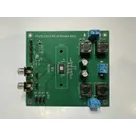
TPA3116D2 Amplifier Design
Worked for 1 min 39 sec
Project overview
This is a high-power Class-D audio amplifier board built around the Texas Instruments TPA3116D2DAD. Its purpose is to take left/right analog audio inputs and drive speakers as either:
- Stereo amplifier: up to roughly 50 W/channel class operation, depending on supply, load, thermal conditions, and distortion target.
- Mono PBTL-style configuration: intended for higher single-channel power by paralleling bridge outputs, per the project description.
- Inputs come through two CUI RCJ-017 RCA-style jacks:
L INPUTandR INPUT. - The signals are AC-coupled through capacitors such as
C3–C6into the TPA3116D2 differential input pins:LINP/LINNRINP/RINN
- Jumpers
JP1andJP2appear to support mono-input shorting/configuration.
U1is the TPA3116D2DAD, a Class-D bridge-tied-load audio power amplifier.- It handles:
- analog input amplification,
- PWM/Class-D switching,
- bridge output drive,
- fault/shutdown/mute behavior,
- gain/mode configuration,
- power limiting.
- Power enters through terminal connector
J1on nets:PVCCGND
- Bulk capacitors
C10andC12are 220 µF electrolytics on PVCC. - Smaller bypass capacitors such as
C7,C8,C9,C11, andC1provide local high-frequency decoupling for PVCC/GVDD. - This is critical because Class-D outputs draw pulsed current at high edge rates.
- Four 10 µH Bourns SRR1280 inductors form the output LC filters:
L1,L2for left channelL3,L4for right channel
- Speaker outputs go to:
LEFTRIGHT- plus terminal symbols
LOUT+,LOUT-,ROUT+,ROUT-
- Output capacitors
C21–C24are 0.68 µF, forming LC low-pass filters with the inductors. - RC/snubber/Zobel-style networks using resistors such as
R5–R12and capacitors such asC14,C16,C18,C20,C25–C28help damp switching edges and improve EMI/load stability.
- Jumpers
AM0,AM1,AM2configure AM-avoidance / switching-frequency behavior. JP3–JP6,RV1, and related resistors configure:- shutdown
SD, - mute
MUTE, - mode select
MODESEL, - fault handling
FAULT, - power limit
PLIMIT, - gain/slave behavior
GAIN/SLV.
- shutdown
RV1is a Bourns trimmer tied intoPLIMIT, allowing adjustable power limiting.
- The board includes a large heatsink component
HEATSINK, mechanically aligned aroundU1. - Four mounting holes
H1–H4are present. - Layout is a 100 mm × 90 mm, 4-layer board, with all components on the top side.
- Class-D topology: high efficiency and high output power in a compact board, but requires careful EMI, output filtering, and layout.
- TPA3116D2: good integration and common DIY/audio use; trade-off is that performance depends strongly on PCB layout, supply quality, heatsinking, and output filter design.
- External LC filters: improves EMI and speaker compatibility, but adds size, cost, and inductor saturation/current-rating concerns.
- Configurable jumpers: flexible for experimentation, mono/stereo modes, shutdown, AM avoidance, and gain/mode behavior; trade-off is user setup complexity.
- Large heatsink: helps real-world power delivery; trade-off is board height/volume and mechanical assembly effort.
- 4-layer PCB: improves power/ground integrity and routing, but costs more than 2-layer.
- Thermal performance: 50 W stereo or 100 W mono operation requires strong heat dissipation and realistic power/load expectations.
- Inductor current/saturation: the 10 µH output inductors must tolerate speaker current without saturating.
- EMI: Class-D switching edges can radiate through output traces, speaker cables, and poor grounding.
- PVCC supply quality: supply droop or noise can cause distortion, shutdown, pops/clicks, or instability.
- Layout sensitivity: high-current switching loops, bootstrap caps, decoupling caps, and output filters need tight placement.
- Configuration errors: jumpers for mono/stereo, AM avoidance, shutdown, mute, and PLIMIT must be documented clearly for users.
The project has ERC floating-pin errors on:
- mounting holes
H1–H4 - heatsink pins
HEATSINK:S1,HEATSINK:S2
These are likely mechanical/thermal parts rather than functional signal errors, but they should be intentionally tied to chassis/GND or marked no-connect as appropriate.
Real-world applications
- DIY stereo amplifier
- powered bookshelf speaker module
- subwoofer/mono amplifier
- portable speaker amplifier with external DC supply
- educational Class-D amplifier reference design
- embedded audio output stage for kiosks, arcade cabinets, or instruments
- Add clear silkscreen labels for jumper modes, speaker polarity, PVCC voltage range, and mono/stereo setup.
- Verify TPA3116D2 datasheet-recommended layout around PVCC decoupling, bootstrap capacitors, and output filter loops.
- Confirm output inductor saturation current and thermal rating for target speaker impedance.
- Add input ESD/protection or RF filtering if the RCA jacks connect to long external cables.
- Resolve floating mechanical/heatsink ERCs with intentional grounding/no-connect decisions.
- Add a bring-up/test document covering safe first power-up, dummy load testing, thermal checks, and oscilloscope measurements.
Fix ERC and review
Fix floating pins
Check output inductors
Review layout quality
Create bring-up plan