TL494CN Overview and Applications
Thought for 1 min 3 sec
I reviewed the TI datasheet. The TL494CN is a classic PWM switching power-supply controller: it provides the control brain for buck, boost, flyback, forward, push-pull, half-bridge, and full-bridge converters, but it does not contain the main power switch.
Key internal blocks are:
- two error amplifiers
- adjustable oscillator using RT/CT
- dead-time control
- PWM comparator
- pulse-steering flip-flop for push-pull operation
- 5 V reference
- two uncommitted output transistors
How it works in a circuit:
- The oscillator creates a ramp waveform.
- Feedback from the converter output goes into the error amplifiers.
- The PWM comparator adjusts duty cycle based on that feedback.
- Dead-time control sets minimum off-time or soft-start behavior.
- The outputs drive external transistor/MOSFET stages in either single-ended or push-pull mode.
Notable characteristics from the datasheet:
- 5 V reference, nominal, with 5% tolerance
- Output transistors can source/sink about 200 mA
- Built-in architecture prevents double-pulsing in push-pull mode
- Commercial-grade TL494C family operates from 0 C to 70 C
For the family/series:
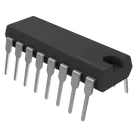
- TL494CN = commercial-temp, PDIP-16
- TL494IN = industrial-temp, PDIP-16 (-40 C to 85 C)
- Other variants mainly differ by package and temperature grade, such as SOIC, SOP, and TSSOP versions
So in practice:
- TL494CN is best for through-hole prototyping, education, repair, and legacy designs
- I-grade parts are better for harsher environments
- SMT variants are better for compact production boards
One limitation versus newer controllers: TL494 is flexible and proven, but it is an older general-purpose analog PWM controller, so modern switcher ICs often integrate more protection and MOSFET-driving features.
I also attempted to save a full written breakdown into the project files, but this project is comment-only from my side, so I could not create it.
Find SMT variants
Compare newer controllers
Show buck connections
Check TL494 wiring
Welcome 👋
Flux accelerates your PCB design with AI.
Create your account to start using this component and bring your ideas to life.
furqan
copilot